

11
We return to North Carolina and Alex Manda’s stories on water resource issues. Of
course, the availability of water is a basic societal need – recall that the capital of
South Africa, Cape Town, came perilously close to running out of water in 2018
(water levels of major dams dropped to 13.5% of capacity). The next chapter, by
Kathleen Farrell, is about her experiences drilling into the subsurface of the
Mississippi Delta and the Georgia and North Carolina Coastal Plain, the source for
much of this region’s ground water supply. We then travel to the west coast of the
US and hear from Andrea Hawkes about coastal change driven by earthquakes.
Andrea then takes us back to Malaysia and describes her experiences as a graduate
student studying the geologic record of the horrifying tsunami of December 2004
caused by a megathrust earthquake off Sumatra, Indonesia. We stay in warmer
realms with Lynn Wyngard’s chapter on the value of coastal mangrove forests and
threats to the unique Everglades environment and David Lagomasino’s chapter on
remote sensing of mangrove forests in Gabon, Tanzania and the Philippines.
Following is Pam Hallock’s extremely educational but, unfortunately, disturbing
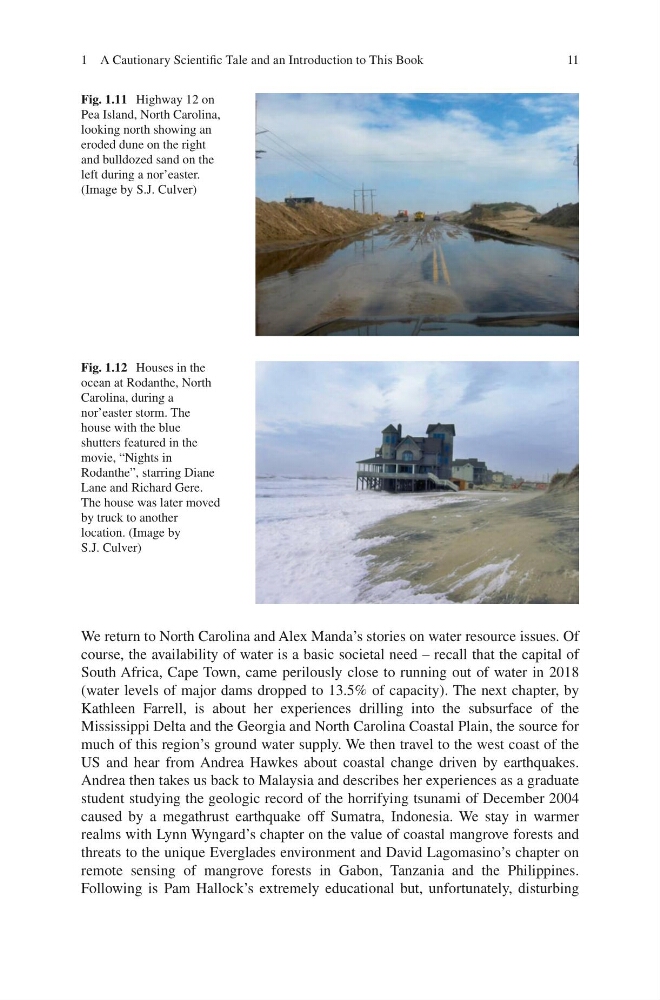
Fig. 1.11 Highway 12 on
Pea Island, North Carolina,
looking north showing an
eroded dune on the right
and bulldozed sand on the
left during a nor’easter.
(Image by S.J. Culver)
Fig. 1.12 Houses in the
ocean at Rodanthe, North
Carolina, during a
nor’easter storm. The
house with the blue
shutters featured in the
movie, “Nights in
Rodanthe”, starring Diane
Lane and Richard Gere.
The house was later moved
by truck to another
location. (Image by
S.J. Culver)
1 A Cautionary Scientific Tale and an Introduction to This Book
We return to North Carolina and Alex Manda’s stories on water resource issues. Of
course, the availability of water is a basic societal need – recall that the capital of
South Africa, Cape Town, came perilously close to running out of water in 2018
(water levels of major dams dropped to 13.5% of capacity). The next chapter, by
Kathleen Farrell, is about her experiences drilling into the subsurface of the
Mississippi Delta and the Georgia and North Carolina Coastal Plain, the source for
much of this region’s ground water supply. We then travel to the west coast of the
US and hear from Andrea Hawkes about coastal change driven by earthquakes.
Andrea then takes us back to Malaysia and describes her experiences as a graduate
student studying the geologic record of the horrifying tsunami of December 2004
caused by a megathrust earthquake off Sumatra, Indonesia. We stay in warmer
realms with Lynn Wyngard’s chapter on the value of coastal mangrove forests and
threats to the unique Everglades environment and David Lagomasino’s chapter on
remote sensing of mangrove forests in Gabon, Tanzania and the Philippines.
Following is Pam Hallock’s extremely educational but, unfortunately, disturbing
Fig. 1.11 Highway 12 on
Pea Island, North Carolina,
looking north showing an
eroded dune on the right
and bulldozed sand on the
left during a nor’easter.
(Image by S.J. Culver)
Fig. 1.12 Houses in the
ocean at Rodanthe, North
Carolina, during a
nor’easter storm. The
house with the blue
shutters featured in the
movie, “Nights in
Rodanthe”, starring Diane
Lane and Richard Gere.
The house was later moved
by truck to another
location. (Image by
S.J. Culver)
1 A Cautionary Scientific Tale and an Introduction to This Book