

244
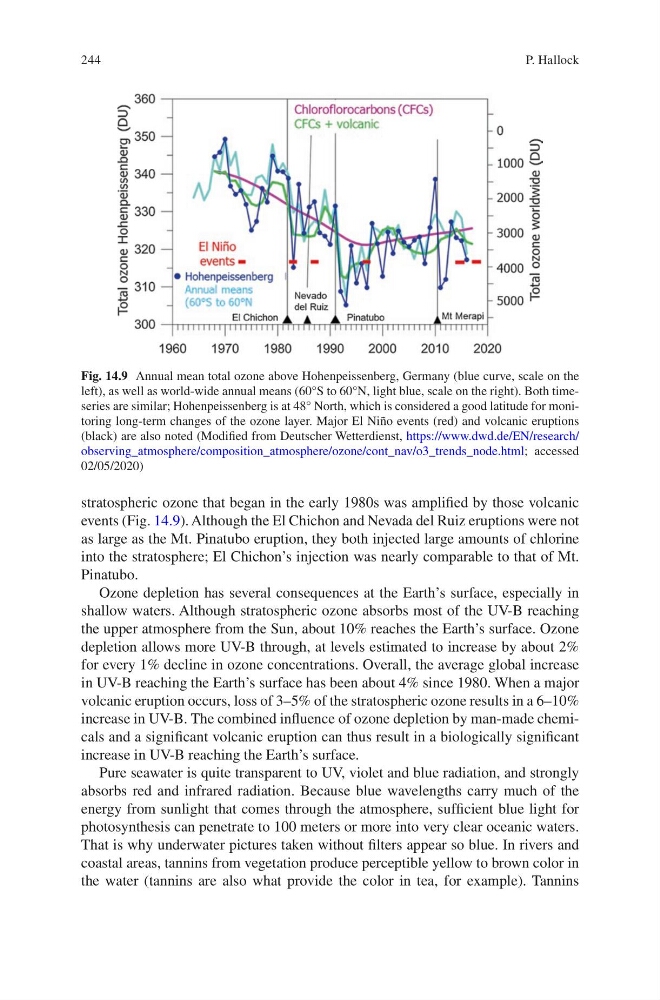
stratospheric ozone that began in the early 1980s was amplified by those volcanic
events (Fig. 14.9). Although the El Chichon and Nevada del Ruiz eruptions were not
as large as the Mt. Pinatubo eruption, they both injected large amounts of chlorine
into the stratosphere; El Chichon’s injection was nearly comparable to that of Mt.
Pinatubo.
Ozone depletion has several consequences at the Earth’s surface, especially in
shallow waters. Although stratospheric ozone absorbs most of the UV-B reaching
the upper atmosphere from the Sun, about 10% reaches the Earth’s surface. Ozone
depletion allows more UV-B through, at levels estimated to increase by about 2%
for every 1% decline in ozone concentrations. Overall, the average global increase
in UV-B reaching the Earth’s surface has been about 4% since 1980. When a major
volcanic eruption occurs, loss of 3–5% of the stratospheric ozone results in a 6–10%
increase in UV-B. The combined influence of ozone depletion by man-made chemicals and a significant volcanic eruption can thus result in a biologically significant
increase in UV-B reaching the Earth’s surface.
Pure seawater is quite transparent to UV, violet and blue radiation, and strongly
absorbs red and infrared radiation. Because blue wavelengths carry much of the
energy from sunlight that comes through the atmosphere, sufficient blue light for
photosynthesis can penetrate to 100 meters or more into very clear oceanic waters.
That is why underwater pictures taken without filters appear so blue. In rivers and
coastal areas, tannins from vegetation produce perceptible yellow to brown color in
the water (tannins are also what provide the color in tea, for example). Tannins
Fig. 14.9 Annual mean total ozone above Hohenpeissenberg, Germany (blue curve, scale on the
left), as well as world-wide annual means (60°S to 60°N, light blue, scale on the right). Both timeseries are similar; Hohenpeissenberg is at 48° North, which is considered a good latitude for monitoring long-term changes of the ozone layer. Major El Niño events (red) and volcanic eruptions
(black) are also noted (Modified from Deutscher Wetterdienst, https://www.dwd.de/EN/research/
observing_atmosphere/composition_atmosphere/ozone/cont_nav/o3_trends_node.html; accessed
02/05/2020)
P. Hallock
stratospheric ozone that began in the early 1980s was amplified by those volcanic
events (Fig. 14.9). Although the El Chichon and Nevada del Ruiz eruptions were not
as large as the Mt. Pinatubo eruption, they both injected large amounts of chlorine
into the stratosphere; El Chichon’s injection was nearly comparable to that of Mt.
Pinatubo.
Ozone depletion has several consequences at the Earth’s surface, especially in
shallow waters. Although stratospheric ozone absorbs most of the UV-B reaching
the upper atmosphere from the Sun, about 10% reaches the Earth’s surface. Ozone
depletion allows more UV-B through, at levels estimated to increase by about 2%
for every 1% decline in ozone concentrations. Overall, the average global increase
in UV-B reaching the Earth’s surface has been about 4% since 1980. When a major
volcanic eruption occurs, loss of 3–5% of the stratospheric ozone results in a 6–10%
increase in UV-B. The combined influence of ozone depletion by man-made chemicals and a significant volcanic eruption can thus result in a biologically significant
increase in UV-B reaching the Earth’s surface.
Pure seawater is quite transparent to UV, violet and blue radiation, and strongly
absorbs red and infrared radiation. Because blue wavelengths carry much of the
energy from sunlight that comes through the atmosphere, sufficient blue light for
photosynthesis can penetrate to 100 meters or more into very clear oceanic waters.
That is why underwater pictures taken without filters appear so blue. In rivers and
coastal areas, tannins from vegetation produce perceptible yellow to brown color in
the water (tannins are also what provide the color in tea, for example). Tannins
Fig. 14.9 Annual mean total ozone above Hohenpeissenberg, Germany (blue curve, scale on the
left), as well as world-wide annual means (60°S to 60°N, light blue, scale on the right). Both timeseries are similar; Hohenpeissenberg is at 48° North, which is considered a good latitude for monitoring long-term changes of the ozone layer. Major El Niño events (red) and volcanic eruptions
(black) are also noted (Modified from Deutscher Wetterdienst, https://www.dwd.de/EN/research/
observing_atmosphere/composition_atmosphere/ozone/cont_nav/o3_trends_node.html; accessed
02/05/2020)
P. Hallock