

240
impacts, and, on more regional or local scales, by changes in ocean currents or river
discharge. Thanks to my diving experiences across a range of reef conditions, from
thriving to degraded, the strong relationship between clear ocean waters and “heathy
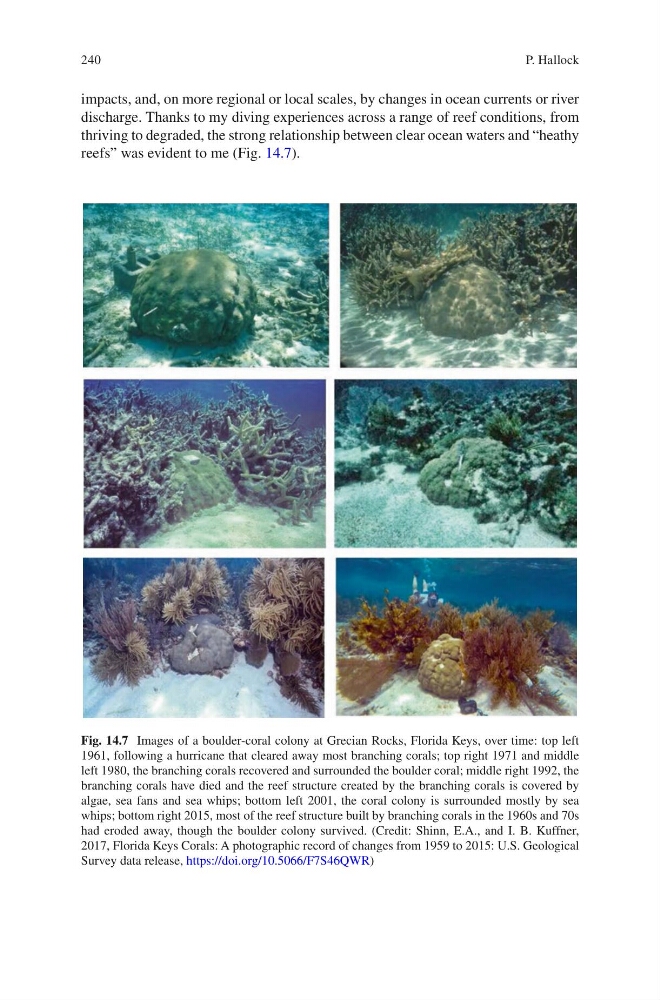
reefs” was evident to me (Fig. 14.7).
Fig. 14.7 Images of a boulder-coral colony at Grecian Rocks, Florida Keys, over time: top left
1961, following a hurricane that cleared away most branching corals; top right 1971 and middle
left 1980, the branching corals recovered and surrounded the boulder coral; middle right 1992, the
branching corals have died and the reef structure created by the branching corals is covered by
algae, sea fans and sea whips; bottom left 2001, the coral colony is surrounded mostly by sea
whips; bottom right 2015, most of the reef structure built by branching corals in the 1960s and 70s
had eroded away, though the boulder colony survived. (Credit: Shinn, E.A., and I. B. Kuffner,
2017, Florida Keys Corals: A photographic record of changes from 1959 to 2015: U.S. Geological
Survey data release, https://doi.org/10.5066/F7S46QWR)
P. Hallock
impacts, and, on more regional or local scales, by changes in ocean currents or river
discharge. Thanks to my diving experiences across a range of reef conditions, from
thriving to degraded, the strong relationship between clear ocean waters and “heathy
reefs” was evident to me (Fig. 14.7).
Fig. 14.7 Images of a boulder-coral colony at Grecian Rocks, Florida Keys, over time: top left
1961, following a hurricane that cleared away most branching corals; top right 1971 and middle
left 1980, the branching corals recovered and surrounded the boulder coral; middle right 1992, the
branching corals have died and the reef structure created by the branching corals is covered by
algae, sea fans and sea whips; bottom left 2001, the coral colony is surrounded mostly by sea
whips; bottom right 2015, most of the reef structure built by branching corals in the 1960s and 70s
had eroded away, though the boulder colony survived. (Credit: Shinn, E.A., and I. B. Kuffner,
2017, Florida Keys Corals: A photographic record of changes from 1959 to 2015: U.S. Geological
Survey data release, https://doi.org/10.5066/F7S46QWR)
P. Hallock