

173
preserved as 100 million-year-old rocks in Montana. If the sediments and rocks
were similar, then perhaps the processes that formed them were similar. Thus, the
present becomes the key to the past.
In the study of Earth history, the phrase, “the present is the key to the past”, is a
critical geologic concept, known as the Principle of Uniformitarianism. This principle was promulgated by Scottish naturalist James Hutton in his 1795 book “Theory
of the Earth”. Applied to coastal systems, this principle simply states that, for example, ancient barrier islands with their associated beaches, marshes, and estuaries
probably formed and functioned in much the same manner as barrier islands do
today. Our field trips to modern US coastal systems led us to the conclusion that,
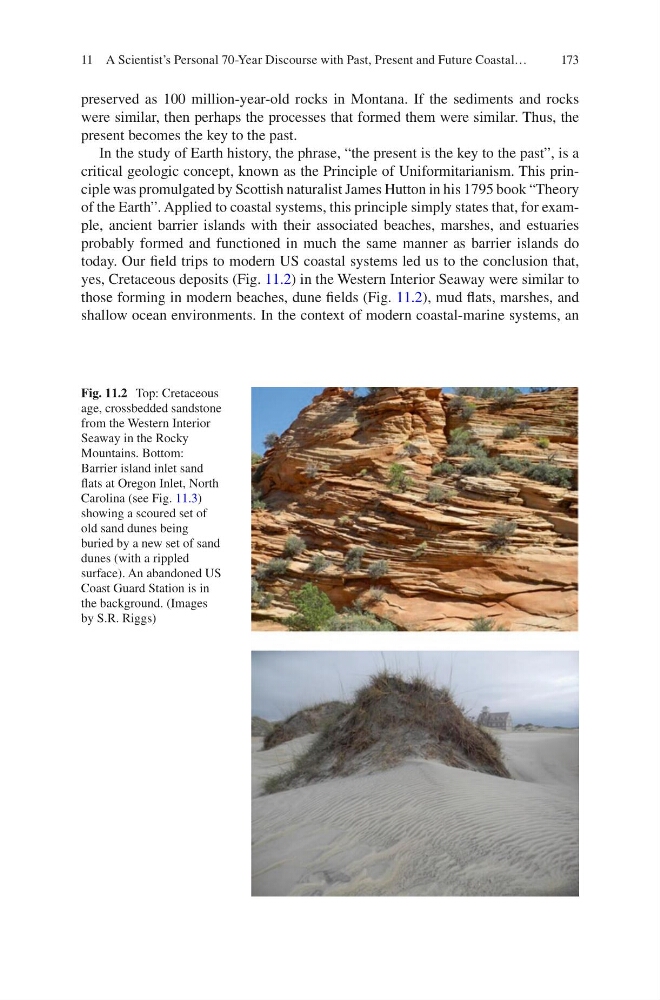
yes, Cretaceous deposits (Fig. 11.2) in the Western Interior Seaway were similar to
those forming in modern beaches, dune fields (Fig. 11.2), mud flats, marshes, and
shallow ocean environments. In the context of modern coastal-marine systems, an
Fig. 11.2 Top: Cretaceous
age, crossbedded sandstone
from the Western Interior
Seaway in the Rocky
Mountains. Bottom:
Barrier island inlet sand
flats at Oregon Inlet, North
Carolina (see Fig. 11.3)
showing a scoured set of
old sand dunes being
buried by a new set of sand
dunes (with a rippled
surface). An abandoned US
Coast Guard Station is in
the background. (Images
by S.R. Riggs)
11 A Scientist’s Personal 70-Year Discourse with Past, Present and Future Coastal…
preserved as 100 million-year-old rocks in Montana. If the sediments and rocks
were similar, then perhaps the processes that formed them were similar. Thus, the
present becomes the key to the past.
In the study of Earth history, the phrase, “the present is the key to the past”, is a
critical geologic concept, known as the Principle of Uniformitarianism. This principle was promulgated by Scottish naturalist James Hutton in his 1795 book “Theory
of the Earth”. Applied to coastal systems, this principle simply states that, for example, ancient barrier islands with their associated beaches, marshes, and estuaries
probably formed and functioned in much the same manner as barrier islands do
today. Our field trips to modern US coastal systems led us to the conclusion that,
yes, Cretaceous deposits (Fig. 11.2) in the Western Interior Seaway were similar to
those forming in modern beaches, dune fields (Fig. 11.2), mud flats, marshes, and
shallow ocean environments. In the context of modern coastal-marine systems, an
Fig. 11.2 Top: Cretaceous
age, crossbedded sandstone
from the Western Interior
Seaway in the Rocky
Mountains. Bottom:
Barrier island inlet sand
flats at Oregon Inlet, North
Carolina (see Fig. 11.3)
showing a scoured set of
old sand dunes being
buried by a new set of sand
dunes (with a rippled
surface). An abandoned US
Coast Guard Station is in
the background. (Images
by S.R. Riggs)
11 A Scientist’s Personal 70-Year Discourse with Past, Present and Future Coastal…