

143
Meanwhile, my dissertation research at LSU, with Dag as major advisor, consisted of drilling coreholes in flood deposits of the Mississippi River near False
River, Louisiana, a huge oxbow lake. Why? The usual reasons: scientific curiosity
and the acquisition of knowledge. No one before me had described flood deposits
from a sedimentologic and stratigraphic perspective, and I wanted to do it first. My
focus area included the geologic environments—oxbow lake, backswamp, natural
levees and crevasse splays, along the margin of the Mississippi River’s meander
belts. One day while exploring black water marshes at the end of the oxbow lake, I
saw a baby alligator and realized that I was trekking through floating marshes; alligators nest underneath the floating marshes! Later, a woman who lived on the lake’s
shoreline showed me a photograph of her husband and a large group of his friends
standing on the back of the largest alligator that I have ever seen. It must have been
8 ft. (2.4 m) wide and 15 ft. (4.6 m) long or more. As the story goes, it was this
behemoth alligator who was the great grandfather of all the little alligators living in
False River Lake. But a field scientist can’t worry about snakes and alligators when
obsessed with coring in swamps. Fearlessness is essential! The last core was collected from a sugarcane field when I was 8 months pregnant, on a day when it was
110 °F (43 °C) in the shade.
After completing my education, I managed to secure a position as Senior Coastal
Geologist at the Georgia Geologic Survey. My job was to study the stratigraphy of
the Georgia coast using, yes, geologic cores. Meanwhile, a geologist in Canada
(Derald Smith) had invented a scaled-down version of Dag’s gigantic vibracorer.
Because I needed to improve portability and decrease personnel needs for field
operations, I set up Derald’s ultra-light vibracorer. This assembly included a 19 lb.
(8.6 kg) backpack concrete vibrator, and a lightweight portable tripod (designed to
rescue injured people from manholes) and resulted in a coring operation that
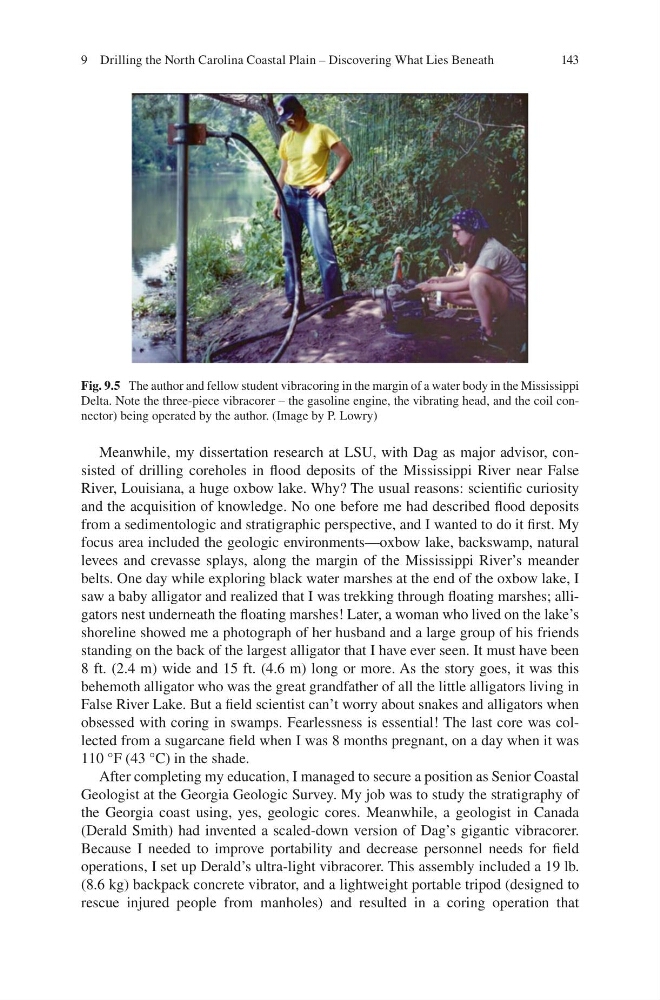
Fig. 9.5 The author and fellow student vibracoring in the margin of a water body in the Mississippi
Delta. Note the three-piece vibracorer – the gasoline engine, the vibrating head, and the coil connector) being operated by the author. (Image by P. Lowry)
9 Drilling the North Carolina Coastal Plain – Discovering What Lies Beneath
Meanwhile, my dissertation research at LSU, with Dag as major advisor, consisted of drilling coreholes in flood deposits of the Mississippi River near False
River, Louisiana, a huge oxbow lake. Why? The usual reasons: scientific curiosity
and the acquisition of knowledge. No one before me had described flood deposits
from a sedimentologic and stratigraphic perspective, and I wanted to do it first. My
focus area included the geologic environments—oxbow lake, backswamp, natural
levees and crevasse splays, along the margin of the Mississippi River’s meander
belts. One day while exploring black water marshes at the end of the oxbow lake, I
saw a baby alligator and realized that I was trekking through floating marshes; alligators nest underneath the floating marshes! Later, a woman who lived on the lake’s
shoreline showed me a photograph of her husband and a large group of his friends
standing on the back of the largest alligator that I have ever seen. It must have been
8 ft. (2.4 m) wide and 15 ft. (4.6 m) long or more. As the story goes, it was this
behemoth alligator who was the great grandfather of all the little alligators living in
False River Lake. But a field scientist can’t worry about snakes and alligators when
obsessed with coring in swamps. Fearlessness is essential! The last core was collected from a sugarcane field when I was 8 months pregnant, on a day when it was
110 °F (43 °C) in the shade.
After completing my education, I managed to secure a position as Senior Coastal
Geologist at the Georgia Geologic Survey. My job was to study the stratigraphy of
the Georgia coast using, yes, geologic cores. Meanwhile, a geologist in Canada
(Derald Smith) had invented a scaled-down version of Dag’s gigantic vibracorer.
Because I needed to improve portability and decrease personnel needs for field
operations, I set up Derald’s ultra-light vibracorer. This assembly included a 19 lb.
(8.6 kg) backpack concrete vibrator, and a lightweight portable tripod (designed to
rescue injured people from manholes) and resulted in a coring operation that
Fig. 9.5 The author and fellow student vibracoring in the margin of a water body in the Mississippi
Delta. Note the three-piece vibracorer – the gasoline engine, the vibrating head, and the coil connector) being operated by the author. (Image by P. Lowry)
9 Drilling the North Carolina Coastal Plain – Discovering What Lies Beneath