

112
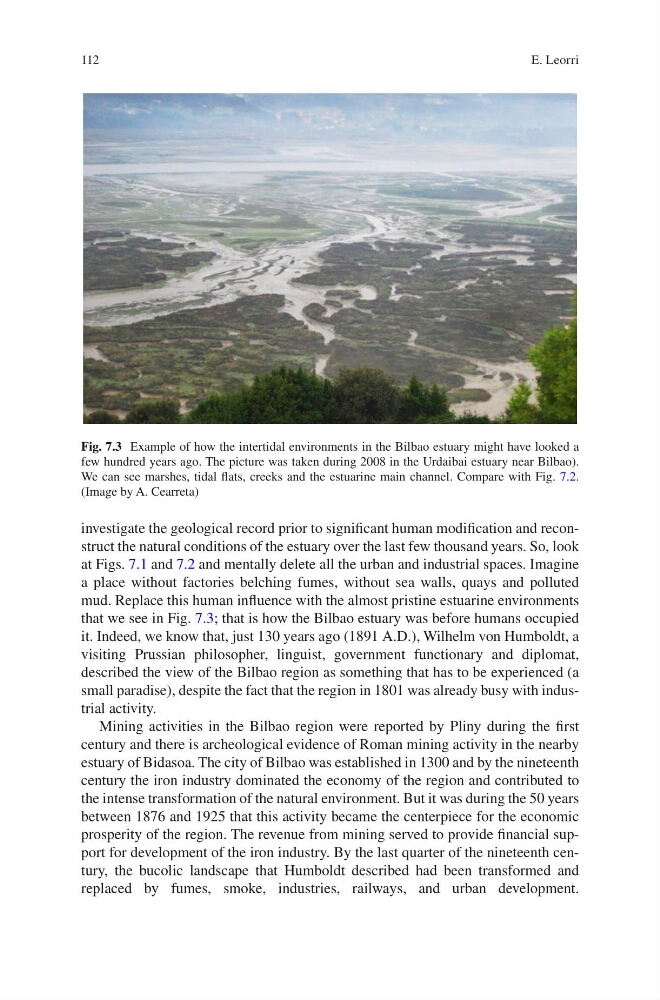
investigate the geological record prior to significant human modification and reconstruct the natural conditions of the estuary over the last few thousand years. So, look
at Figs. 7.1 and 7.2 and mentally delete all the urban and industrial spaces. Imagine
a place without factories belching fumes, without sea walls, quays and polluted
mud. Replace this human influence with the almost pristine estuarine environments
that we see in Fig. 7.3; that is how the Bilbao estuary was before humans occupied
it. Indeed, we know that, just 130 years ago (1891 A.D.), Wilhelm von Humboldt, a
visiting Prussian philosopher, linguist, government functionary and diplomat,
described the view of the Bilbao region as something that has to be experienced (a
small paradise), despite the fact that the region in 1801 was already busy with industrial activity.
Mining activities in the Bilbao region were reported by Pliny during the first
century and there is archeological evidence of Roman mining activity in the nearby
estuary of Bidasoa. The city of Bilbao was established in 1300 and by the nineteenth
century the iron industry dominated the economy of the region and contributed to
the intense transformation of the natural environment. But it was during the 50 years
between 1876 and 1925 that this activity became the centerpiece for the economic
prosperity of the region. The revenue from mining served to provide financial support for development of the iron industry. By the last quarter of the nineteenth century, the bucolic landscape that Humboldt described had been transformed and
replaced by fumes, smoke, industries, railways, and urban development.
Fig. 7.3 Example of how the intertidal environments in the Bilbao estuary might have looked a
few hundred years ago. The picture was taken during 2008 in the Urdaibai estuary near Bilbao).
We can see marshes, tidal flats, creeks and the estuarine main channel. Compare with Fig. 7.2.
(Image by A. Cearreta)
E. Leorri
investigate the geological record prior to significant human modification and reconstruct the natural conditions of the estuary over the last few thousand years. So, look
at Figs. 7.1 and 7.2 and mentally delete all the urban and industrial spaces. Imagine
a place without factories belching fumes, without sea walls, quays and polluted
mud. Replace this human influence with the almost pristine estuarine environments
that we see in Fig. 7.3; that is how the Bilbao estuary was before humans occupied
it. Indeed, we know that, just 130 years ago (1891 A.D.), Wilhelm von Humboldt, a
visiting Prussian philosopher, linguist, government functionary and diplomat,
described the view of the Bilbao region as something that has to be experienced (a
small paradise), despite the fact that the region in 1801 was already busy with industrial activity.
Mining activities in the Bilbao region were reported by Pliny during the first
century and there is archeological evidence of Roman mining activity in the nearby
estuary of Bidasoa. The city of Bilbao was established in 1300 and by the nineteenth
century the iron industry dominated the economy of the region and contributed to
the intense transformation of the natural environment. But it was during the 50 years
between 1876 and 1925 that this activity became the centerpiece for the economic
prosperity of the region. The revenue from mining served to provide financial support for development of the iron industry. By the last quarter of the nineteenth century, the bucolic landscape that Humboldt described had been transformed and
replaced by fumes, smoke, industries, railways, and urban development.
Fig. 7.3 Example of how the intertidal environments in the Bilbao estuary might have looked a
few hundred years ago. The picture was taken during 2008 in the Urdaibai estuary near Bilbao).
We can see marshes, tidal flats, creeks and the estuarine main channel. Compare with Fig. 7.2.
(Image by A. Cearreta)
E. Leorri