

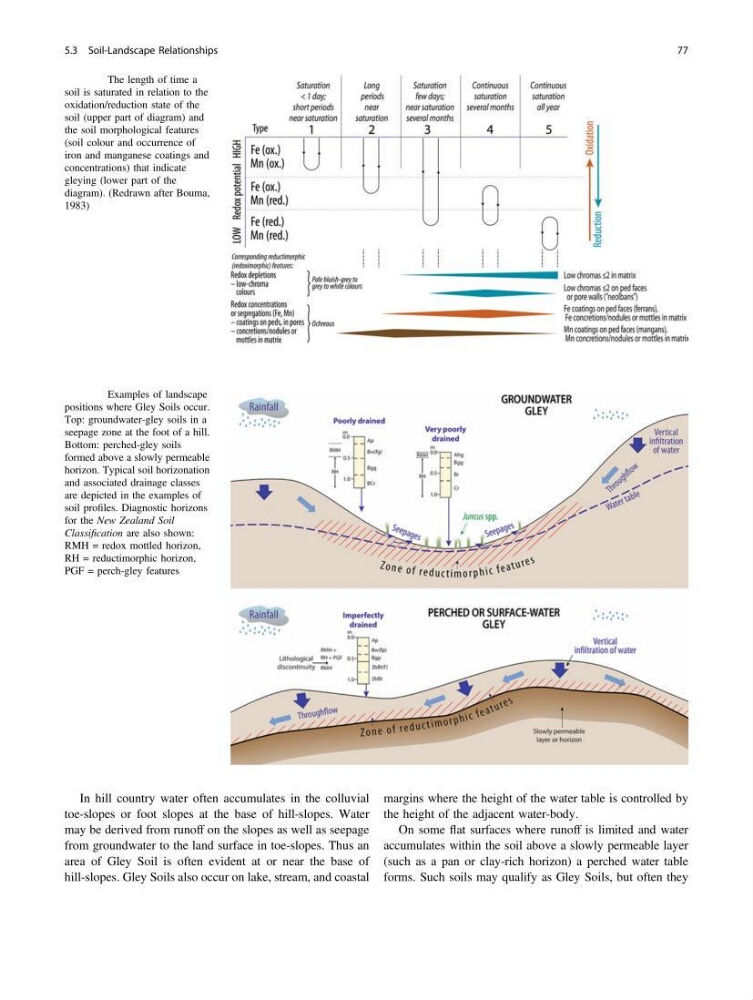
In hill country water often accumulates in the colluvial
toe-slopes or foot slopes at the base of hill-slopes. Water
may be derived from runoff on the slopes as well as seepage
from groundwater to the land surface in toe-slopes. Thus an
area of Gley Soil is often evident at or near the base of
hill-slopes. Gley Soils also occur on lake, stream, and coastal
margins where the height of the water table is controlled by
the height of the adjacent water-body.
On some flat surfaces where runoff is limited and water
accumulates within the soil above a slowly permeable layer
(such as a pan or clay-rich horizon) a perched water table
forms. Such soils may qualify as Gley Soils, but often they
Fig. 5.4 The length of time a
soil is saturated in relation to the
oxidation/reduction state of the
soil (upper part of diagram) and
the soil morphological features
(soil colour and occurrence of
iron and manganese coatings and
concentrations) that indicate
gleying (lower part of the
diagram). (Redrawn after Bouma,
1983)
Fig. 5.5 Examples of landscape
positions where Gley Soils occur.
Top: groundwater-gley soils in a
seepage zone at the foot of a hill.
Bottom: perched-gley soils
formed above a slowly permeable
horizon. Typical soil horizonation
and associated drainage classes
are depicted in the examples of
soil profiles. Diagnostic horizons
for the New Zealand Soil
Classification are also shown:
RMH = redox mottled horizon,
RH = reductimorphic horizon,
PGF = perch-gley features
5.3 Soil-Landscape Relationships
77
toe-slopes or foot slopes at the base of hill-slopes. Water
may be derived from runoff on the slopes as well as seepage
from groundwater to the land surface in toe-slopes. Thus an
area of Gley Soil is often evident at or near the base of
hill-slopes. Gley Soils also occur on lake, stream, and coastal
margins where the height of the water table is controlled by
the height of the adjacent water-body.
On some flat surfaces where runoff is limited and water
accumulates within the soil above a slowly permeable layer
(such as a pan or clay-rich horizon) a perched water table
forms. Such soils may qualify as Gley Soils, but often they
Fig. 5.4 The length of time a
soil is saturated in relation to the
oxidation/reduction state of the
soil (upper part of diagram) and
the soil morphological features
(soil colour and occurrence of
iron and manganese coatings and
concentrations) that indicate
gleying (lower part of the
diagram). (Redrawn after Bouma,
1983)
Fig. 5.5 Examples of landscape
positions where Gley Soils occur.
Top: groundwater-gley soils in a
seepage zone at the foot of a hill.
Bottom: perched-gley soils
formed above a slowly permeable
horizon. Typical soil horizonation
and associated drainage classes
are depicted in the examples of
soil profiles. Diagnostic horizons
for the New Zealand Soil
Classification are also shown:
RMH = redox mottled horizon,
RH = reductimorphic horizon,
PGF = perch-gley features
5.3 Soil-Landscape Relationships
77