

Organic Soils, Gley Soils represent the original extent of
New Zealand wetlands.
5.1.3 Variation Within the Gley Soil Order
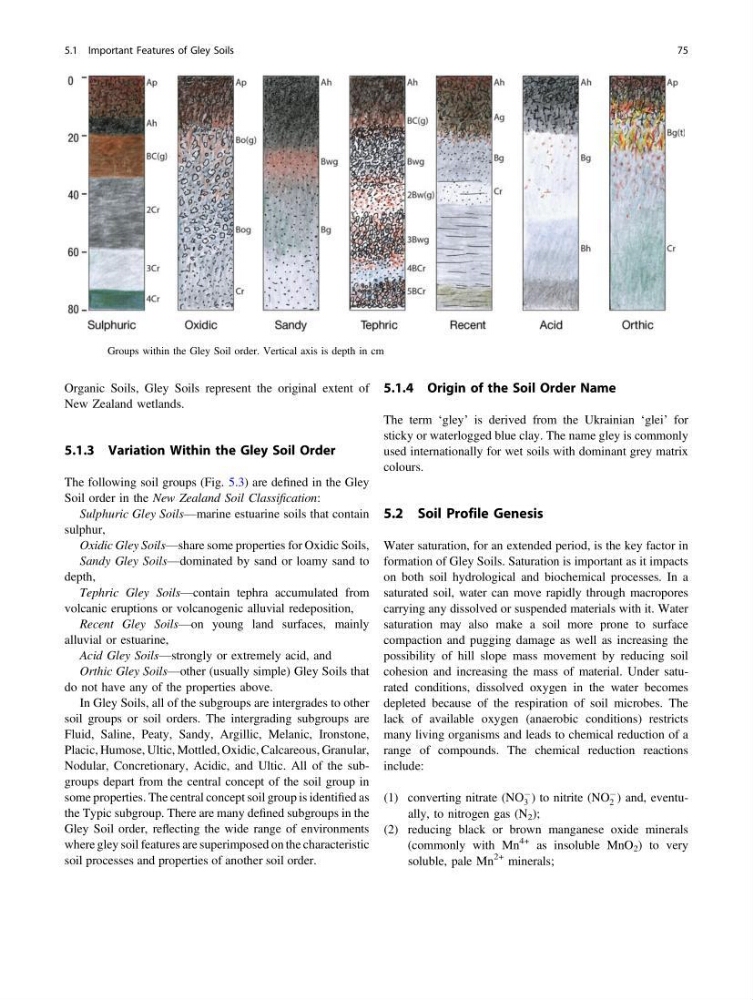
The following soil groups (Fig. 5.3) are defined in the Gley
Soil order in the New Zealand Soil Classification:
Sulphuric Gley Soils—marine estuarine soils that contain
sulphur,
Oxidic Gley Soils—share some properties for Oxidic Soils,
Sandy Gley Soils—dominated by sand or loamy sand to
depth,
Tephric Gley Soils—contain tephra accumulated from
volcanic eruptions or volcanogenic alluvial redeposition,
Recent Gley Soils—on young land surfaces, mainly
alluvial or estuarine,
Acid Gley Soils—strongly or extremely acid, and
Orthic Gley Soils—other (usually simple) Gley Soils that
do not have any of the properties above.
In Gley Soils, all of the subgroups are intergrades to other
soil groups or soil orders. The intergrading subgroups are
Fluid, Saline, Peaty, Sandy, Argillic, Melanic, Ironstone,
Placic, Humose, Ultic, Mottled, Oxidic, Calcareous, Granular,
Nodular, Concretionary, Acidic, and Ultic. All of the subgroups depart from the central concept of the soil group in
some properties. The central concept soil group is identified as
the Typic subgroup. There are many defined subgroups in the
Gley Soil order, reflecting the wide range of environments
where gley soil features are superimposed on the characteristic
soil processes and properties of another soil order.
5.1.4 Origin of the Soil Order Name
The term ‘gley’ is derived from the Ukrainian ‘glei’ for
sticky or waterlogged blue clay. The name gley is commonly
used internationally for wet soils with dominant grey matrix
colours.
5.2 Soil Profile Genesis
Water saturation, for an extended period, is the key factor in
formation of Gley Soils. Saturation is important as it impacts
on both soil hydrological and biochemical processes. In a
saturated soil, water can move rapidly through macropores
carrying any dissolved or suspended materials with it. Water
saturation may also make a soil more prone to surface
compaction and pugging damage as well as increasing the
possibility of hill slope mass movement by reducing soil
cohesion and increasing the mass of material. Under saturated conditions, dissolved oxygen in the water becomes
depleted because of the respiration of soil microbes. The
lack of available oxygen (anaerobic conditions) restricts
many living organisms and leads to chemical reduction of a
range of compounds. The chemical reduction reactions
include:
(1) converting nitrate (NO
À
3 ) to nitrite (NO
À
2 ) and, eventually, to nitrogen gas (N 2 );
(2) reducing black or brown manganese oxide minerals
(commonly with Mn
4+ as insoluble MnO 2 ) to very
soluble, pale Mn
2+ minerals;
Fig. 5.3 Groups within the Gley Soil order. Vertical axis is depth in cm
5.1 Important Features of Gley Soils
75
New Zealand wetlands.
5.1.3 Variation Within the Gley Soil Order
The following soil groups (Fig. 5.3) are defined in the Gley
Soil order in the New Zealand Soil Classification:
Sulphuric Gley Soils—marine estuarine soils that contain
sulphur,
Oxidic Gley Soils—share some properties for Oxidic Soils,
Sandy Gley Soils—dominated by sand or loamy sand to
depth,
Tephric Gley Soils—contain tephra accumulated from
volcanic eruptions or volcanogenic alluvial redeposition,
Recent Gley Soils—on young land surfaces, mainly
alluvial or estuarine,
Acid Gley Soils—strongly or extremely acid, and
Orthic Gley Soils—other (usually simple) Gley Soils that
do not have any of the properties above.
In Gley Soils, all of the subgroups are intergrades to other
soil groups or soil orders. The intergrading subgroups are
Fluid, Saline, Peaty, Sandy, Argillic, Melanic, Ironstone,
Placic, Humose, Ultic, Mottled, Oxidic, Calcareous, Granular,
Nodular, Concretionary, Acidic, and Ultic. All of the subgroups depart from the central concept of the soil group in
some properties. The central concept soil group is identified as
the Typic subgroup. There are many defined subgroups in the
Gley Soil order, reflecting the wide range of environments
where gley soil features are superimposed on the characteristic
soil processes and properties of another soil order.
5.1.4 Origin of the Soil Order Name
The term ‘gley’ is derived from the Ukrainian ‘glei’ for
sticky or waterlogged blue clay. The name gley is commonly
used internationally for wet soils with dominant grey matrix
colours.
5.2 Soil Profile Genesis
Water saturation, for an extended period, is the key factor in
formation of Gley Soils. Saturation is important as it impacts
on both soil hydrological and biochemical processes. In a
saturated soil, water can move rapidly through macropores
carrying any dissolved or suspended materials with it. Water
saturation may also make a soil more prone to surface
compaction and pugging damage as well as increasing the
possibility of hill slope mass movement by reducing soil
cohesion and increasing the mass of material. Under saturated conditions, dissolved oxygen in the water becomes
depleted because of the respiration of soil microbes. The
lack of available oxygen (anaerobic conditions) restricts
many living organisms and leads to chemical reduction of a
range of compounds. The chemical reduction reactions
include:
(1) converting nitrate (NO
À
3 ) to nitrite (NO
À
2 ) and, eventually, to nitrogen gas (N 2 );
(2) reducing black or brown manganese oxide minerals
(commonly with Mn
4+ as insoluble MnO 2 ) to very
soluble, pale Mn
2+ minerals;
Fig. 5.3 Groups within the Gley Soil order. Vertical axis is depth in cm
5.1 Important Features of Gley Soils
75