

Cambisols is the better correlative of most of the Brown
Soils, until such time that the World Reference Base soil
groups are specifically studied in New Zealand.
4.7 Use and Management of Brown Soils
4.7.1 Introduction
Because of the wide range within the Brown Soils, it is
useful to first consider the management and use of each soil
group.
Allophanic Brown Soils occur most extensively in the
South Island mountains where the land is used for extensive
grazing, or managed for catchment protection. In northern
Southland hill country, Allophanic Brown Soils are formed
in tuffaceous greywacke and their fertility and structural
character support highly productive uses. Allophanic Brown
Soils on the fringes of the tephra-derived Allophanic Soils
and Pumice Soils in the North Island on rolling to hilly land
also have high productive capability, aided in part by the
allophane-dominated soil physical properties. However, the
allophane will provide the soils with higher anion retention,
therefore it is better to apply smaller amounts of P fertiliser
more often to ensure its availability to plants.
Sandy Brown Soils range from soils that are weakly
weathered to soils with well-developed weathered
B-horizons. They are predominantly in coastal sand dunes
and associated sand plains. Challenges include rapid permeability and limited profile available water capacity. Risk
of soil-water deficits may necessitate irrigation. Groundwater
may be accessible for deep rooting plants in sand plains.
Wind erosion is a risk and maintaining vegetation cover has
to be a priority. Available reserve nutrients are low. Dune
lands are commonly under some form of land conservation
protection. Pine forests are established in some areas, particularly in the Manawatu sand country on the west coast
near Foxton and Himatangi.
Oxidic Brown Soils are transition soils between Brown
and Oxidic Soils in which there are significant weatherable
minerals remaining, and soils are expected to have higher
inherent (chemical) fertility than Oxidic Soils. The Oxidic
Brown Soils are frequently in hill or steepland sites where
there is sufficient disturbance to partly counteract the full
expression of Oxidic Soils. While more fertile than Oxidic
Soils, the Oxidic Brown Soils are more strongly weathered
than other Brown Soil groups. Thus Oxidic Brown Soils will
likely have higher clay contents and lower fertility, and so
need higher fertiliser inputs and more careful management
(e.g. to avoid compaction from mob-stocking or ploughing
at high moisture contents) than other Brown Soils. On the
other hand, the oxidic character can provide a stronger soil
structure.
Mafic Brown Soils have favourable topsoil structure and
soil aggregates are stable. The dark volcanic (basalt or andesite) parent rocks or tephra impart good inherent fertility.
Mafic Brown Soils, such as those on Mt Cargill near
Dunedin, often form on hilly or steep slopes. However,
where slopes are suitable, they have high capability for
productive use.
Acid Brown Soils have very strongly acid subsoils and
high risk of aluminium toxicity to many plants. The acidity
and associated high rainfall limits their capability for productive use. Inputs of lime can lead to greatly increased
productivity as the acidity is neutralised.
Acidic Brown Soils tend to occur at higher altitudes on
steeper land which may limit their preferred use to sheep
grazing or forestry.
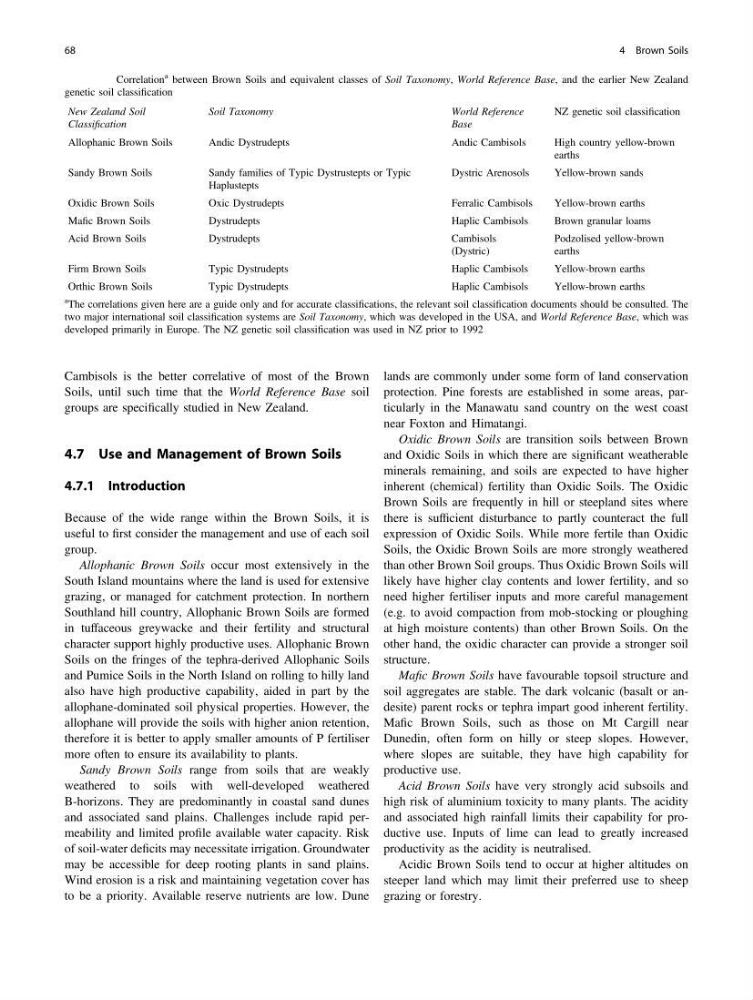
Table 4.3 Correlation
a between Brown Soils and equivalent classes of Soil Taxonomy, World Reference Base, and the earlier New Zealand
genetic soil classification
New Zealand Soil
Classification
Soil Taxonomy
World Reference
Base
NZ genetic soil classification
Allophanic Brown Soils
Andic Dystrudepts
Andic Cambisols
High country yellow-brown
earths
Sandy Brown Soils
Sandy families of Typic Dystrustepts or Typic
Haplustepts
Dystric Arenosols
Yellow-brown sands
Oxidic Brown Soils
Oxic Dystrudepts
Ferralic Cambisols
Yellow-brown earths
Mafic Brown Soils
Dystrudepts
Haplic Cambisols
Brown granular loams
Acid Brown Soils
Dystrudepts
Cambisols
(Dystric)
Podzolised yellow-brown
earths
Firm Brown Soils
Typic Dystrudepts
Haplic Cambisols
Yellow-brown earths
Orthic Brown Soils
Typic Dystrudepts
Haplic Cambisols
Yellow-brown earths
a The correlations given here are a guide only and for accurate classifications, the relevant soil classification documents should be consulted. The
two major international soil classification systems are Soil Taxonomy, which was developed in the USA, and World Reference Base, which was
developed primarily in Europe. The NZ genetic soil classification was used in NZ prior to 1992
68
4 Brown Soils
Soils, until such time that the World Reference Base soil
groups are specifically studied in New Zealand.
4.7 Use and Management of Brown Soils
4.7.1 Introduction
Because of the wide range within the Brown Soils, it is
useful to first consider the management and use of each soil
group.
Allophanic Brown Soils occur most extensively in the
South Island mountains where the land is used for extensive
grazing, or managed for catchment protection. In northern
Southland hill country, Allophanic Brown Soils are formed
in tuffaceous greywacke and their fertility and structural
character support highly productive uses. Allophanic Brown
Soils on the fringes of the tephra-derived Allophanic Soils
and Pumice Soils in the North Island on rolling to hilly land
also have high productive capability, aided in part by the
allophane-dominated soil physical properties. However, the
allophane will provide the soils with higher anion retention,
therefore it is better to apply smaller amounts of P fertiliser
more often to ensure its availability to plants.
Sandy Brown Soils range from soils that are weakly
weathered to soils with well-developed weathered
B-horizons. They are predominantly in coastal sand dunes
and associated sand plains. Challenges include rapid permeability and limited profile available water capacity. Risk
of soil-water deficits may necessitate irrigation. Groundwater
may be accessible for deep rooting plants in sand plains.
Wind erosion is a risk and maintaining vegetation cover has
to be a priority. Available reserve nutrients are low. Dune
lands are commonly under some form of land conservation
protection. Pine forests are established in some areas, particularly in the Manawatu sand country on the west coast
near Foxton and Himatangi.
Oxidic Brown Soils are transition soils between Brown
and Oxidic Soils in which there are significant weatherable
minerals remaining, and soils are expected to have higher
inherent (chemical) fertility than Oxidic Soils. The Oxidic
Brown Soils are frequently in hill or steepland sites where
there is sufficient disturbance to partly counteract the full
expression of Oxidic Soils. While more fertile than Oxidic
Soils, the Oxidic Brown Soils are more strongly weathered
than other Brown Soil groups. Thus Oxidic Brown Soils will
likely have higher clay contents and lower fertility, and so
need higher fertiliser inputs and more careful management
(e.g. to avoid compaction from mob-stocking or ploughing
at high moisture contents) than other Brown Soils. On the
other hand, the oxidic character can provide a stronger soil
structure.
Mafic Brown Soils have favourable topsoil structure and
soil aggregates are stable. The dark volcanic (basalt or andesite) parent rocks or tephra impart good inherent fertility.
Mafic Brown Soils, such as those on Mt Cargill near
Dunedin, often form on hilly or steep slopes. However,
where slopes are suitable, they have high capability for
productive use.
Acid Brown Soils have very strongly acid subsoils and
high risk of aluminium toxicity to many plants. The acidity
and associated high rainfall limits their capability for productive use. Inputs of lime can lead to greatly increased
productivity as the acidity is neutralised.
Acidic Brown Soils tend to occur at higher altitudes on
steeper land which may limit their preferred use to sheep
grazing or forestry.
Table 4.3 Correlation
a between Brown Soils and equivalent classes of Soil Taxonomy, World Reference Base, and the earlier New Zealand
genetic soil classification
New Zealand Soil
Classification
Soil Taxonomy
World Reference
Base
NZ genetic soil classification
Allophanic Brown Soils
Andic Dystrudepts
Andic Cambisols
High country yellow-brown
earths
Sandy Brown Soils
Sandy families of Typic Dystrustepts or Typic
Haplustepts
Dystric Arenosols
Yellow-brown sands
Oxidic Brown Soils
Oxic Dystrudepts
Ferralic Cambisols
Yellow-brown earths
Mafic Brown Soils
Dystrudepts
Haplic Cambisols
Brown granular loams
Acid Brown Soils
Dystrudepts
Cambisols
(Dystric)
Podzolised yellow-brown
earths
Firm Brown Soils
Typic Dystrudepts
Haplic Cambisols
Yellow-brown earths
Orthic Brown Soils
Typic Dystrudepts
Haplic Cambisols
Yellow-brown earths
a The correlations given here are a guide only and for accurate classifications, the relevant soil classification documents should be consulted. The
two major international soil classification systems are Soil Taxonomy, which was developed in the USA, and World Reference Base, which was
developed primarily in Europe. The NZ genetic soil classification was used in NZ prior to 1992
68
4 Brown Soils