

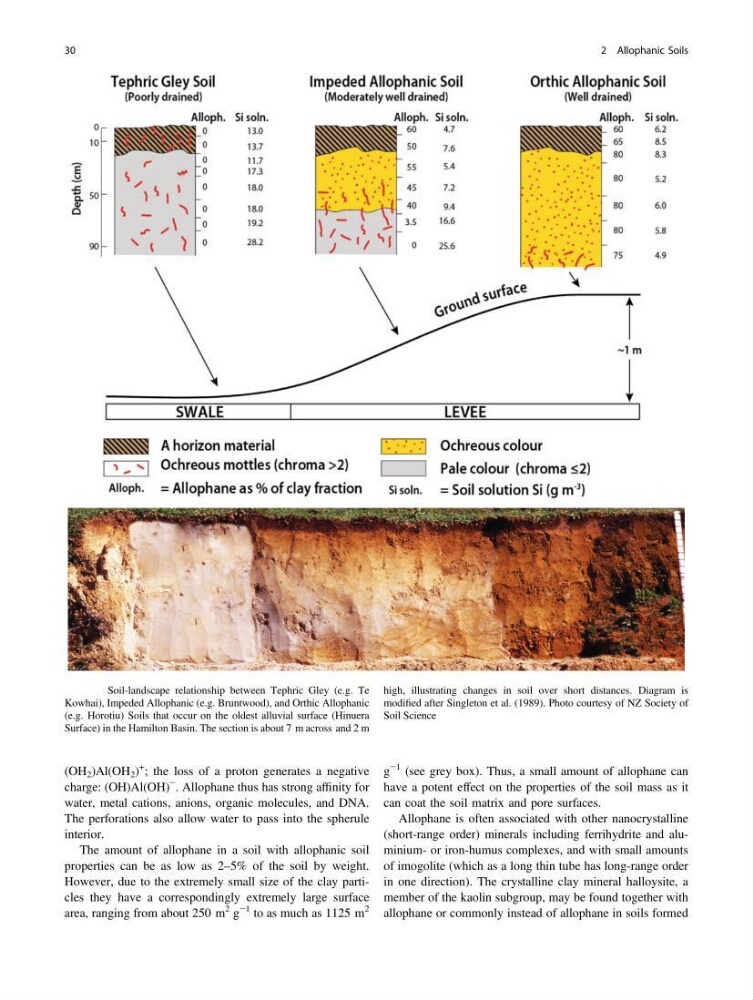
Fig. 2.6 Soil-landscape relationship between Tephric Gley (e.g. Te
Kowhai), Impeded Allophanic (e.g. Bruntwood), and Orthic Allophanic
(e.g. Horotiu) Soils that occur on the oldest alluvial surface (Hinuera
Surface) in the Hamilton Basin. The section is about 7 m across and 2 m
high, illustrating changes in soil over short distances. Diagram is
modified after Singleton et al. (1989). Photo courtesy of NZ Society of
Soil Science
(OH 2 )Al(OH 2 )
+
; the loss of a proton generates a negative
charge: (OH)Al(OH)
− . Allophane thus has strong affinity for
water, metal cations, anions, organic molecules, and DNA.
The perforations also allow water to pass into the spherule
interior.
The amount of allophane in a soil with allophanic soil
properties can be as low as 2–5% of the soil by weight.
However, due to the extremely small size of the clay particles they have a correspondingly extremely large surface
area, ranging from about 250 m
2 g
−1 to as much as 1125 m
2
g
−1 (see grey box). Thus, a small amount of allophane can
have a potent effect on the properties of the soil mass as it
can coat the soil matrix and pore surfaces.
Allophane is often associated with other nanocrystalline
(short-range order) minerals including ferrihydrite and aluminium- or iron-humus complexes, and with small amounts
of imogolite (which as a long thin tube has long-range order
in one direction). The crystalline clay mineral halloysite, a
member of the kaolin subgroup, may be found together with
allophane or commonly instead of allophane in soils formed
30
2 Allophanic Soils
Kowhai), Impeded Allophanic (e.g. Bruntwood), and Orthic Allophanic
(e.g. Horotiu) Soils that occur on the oldest alluvial surface (Hinuera
Surface) in the Hamilton Basin. The section is about 7 m across and 2 m
high, illustrating changes in soil over short distances. Diagram is
modified after Singleton et al. (1989). Photo courtesy of NZ Society of
Soil Science
(OH 2 )Al(OH 2 )
+
; the loss of a proton generates a negative
charge: (OH)Al(OH)
− . Allophane thus has strong affinity for
water, metal cations, anions, organic molecules, and DNA.
The perforations also allow water to pass into the spherule
interior.
The amount of allophane in a soil with allophanic soil
properties can be as low as 2–5% of the soil by weight.
However, due to the extremely small size of the clay particles they have a correspondingly extremely large surface
area, ranging from about 250 m
2 g
−1 to as much as 1125 m
2
g
−1 (see grey box). Thus, a small amount of allophane can
have a potent effect on the properties of the soil mass as it
can coat the soil matrix and pore surfaces.
Allophane is often associated with other nanocrystalline
(short-range order) minerals including ferrihydrite and aluminium- or iron-humus complexes, and with small amounts
of imogolite (which as a long thin tube has long-range order
in one direction). The crystalline clay mineral halloysite, a
member of the kaolin subgroup, may be found together with
allophane or commonly instead of allophane in soils formed
30
2 Allophanic Soils