

New Zealand that incorporated the best parts of the New
Zealand ‘genetic classification’ alongside some of the new
ideas and principles established in Soil Taxonomy. This
effort culminated in the publication of the ‘New Zealand Soil
Classification’ in 1992, by Allan Hewitt, which has now
been widely adopted for use in New Zealand. Here we will
follow the 3
rd edition published in 2010.
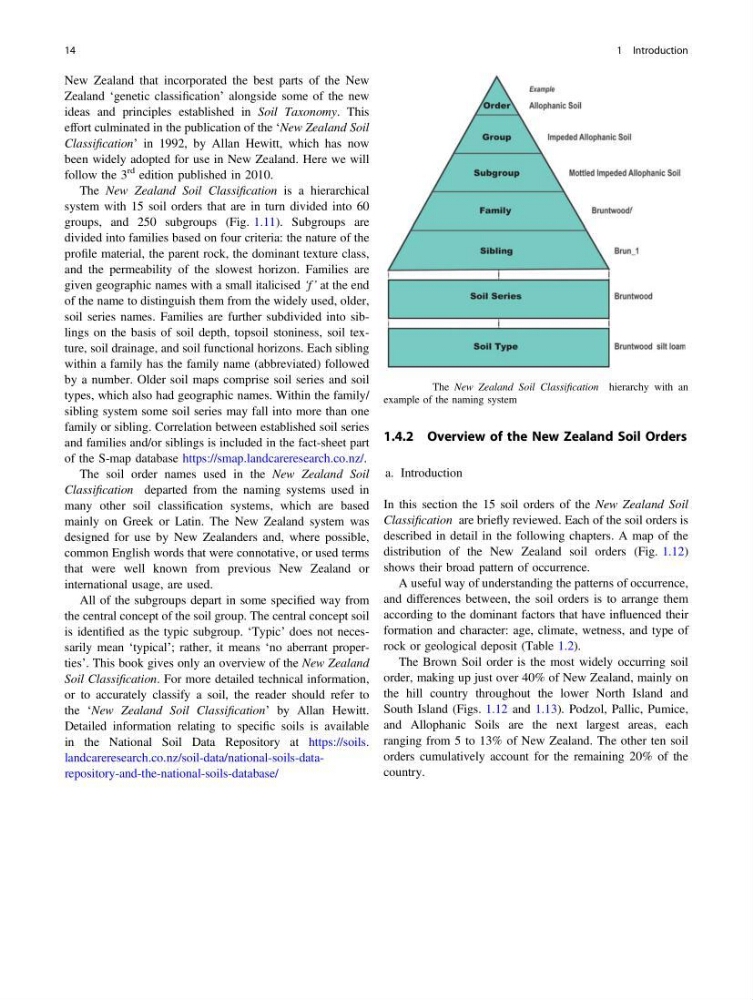
The New Zealand Soil Classification is a hierarchical
system with 15 soil orders that are in turn divided into 60
groups, and 250 subgroups (Fig. 1.11). Subgroups are
divided into families based on four criteria: the nature of the
profile material, the parent rock, the dominant texture class,
and the permeability of the slowest horizon. Families are
given geographic names with a small italicised ‘f’ at the end
of the name to distinguish them from the widely used, older,
soil series names. Families are further subdivided into siblings on the basis of soil depth, topsoil stoniness, soil texture, soil drainage, and soil functional horizons. Each sibling
within a family has the family name (abbreviated) followed
by a number. Older soil maps comprise soil series and soil
types, which also had geographic names. Within the family/
sibling system some soil series may fall into more than one
family or sibling. Correlation between established soil series
and families and/or siblings is included in the fact-sheet part
of the S-map database https://smap.landcareresearch.co.nz/.
The soil order names used in the New Zealand Soil
Classification departed from the naming systems used in
many other soil classification systems, which are based
mainly on Greek or Latin. The New Zealand system was
designed for use by New Zealanders and, where possible,
common English words that were connotative, or used terms
that were well known from previous New Zealand or
international usage, are used.
All of the subgroups depart in some specified way from
the central concept of the soil group. The central concept soil
is identified as the typic subgroup. ‘Typic’ does not necessarily mean ‘typical’; rather, it means ‘no aberrant properties’. This book gives only an overview of the New Zealand
Soil Classification. For more detailed technical information,
or to accurately classify a soil, the reader should refer to
the ‘New Zealand Soil Classification’ by Allan Hewitt.
Detailed information relating to specific soils is available
in the National Soil Data Repository at https://soils.
landcareresearch.co.nz/soil-data/national-soils-datarepository-and-the-national-soils-database/
1.4.2 Overview of the New Zealand Soil Orders
a. Introduction
In this section the 15 soil orders of the New Zealand Soil
Classification are briefly reviewed. Each of the soil orders is
described in detail in the following chapters. A map of the
distribution of the New Zealand soil orders (Fig. 1.12)
shows their broad pattern of occurrence.
A useful way of understanding the patterns of occurrence,
and differences between, the soil orders is to arrange them
according to the dominant factors that have influenced their
formation and character: age, climate, wetness, and type of
rock or geological deposit (Table 1.2).
The Brown Soil order is the most widely occurring soil
order, making up just over 40% of New Zealand, mainly on
the hill country throughout the lower North Island and
South Island (Figs. 1.12 and 1.13). Podzol, Pallic, Pumice,
and Allophanic Soils are the next largest areas, each
ranging from 5 to 13% of New Zealand. The other ten soil
orders cumulatively account for the remaining 20% of the
country.
Fig. 1.11 The New Zealand Soil Classification hierarchy with an
example of the naming system
14
1 Introduction
Zealand ‘genetic classification’ alongside some of the new
ideas and principles established in Soil Taxonomy. This
effort culminated in the publication of the ‘New Zealand Soil
Classification’ in 1992, by Allan Hewitt, which has now
been widely adopted for use in New Zealand. Here we will
follow the 3
rd edition published in 2010.
The New Zealand Soil Classification is a hierarchical
system with 15 soil orders that are in turn divided into 60
groups, and 250 subgroups (Fig. 1.11). Subgroups are
divided into families based on four criteria: the nature of the
profile material, the parent rock, the dominant texture class,
and the permeability of the slowest horizon. Families are
given geographic names with a small italicised ‘f’ at the end
of the name to distinguish them from the widely used, older,
soil series names. Families are further subdivided into siblings on the basis of soil depth, topsoil stoniness, soil texture, soil drainage, and soil functional horizons. Each sibling
within a family has the family name (abbreviated) followed
by a number. Older soil maps comprise soil series and soil
types, which also had geographic names. Within the family/
sibling system some soil series may fall into more than one
family or sibling. Correlation between established soil series
and families and/or siblings is included in the fact-sheet part
of the S-map database https://smap.landcareresearch.co.nz/.
The soil order names used in the New Zealand Soil
Classification departed from the naming systems used in
many other soil classification systems, which are based
mainly on Greek or Latin. The New Zealand system was
designed for use by New Zealanders and, where possible,
common English words that were connotative, or used terms
that were well known from previous New Zealand or
international usage, are used.
All of the subgroups depart in some specified way from
the central concept of the soil group. The central concept soil
is identified as the typic subgroup. ‘Typic’ does not necessarily mean ‘typical’; rather, it means ‘no aberrant properties’. This book gives only an overview of the New Zealand
Soil Classification. For more detailed technical information,
or to accurately classify a soil, the reader should refer to
the ‘New Zealand Soil Classification’ by Allan Hewitt.
Detailed information relating to specific soils is available
in the National Soil Data Repository at https://soils.
landcareresearch.co.nz/soil-data/national-soils-datarepository-and-the-national-soils-database/
1.4.2 Overview of the New Zealand Soil Orders
a. Introduction
In this section the 15 soil orders of the New Zealand Soil
Classification are briefly reviewed. Each of the soil orders is
described in detail in the following chapters. A map of the
distribution of the New Zealand soil orders (Fig. 1.12)
shows their broad pattern of occurrence.
A useful way of understanding the patterns of occurrence,
and differences between, the soil orders is to arrange them
according to the dominant factors that have influenced their
formation and character: age, climate, wetness, and type of
rock or geological deposit (Table 1.2).
The Brown Soil order is the most widely occurring soil
order, making up just over 40% of New Zealand, mainly on
the hill country throughout the lower North Island and
South Island (Figs. 1.12 and 1.13). Podzol, Pallic, Pumice,
and Allophanic Soils are the next largest areas, each
ranging from 5 to 13% of New Zealand. The other ten soil
orders cumulatively account for the remaining 20% of the
country.
Fig. 1.11 The New Zealand Soil Classification hierarchy with an
example of the naming system
14
1 Introduction