

In contrast, retardant upbuilding occurs when a relatively
thick layer of tephra, alluvium, or colluvium is instantaneously added to the surface of a soil which thus becomes a
buried soil, cut off and isolated from the new land surface in
which topdown pedogenesis then begins anew (hence the
development of the original soil is retarded). Retardant
upbuilding can also occur where thin geological additions
accumulate sufficiently rapidly for the original soil surface to
be buried quickly, thereby isolating it from the surface
processes. Once a paleosol is isolated, any changes may be
regarded as largely diagenetic (low-temperature alteration of
geological deposits), not pedogenic (active soil processes),
especially when cut off completely from surface processes
(i.e. deeply buried). Examples of soils formed by retardant
upbuilding pedogenesis were given in Chaps. 2 (Allophanic
Soils), 12 (Pumice Soils), and 13 (Recent Soils).
The pedogenic processes most important in New Zealand
soil formation include:
• weathering of rock and soil materials and the concomitant
synthesis of clay minerals (argillisation), including the
formation of allophane and halloysite (Chap. 2);
• leaching of solutes (including nutrients) from the soil;
• formation of pale E horizons and underlying iron and
organic matter enriched horizons via leaching under acid
conditions (podzolisation, Chap. 11);
• darkening of inorganic matter by admixing with humified
organic matter (melanisation, Chaps. 7 and 14);
• acidification (replacement of cations in the soil by
hydrogen with the cations lost via leaching);
• soil mixing by mechanisms such as treefall;
• migration of fine clay and humus down through the soil
profile mainly in suspension (illimerisation, or illuviation,
Chaps. 6 and 16);
• formation of pale-coloured soils due to chemical reduction of iron and manganese compounds under anaerobic
(oxygen deficient), or redox (alternating oxidation and
reducing) conditions (gleying, Chap. 5);
• initiation of peat formation (paludisation, Chap. 8); and
• accumulation of iron and related oxides to give soils
yellow to brown colours (brunification, Chap. 4).
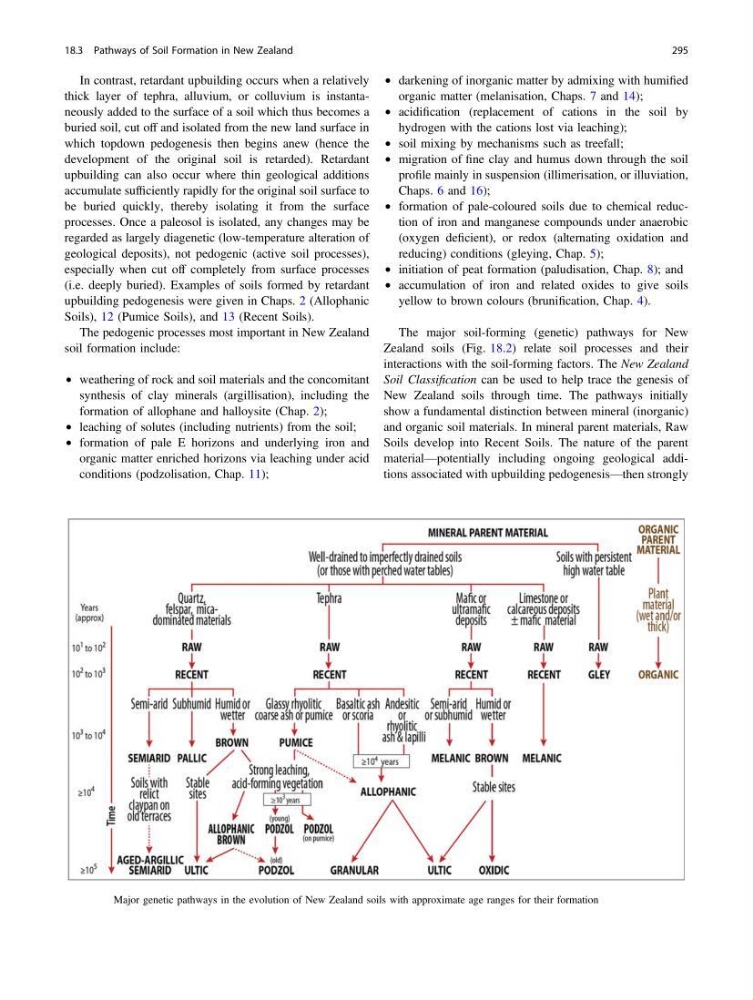
The major soil-forming (genetic) pathways for New
Zealand soils (Fig. 18.2) relate soil processes and their
interactions with the soil-forming factors. The New Zealand
Soil Classification can be used to help trace the genesis of
New Zealand soils through time. The pathways initially
show a fundamental distinction between mineral (inorganic)
and organic soil materials. In mineral parent materials, Raw
Soils develop into Recent Soils. The nature of the parent
material—potentially including ongoing geological additions associated with upbuilding pedogenesis—then strongly
Fig. 18.2 Major genetic pathways in the evolution of New Zealand soils with approximate age ranges for their formation
18.3 Pathways of Soil Formation in New Zealand
295
thick layer of tephra, alluvium, or colluvium is instantaneously added to the surface of a soil which thus becomes a
buried soil, cut off and isolated from the new land surface in
which topdown pedogenesis then begins anew (hence the
development of the original soil is retarded). Retardant
upbuilding can also occur where thin geological additions
accumulate sufficiently rapidly for the original soil surface to
be buried quickly, thereby isolating it from the surface
processes. Once a paleosol is isolated, any changes may be
regarded as largely diagenetic (low-temperature alteration of
geological deposits), not pedogenic (active soil processes),
especially when cut off completely from surface processes
(i.e. deeply buried). Examples of soils formed by retardant
upbuilding pedogenesis were given in Chaps. 2 (Allophanic
Soils), 12 (Pumice Soils), and 13 (Recent Soils).
The pedogenic processes most important in New Zealand
soil formation include:
• weathering of rock and soil materials and the concomitant
synthesis of clay minerals (argillisation), including the
formation of allophane and halloysite (Chap. 2);
• leaching of solutes (including nutrients) from the soil;
• formation of pale E horizons and underlying iron and
organic matter enriched horizons via leaching under acid
conditions (podzolisation, Chap. 11);
• darkening of inorganic matter by admixing with humified
organic matter (melanisation, Chaps. 7 and 14);
• acidification (replacement of cations in the soil by
hydrogen with the cations lost via leaching);
• soil mixing by mechanisms such as treefall;
• migration of fine clay and humus down through the soil
profile mainly in suspension (illimerisation, or illuviation,
Chaps. 6 and 16);
• formation of pale-coloured soils due to chemical reduction of iron and manganese compounds under anaerobic
(oxygen deficient), or redox (alternating oxidation and
reducing) conditions (gleying, Chap. 5);
• initiation of peat formation (paludisation, Chap. 8); and
• accumulation of iron and related oxides to give soils
yellow to brown colours (brunification, Chap. 4).
The major soil-forming (genetic) pathways for New
Zealand soils (Fig. 18.2) relate soil processes and their
interactions with the soil-forming factors. The New Zealand
Soil Classification can be used to help trace the genesis of
New Zealand soils through time. The pathways initially
show a fundamental distinction between mineral (inorganic)
and organic soil materials. In mineral parent materials, Raw
Soils develop into Recent Soils. The nature of the parent
material—potentially including ongoing geological additions associated with upbuilding pedogenesis—then strongly
Fig. 18.2 Major genetic pathways in the evolution of New Zealand soils with approximate age ranges for their formation
18.3 Pathways of Soil Formation in New Zealand
295