

good seed-bed. However, such soils may also be prone to
erosion, especially if plant cover is lacking.
Soil horizons that do not comprise aggregates, or that
have aggregates that are <6 mm in diameter, are termed
‘apedal’. Apedal horizons often comprise loose individual
sand grains (single grained), crumb-like aggregates of
<6 mm diameter (termed ‘earthy’), or a massive structure
with no clear natural breaks in the soil material.
d. Soil chemical properties
A wide range of soil chemical properties may be measured
to determine the fertility status of a soil and its potential for a
variety of crops and uses. The soil pH (a measure of acidity
or alkalinity) impacts on nutrient availability and on the
suitability of a soil for particular crops. Soil nutrient contents, and in particular P, N, K, Ca, Mg, and Na are commonly measured. Soil carbon contents give an indication of
soil fertility because organic matter is important to both plant
nutrient availability and soil physical properties (such as
aiding water holding capacity). Soil carbon is also of interest
in determining global carbon budgets as soils contain about
the same amount of carbon as the plants plus the atmosphere. Many other elements, including Al, Cd, Pb, and As
are measured in soils to give indications of potential toxicity
or contamination issues. In New Zealand, and in this book,
we often refer to the levels of soil chemical components as
low, medium, high, etc. following a ratings table (reproduced in Appendix A) first published by Les Blakemore and
others in 1987.
1.4 New Zealand Soil Classification
1.4.1 Introduction
The first workers in New Zealand who set out to map soils
from the 1920s to 1940s gradually developed a soil classification system based on ideas developed mainly by V.V.
Dokuchiaev (1848–1903) in Russia on soil genesis and the
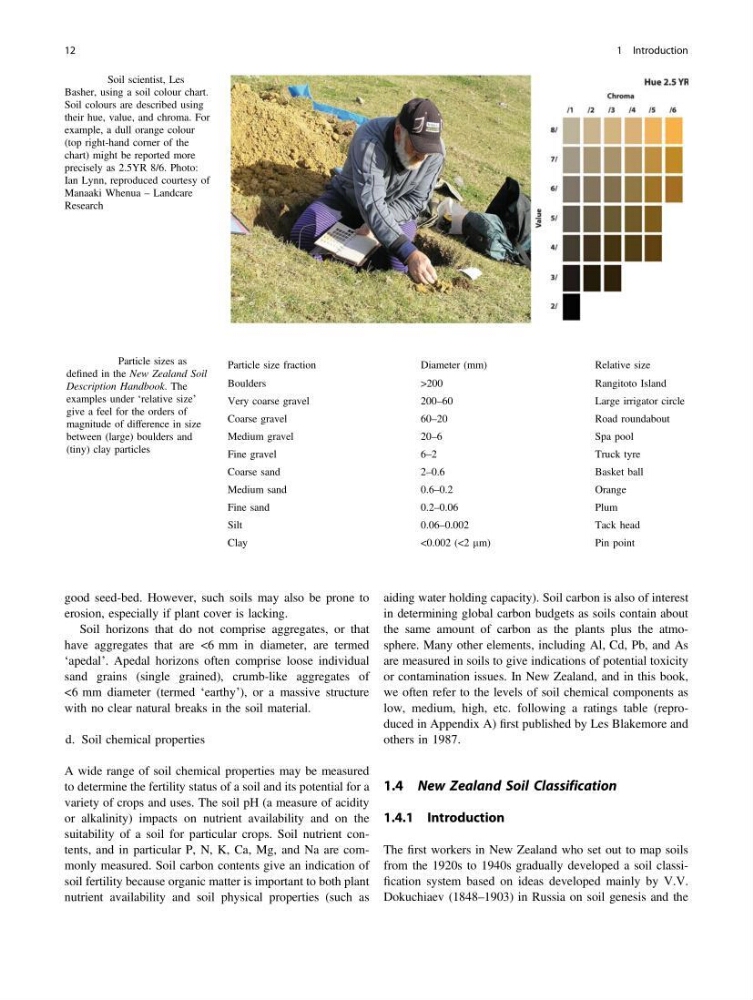
Fig. 1.8 Soil scientist, Les
Basher, using a soil colour chart.
Soil colours are described using
their hue, value, and chroma. For
example, a dull orange colour
(top right-hand corner of the
chart) might be reported more
precisely as 2.5YR 8/6. Photo:
Ian Lynn, reproduced courtesy of
Manaaki Whenua – Landcare
Research
Table 1.1 Particle sizes as
defined in the New Zealand Soil
Description Handbook. The
examples under ‘relative size’
give a feel for the orders of
magnitude of difference in size
between (large) boulders and
(tiny) clay particles
Particle size fraction
Diameter (mm)
Relative size
Boulders
>200
Rangitoto Island
Very coarse gravel
200–60
Large irrigator circle
Coarse gravel
60–20
Road roundabout
Medium gravel
20–6
Spa pool
Fine gravel
6–2
Truck tyre
Coarse sand
2–0.6
Basket ball
Medium sand
0.6–0.2
Orange
Fine sand
0.2–0.06
Plum
Silt
0.06–0.002
Tack head
Clay
<0.002 (<2 lm)
Pin point
12
1 Introduction
erosion, especially if plant cover is lacking.
Soil horizons that do not comprise aggregates, or that
have aggregates that are <6 mm in diameter, are termed
‘apedal’. Apedal horizons often comprise loose individual
sand grains (single grained), crumb-like aggregates of
<6 mm diameter (termed ‘earthy’), or a massive structure
with no clear natural breaks in the soil material.
d. Soil chemical properties
A wide range of soil chemical properties may be measured
to determine the fertility status of a soil and its potential for a
variety of crops and uses. The soil pH (a measure of acidity
or alkalinity) impacts on nutrient availability and on the
suitability of a soil for particular crops. Soil nutrient contents, and in particular P, N, K, Ca, Mg, and Na are commonly measured. Soil carbon contents give an indication of
soil fertility because organic matter is important to both plant
nutrient availability and soil physical properties (such as
aiding water holding capacity). Soil carbon is also of interest
in determining global carbon budgets as soils contain about
the same amount of carbon as the plants plus the atmosphere. Many other elements, including Al, Cd, Pb, and As
are measured in soils to give indications of potential toxicity
or contamination issues. In New Zealand, and in this book,
we often refer to the levels of soil chemical components as
low, medium, high, etc. following a ratings table (reproduced in Appendix A) first published by Les Blakemore and
others in 1987.
1.4 New Zealand Soil Classification
1.4.1 Introduction
The first workers in New Zealand who set out to map soils
from the 1920s to 1940s gradually developed a soil classification system based on ideas developed mainly by V.V.
Dokuchiaev (1848–1903) in Russia on soil genesis and the
Fig. 1.8 Soil scientist, Les
Basher, using a soil colour chart.
Soil colours are described using
their hue, value, and chroma. For
example, a dull orange colour
(top right-hand corner of the
chart) might be reported more
precisely as 2.5YR 8/6. Photo:
Ian Lynn, reproduced courtesy of
Manaaki Whenua – Landcare
Research
Table 1.1 Particle sizes as
defined in the New Zealand Soil
Description Handbook. The
examples under ‘relative size’
give a feel for the orders of
magnitude of difference in size
between (large) boulders and
(tiny) clay particles
Particle size fraction
Diameter (mm)
Relative size
Boulders
>200
Rangitoto Island
Very coarse gravel
200–60
Large irrigator circle
Coarse gravel
60–20
Road roundabout
Medium gravel
20–6
Spa pool
Fine gravel
6–2
Truck tyre
Coarse sand
2–0.6
Basket ball
Medium sand
0.6–0.2
Orange
Fine sand
0.2–0.06
Plum
Silt
0.06–0.002
Tack head
Clay
<0.002 (<2 lm)
Pin point
12
1 Introduction