

international environmental standards. How unique are New
Zealand soils? Do our soils have close global relatives, or do
they have some truly distinctive character that reflects, in
some way, the geographic and environmental isolation of
New Zealand? There are a number of ways in which the
New Zealand archipelago stands apart from other comparable landmasses including the following:
1. spanning 14° in the mid-latitudes, New Zealand has
temperate island (hence oceanic) status, whereas much of
the rest of the mid-latitude world is continental with
cooler winters, warmer summers, and often drier
conditions;
2. other comparable landmasses (e.g. Japan) have adjacent
continents that experience contrasting climatic extremes,
whereas Australia does not experience the intense cold of
the Northern Hemisphere continental masses, and is over
4000 km from New Zealand;
3. lying astride an obliquely convergent plate boundary,
consequent active plate tectonics and volcanism have
generated a geomorphologically dynamic landscape that
includes uplifted mountains, in the path of westerly
winds, that are high enough to carry ice caps and glaciers
in glacial periods and to cause a marked modern-day rain
shadow;
4. native ecosystems comprise unique flora, dominated by
evergreen mixed conifer-broadleaf forest, developed in
global isolation, and terrestrial animal life that is dominated by birds, apart from sea mammals and two species
of bat;
5. a recent history of human settlement that dates from c.
1280 AD, thus human impacts represent only the past c.
750 years, with only c. 250 years since the arrival of
James Cook, in 1769, which marked the start of
well-recorded changes arising from European exploration
and settlement.
Thus, in summary, the New Zealand archipelago has
• widely varying rock types (including extensive, relatively
young, unconsolidated deposits);
• a diverse topography with strong relief and mainly
youthful landscapes, the result of active and (mainly)
uplifting tectonism, volcanic activity, and the effects of
the last glaciation, together with the reworking of materials by vigorous rivers, and fast rates of erosion by mass
movement;
• markedly varied climate;
• a distinctive flora and fauna;
• and human impacts spanning less than about 750 years.
As a result, New Zealand has a diverse array of soils with
broad patterns driven largely by climate and parent material
together with surface age (Chap. 1). The soil diversity is
related to scale, with New Zealand soils showing distinctive
changes at the land regional scale (*10 km–*100 km).
Using a land systems approach (following a theoretical
framework of pedodiversity developed by Juan Jose Ibánez
and others) Allan Hewitt showed that much of the
regional-scale distinctiveness in New Zealand relates to
steep gradients in climate and underlying geological structures and parent materials which leads to strongly contrasting soils. At paddock or farm scales (*10 m–*10 km),
diverse soils may form complex spatial relationships, in
common with patterns in many other countries.
Apart from the regional-scale distinctiveness, and various
differences such as the extensive Pumice Soils, none of the
features listed above are globally unique. Thus, where there
are similar conditions to those in other parts of the world,
there are likely to be similar soils.
18.2.2 Soil Diversity
The diversity of New Zealand soils does not make the
question of global distinctiveness easy to answer. However,
in considering Soil Taxonomy as a global standard of taxonomic diversity then New Zealand may be remarkable as
one of the few countries that contains soils representing all
of the 12 soil orders defined in Soil Taxonomy, albeit some
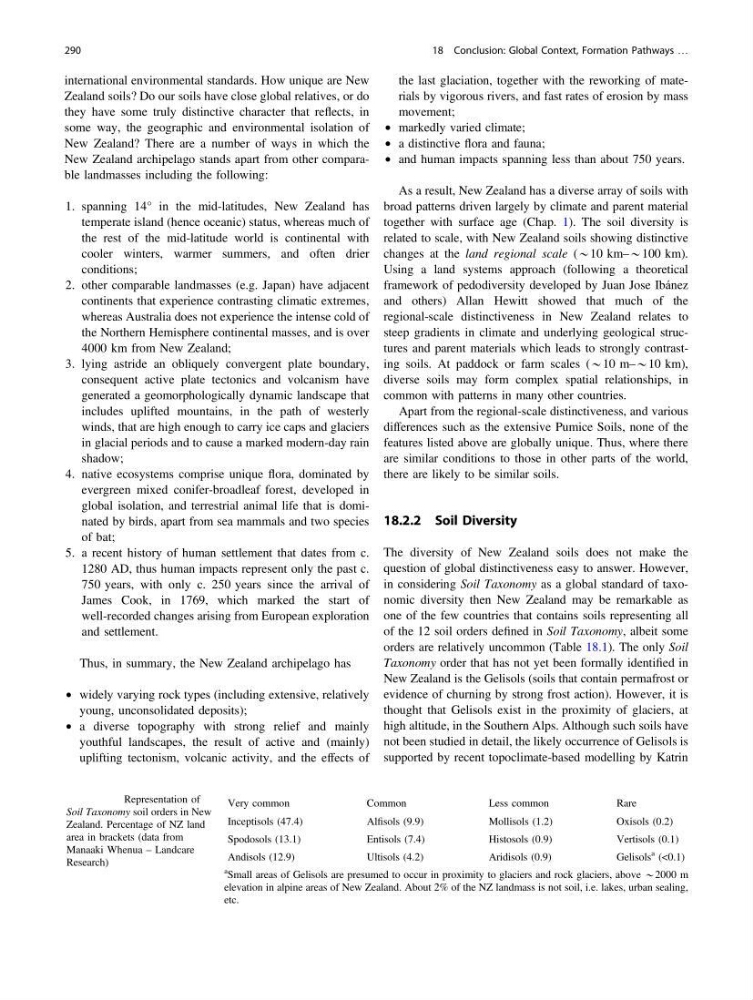
orders are relatively uncommon (Table 18.1). The only Soil
Taxonomy order that has not yet been formally identified in
New Zealand is the Gelisols (soils that contain permafrost or
evidence of churning by strong frost action). However, it is
thought that Gelisols exist in the proximity of glaciers, at
high altitude, in the Southern Alps. Although such soils have
not been studied in detail, the likely occurrence of Gelisols is
supported by recent topoclimate-based modelling by Katrin
Table 18.1 Representation of
Soil Taxonomy soil orders in New
Zealand. Percentage of NZ land
area in brackets (data from
Manaaki Whenua – Landcare
Research)
Very common
Common
Less common
Rare
Inceptisols (47.4)
Alfisols (9.9)
Mollisols (1.2)
Oxisols (0.2)
Spodosols (13.1)
Entisols (7.4)
Histosols (0.9)
Vertisols (0.1)
Andisols (12.9)
Ultisols (4.2)
Aridisols (0.9)
Gelisols
a (<0.1)
a Small areas of Gelisols are presumed to occur in proximity to glaciers and rock glaciers, above *2000 m
elevation in alpine areas of New Zealand. About 2% of the NZ landmass is not soil, i.e. lakes, urban sealing,
etc.
290
18 Conclusion: Global Context, Formation Pathways …
Zealand soils? Do our soils have close global relatives, or do
they have some truly distinctive character that reflects, in
some way, the geographic and environmental isolation of
New Zealand? There are a number of ways in which the
New Zealand archipelago stands apart from other comparable landmasses including the following:
1. spanning 14° in the mid-latitudes, New Zealand has
temperate island (hence oceanic) status, whereas much of
the rest of the mid-latitude world is continental with
cooler winters, warmer summers, and often drier
conditions;
2. other comparable landmasses (e.g. Japan) have adjacent
continents that experience contrasting climatic extremes,
whereas Australia does not experience the intense cold of
the Northern Hemisphere continental masses, and is over
4000 km from New Zealand;
3. lying astride an obliquely convergent plate boundary,
consequent active plate tectonics and volcanism have
generated a geomorphologically dynamic landscape that
includes uplifted mountains, in the path of westerly
winds, that are high enough to carry ice caps and glaciers
in glacial periods and to cause a marked modern-day rain
shadow;
4. native ecosystems comprise unique flora, dominated by
evergreen mixed conifer-broadleaf forest, developed in
global isolation, and terrestrial animal life that is dominated by birds, apart from sea mammals and two species
of bat;
5. a recent history of human settlement that dates from c.
1280 AD, thus human impacts represent only the past c.
750 years, with only c. 250 years since the arrival of
James Cook, in 1769, which marked the start of
well-recorded changes arising from European exploration
and settlement.
Thus, in summary, the New Zealand archipelago has
• widely varying rock types (including extensive, relatively
young, unconsolidated deposits);
• a diverse topography with strong relief and mainly
youthful landscapes, the result of active and (mainly)
uplifting tectonism, volcanic activity, and the effects of
the last glaciation, together with the reworking of materials by vigorous rivers, and fast rates of erosion by mass
movement;
• markedly varied climate;
• a distinctive flora and fauna;
• and human impacts spanning less than about 750 years.
As a result, New Zealand has a diverse array of soils with
broad patterns driven largely by climate and parent material
together with surface age (Chap. 1). The soil diversity is
related to scale, with New Zealand soils showing distinctive
changes at the land regional scale (*10 km–*100 km).
Using a land systems approach (following a theoretical
framework of pedodiversity developed by Juan Jose Ibánez
and others) Allan Hewitt showed that much of the
regional-scale distinctiveness in New Zealand relates to
steep gradients in climate and underlying geological structures and parent materials which leads to strongly contrasting soils. At paddock or farm scales (*10 m–*10 km),
diverse soils may form complex spatial relationships, in
common with patterns in many other countries.
Apart from the regional-scale distinctiveness, and various
differences such as the extensive Pumice Soils, none of the
features listed above are globally unique. Thus, where there
are similar conditions to those in other parts of the world,
there are likely to be similar soils.
18.2.2 Soil Diversity
The diversity of New Zealand soils does not make the
question of global distinctiveness easy to answer. However,
in considering Soil Taxonomy as a global standard of taxonomic diversity then New Zealand may be remarkable as
one of the few countries that contains soils representing all
of the 12 soil orders defined in Soil Taxonomy, albeit some
orders are relatively uncommon (Table 18.1). The only Soil
Taxonomy order that has not yet been formally identified in
New Zealand is the Gelisols (soils that contain permafrost or
evidence of churning by strong frost action). However, it is
thought that Gelisols exist in the proximity of glaciers, at
high altitude, in the Southern Alps. Although such soils have
not been studied in detail, the likely occurrence of Gelisols is
supported by recent topoclimate-based modelling by Katrin
Table 18.1 Representation of
Soil Taxonomy soil orders in New
Zealand. Percentage of NZ land
area in brackets (data from
Manaaki Whenua – Landcare
Research)
Very common
Common
Less common
Rare
Inceptisols (47.4)
Alfisols (9.9)
Mollisols (1.2)
Oxisols (0.2)
Spodosols (13.1)
Entisols (7.4)
Histosols (0.9)
Vertisols (0.1)
Andisols (12.9)
Ultisols (4.2)
Aridisols (0.9)
Gelisols
a (<0.1)
a Small areas of Gelisols are presumed to occur in proximity to glaciers and rock glaciers, above *2000 m
elevation in alpine areas of New Zealand. About 2% of the NZ landmass is not soil, i.e. lakes, urban sealing,
etc.
290
18 Conclusion: Global Context, Formation Pathways …