

cemented and so samples slake in water. Subsoils are usually
pale grey or yellowish in colour but may also include
rust-coloured mottles where saturated conditions occur for
some time during winter/spring. The subsoils have many of
the properties of a fragipan except for the prismatic structure.
The Densipan Ultic Soils are transitional to Densipan Podzol
Soils (the latter requiring a podzolic-B horizon or acidic
ortstein-pan or humus-pan).
Albic Ultic Soils—have a pale-coloured (Ea) horizon just
beneath the topsoil, in which sand and silt grains are clean
and not covered with films of weathered material (an indication of acid leaching). Others may have Eg or Er horizons
on firm, clayey Bt horizons. Albic Ultic Soils are also
transitional to Podzol Soils, but do not have a densipan.
Perch-gley Ultic Soils—have prolonged, periodic wetness
in the upper part of the profile caused by a water table
perched on the slowly permeable subsoil (argillic horizon),
technically a gley profile form.
Sandy Ultic Soils—occur in strongly weathered aeolian
sands, or sandstones, with >60% sand in the B horizon. They
may have higher permeability than other Ultic Soils.
Yellow Ultic Soils—the most common or ‘default’ group
of soils that do not meet the criteria for those above, and
which have yellow or yellow-brown colours in at least part
of the subsoil. This group also includes soils with reddened
lower subsoils and the special case, the Kainui soil formed
on weathered tephra deposits including a buried paleosol.
Subgroups express variations based on gleying
(Perch-gley, and Mottled), a lack of gleying or other diagnostic features (Yellow), sandy texture (Sandy), presence of
an albic horizon (Albic), presence of ultramafic rock influence in the parent material (Magnesic), horizons with
Granular Soil properties at depth (Buried-granular), and soils
typical of the Ultic Soil group without any of the more
specific properties (Typic).
16.1.4 Origin of Soil Order Name
The term ‘Ultic’ comes from the Latin ultimus, meaning
‘final, last’ and was chosen by Allan Hewitt to match the
Ultisols order of Soil Taxonomy (but with a narrower range
for New Zealand). Although it is now well appreciated that
soils evolve by ebb and flow (based on the dynamic-rate
model of pedogenesis) rather than developing in a linear
fashion towards some ultimate point in soil development, the
name ‘Ultic’ does invoke a highly weathered and strongly
enleached character and thus an advanced stage of soil
development.
16.2 Soil Profile Genesis
The vast majority of Ultic Soils have formed through topdown pedogenesis, with soil formation starting at the land
surface on freshly exposed rock material. The soil profile
gradually deepens as soil horizons are formed in a
downward-moving front driven by the organic and hydrologic cycles. Ultic Soils are formed in saprolite on strongly
weathered parent rocks, including sandstones and greywacke, that are rich in quartz, feldspar, and various other
minerals that may include mafic crystals. The
well-developed soils, with advanced weathering, attest to the
long periods of time that the soils have been exposed on
largely stable land surfaces. Many are probably several
hundred thousand years old, or older. As well, the northern
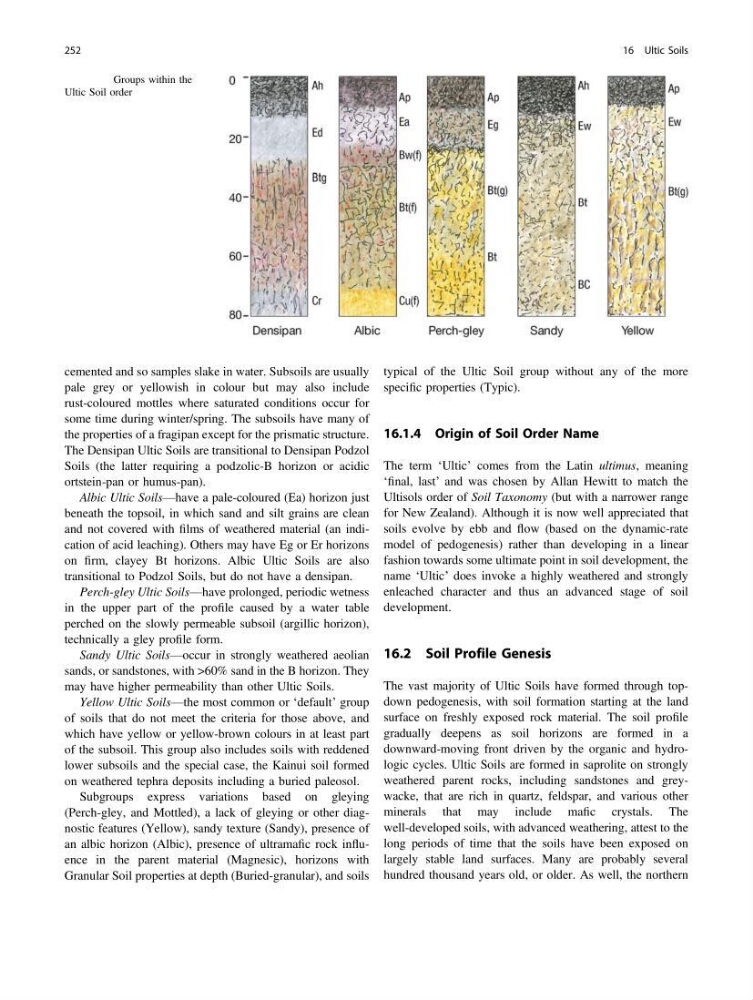
Fig. 16.3 Groups within the
Ultic Soil order
252
16 Ultic Soils
pale grey or yellowish in colour but may also include
rust-coloured mottles where saturated conditions occur for
some time during winter/spring. The subsoils have many of
the properties of a fragipan except for the prismatic structure.
The Densipan Ultic Soils are transitional to Densipan Podzol
Soils (the latter requiring a podzolic-B horizon or acidic
ortstein-pan or humus-pan).
Albic Ultic Soils—have a pale-coloured (Ea) horizon just
beneath the topsoil, in which sand and silt grains are clean
and not covered with films of weathered material (an indication of acid leaching). Others may have Eg or Er horizons
on firm, clayey Bt horizons. Albic Ultic Soils are also
transitional to Podzol Soils, but do not have a densipan.
Perch-gley Ultic Soils—have prolonged, periodic wetness
in the upper part of the profile caused by a water table
perched on the slowly permeable subsoil (argillic horizon),
technically a gley profile form.
Sandy Ultic Soils—occur in strongly weathered aeolian
sands, or sandstones, with >60% sand in the B horizon. They
may have higher permeability than other Ultic Soils.
Yellow Ultic Soils—the most common or ‘default’ group
of soils that do not meet the criteria for those above, and
which have yellow or yellow-brown colours in at least part
of the subsoil. This group also includes soils with reddened
lower subsoils and the special case, the Kainui soil formed
on weathered tephra deposits including a buried paleosol.
Subgroups express variations based on gleying
(Perch-gley, and Mottled), a lack of gleying or other diagnostic features (Yellow), sandy texture (Sandy), presence of
an albic horizon (Albic), presence of ultramafic rock influence in the parent material (Magnesic), horizons with
Granular Soil properties at depth (Buried-granular), and soils
typical of the Ultic Soil group without any of the more
specific properties (Typic).
16.1.4 Origin of Soil Order Name
The term ‘Ultic’ comes from the Latin ultimus, meaning
‘final, last’ and was chosen by Allan Hewitt to match the
Ultisols order of Soil Taxonomy (but with a narrower range
for New Zealand). Although it is now well appreciated that
soils evolve by ebb and flow (based on the dynamic-rate
model of pedogenesis) rather than developing in a linear
fashion towards some ultimate point in soil development, the
name ‘Ultic’ does invoke a highly weathered and strongly
enleached character and thus an advanced stage of soil
development.
16.2 Soil Profile Genesis
The vast majority of Ultic Soils have formed through topdown pedogenesis, with soil formation starting at the land
surface on freshly exposed rock material. The soil profile
gradually deepens as soil horizons are formed in a
downward-moving front driven by the organic and hydrologic cycles. Ultic Soils are formed in saprolite on strongly
weathered parent rocks, including sandstones and greywacke, that are rich in quartz, feldspar, and various other
minerals that may include mafic crystals. The
well-developed soils, with advanced weathering, attest to the
long periods of time that the soils have been exposed on
largely stable land surfaces. Many are probably several
hundred thousand years old, or older. As well, the northern
Fig. 16.3 Groups within the
Ultic Soil order
252
16 Ultic Soils