

no means a feature of Aridisols throughout the world.
Knowledge transfer from Aridisols elsewhere in the world
requires particular attention to cation exchange capacity,
anion characteristics, and soil particle size, as well as other
factors including topography and land management history.
15.7.3 Irrigation History and Management
In Semiarid Soils, soil water deficits limit plant growth for
most of the year. Dryland pasture supports only a low
stocking rate. For horticultural production, or more intense
farming, irrigation is necessary. When the gold rush brought
people to the region, it created a need for water for both
irrigation and gold-mining operations. Much of the gold
mining was undertaken by ‘sluicing’ (washing material
down off slopes and through a sluice or trough where the
heavier gold could be extracted from the remaining
soil/subsoil material). A series of water races were built
along contours to conduct water, under gravity, from
upstream areas to the places where it was needed for irrigation or for gold extraction.
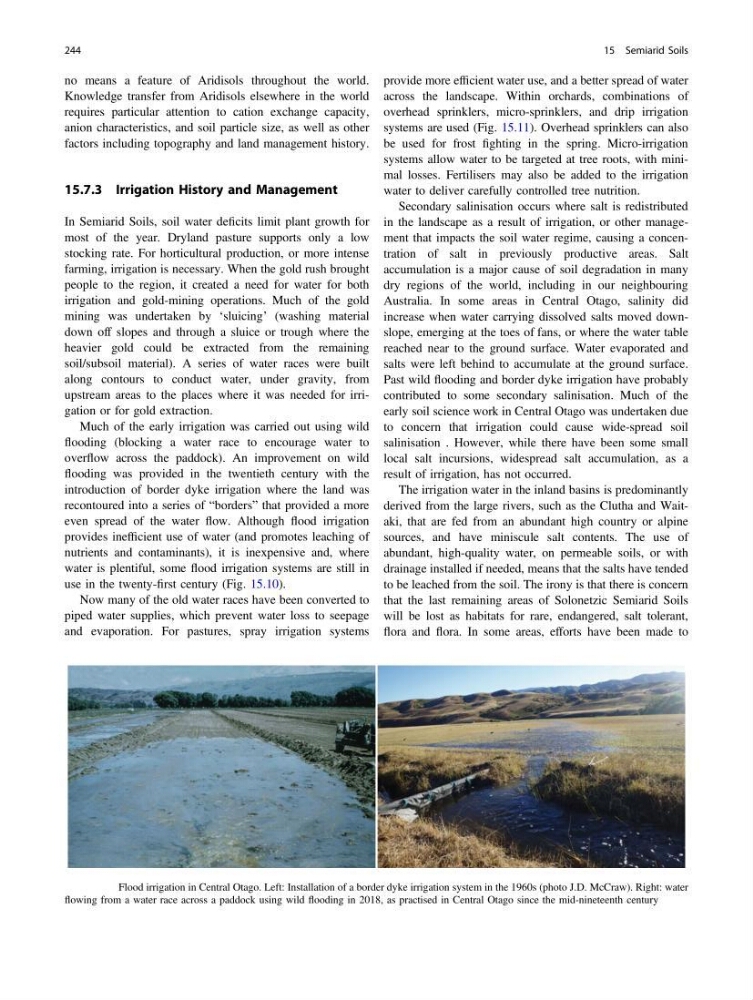
Much of the early irrigation was carried out using wild
flooding (blocking a water race to encourage water to
overflow across the paddock). An improvement on wild
flooding was provided in the twentieth century with the
introduction of border dyke irrigation where the land was
recontoured into a series of “borders” that provided a more
even spread of the water flow. Although flood irrigation
provides inefficient use of water (and promotes leaching of
nutrients and contaminants), it is inexpensive and, where
water is plentiful, some flood irrigation systems are still in
use in the twenty-first century (Fig. 15.10).
Now many of the old water races have been converted to
piped water supplies, which prevent water loss to seepage
and evaporation. For pastures, spray irrigation systems
provide more efficient water use, and a better spread of water
across the landscape. Within orchards, combinations of
overhead sprinklers, micro-sprinklers, and drip irrigation
systems are used (Fig. 15.11). Overhead sprinklers can also
be used for frost fighting in the spring. Micro-irrigation
systems allow water to be targeted at tree roots, with minimal losses. Fertilisers may also be added to the irrigation
water to deliver carefully controlled tree nutrition.
Secondary salinisation occurs where salt is redistributed
in the landscape as a result of irrigation, or other management that impacts the soil water regime, causing a concentration of salt in previously productive areas. Salt
accumulation is a major cause of soil degradation in many
dry regions of the world, including in our neighbouring
Australia. In some areas in Central Otago, salinity did
increase when water carrying dissolved salts moved downslope, emerging at the toes of fans, or where the water table
reached near to the ground surface. Water evaporated and
salts were left behind to accumulate at the ground surface.
Past wild flooding and border dyke irrigation have probably
contributed to some secondary salinisation. Much of the
early soil science work in Central Otago was undertaken due
to concern that irrigation could cause wide-spread soil
salinisation . However, while there have been some small
local salt incursions, widespread salt accumulation, as a
result of irrigation, has not occurred.
The irrigation water in the inland basins is predominantly
derived from the large rivers, such as the Clutha and Waitaki, that are fed from an abundant high country or alpine
sources, and have miniscule salt contents. The use of
abundant, high-quality water, on permeable soils, or with
drainage installed if needed, means that the salts have tended
to be leached from the soil. The irony is that there is concern
that the last remaining areas of Solonetzic Semiarid Soils
will be lost as habitats for rare, endangered, salt tolerant,
flora and flora. In some areas, efforts have been made to
Fig. 15.10 Flood irrigation in Central Otago. Left: Installation of a border dyke irrigation system in the 1960s (photo J.D. McCraw). Right: water
flowing from a water race across a paddock using wild flooding in 2018, as practised in Central Otago since the mid-nineteenth century
244
15 Semiarid Soils
Knowledge transfer from Aridisols elsewhere in the world
requires particular attention to cation exchange capacity,
anion characteristics, and soil particle size, as well as other
factors including topography and land management history.
15.7.3 Irrigation History and Management
In Semiarid Soils, soil water deficits limit plant growth for
most of the year. Dryland pasture supports only a low
stocking rate. For horticultural production, or more intense
farming, irrigation is necessary. When the gold rush brought
people to the region, it created a need for water for both
irrigation and gold-mining operations. Much of the gold
mining was undertaken by ‘sluicing’ (washing material
down off slopes and through a sluice or trough where the
heavier gold could be extracted from the remaining
soil/subsoil material). A series of water races were built
along contours to conduct water, under gravity, from
upstream areas to the places where it was needed for irrigation or for gold extraction.
Much of the early irrigation was carried out using wild
flooding (blocking a water race to encourage water to
overflow across the paddock). An improvement on wild
flooding was provided in the twentieth century with the
introduction of border dyke irrigation where the land was
recontoured into a series of “borders” that provided a more
even spread of the water flow. Although flood irrigation
provides inefficient use of water (and promotes leaching of
nutrients and contaminants), it is inexpensive and, where
water is plentiful, some flood irrigation systems are still in
use in the twenty-first century (Fig. 15.10).
Now many of the old water races have been converted to
piped water supplies, which prevent water loss to seepage
and evaporation. For pastures, spray irrigation systems
provide more efficient water use, and a better spread of water
across the landscape. Within orchards, combinations of
overhead sprinklers, micro-sprinklers, and drip irrigation
systems are used (Fig. 15.11). Overhead sprinklers can also
be used for frost fighting in the spring. Micro-irrigation
systems allow water to be targeted at tree roots, with minimal losses. Fertilisers may also be added to the irrigation
water to deliver carefully controlled tree nutrition.
Secondary salinisation occurs where salt is redistributed
in the landscape as a result of irrigation, or other management that impacts the soil water regime, causing a concentration of salt in previously productive areas. Salt
accumulation is a major cause of soil degradation in many
dry regions of the world, including in our neighbouring
Australia. In some areas in Central Otago, salinity did
increase when water carrying dissolved salts moved downslope, emerging at the toes of fans, or where the water table
reached near to the ground surface. Water evaporated and
salts were left behind to accumulate at the ground surface.
Past wild flooding and border dyke irrigation have probably
contributed to some secondary salinisation. Much of the
early soil science work in Central Otago was undertaken due
to concern that irrigation could cause wide-spread soil
salinisation . However, while there have been some small
local salt incursions, widespread salt accumulation, as a
result of irrigation, has not occurred.
The irrigation water in the inland basins is predominantly
derived from the large rivers, such as the Clutha and Waitaki, that are fed from an abundant high country or alpine
sources, and have miniscule salt contents. The use of
abundant, high-quality water, on permeable soils, or with
drainage installed if needed, means that the salts have tended
to be leached from the soil. The irony is that there is concern
that the last remaining areas of Solonetzic Semiarid Soils
will be lost as habitats for rare, endangered, salt tolerant,
flora and flora. In some areas, efforts have been made to
Fig. 15.10 Flood irrigation in Central Otago. Left: Installation of a border dyke irrigation system in the 1960s (photo J.D. McCraw). Right: water
flowing from a water race across a paddock using wild flooding in 2018, as practised in Central Otago since the mid-nineteenth century
244
15 Semiarid Soils