

Hydrothermal Recent Soils—naturally warmed by current,
previously active, or extremely acidic geothermal activity,
usually in areas adjacent to Hydrothermal Raw Soils,
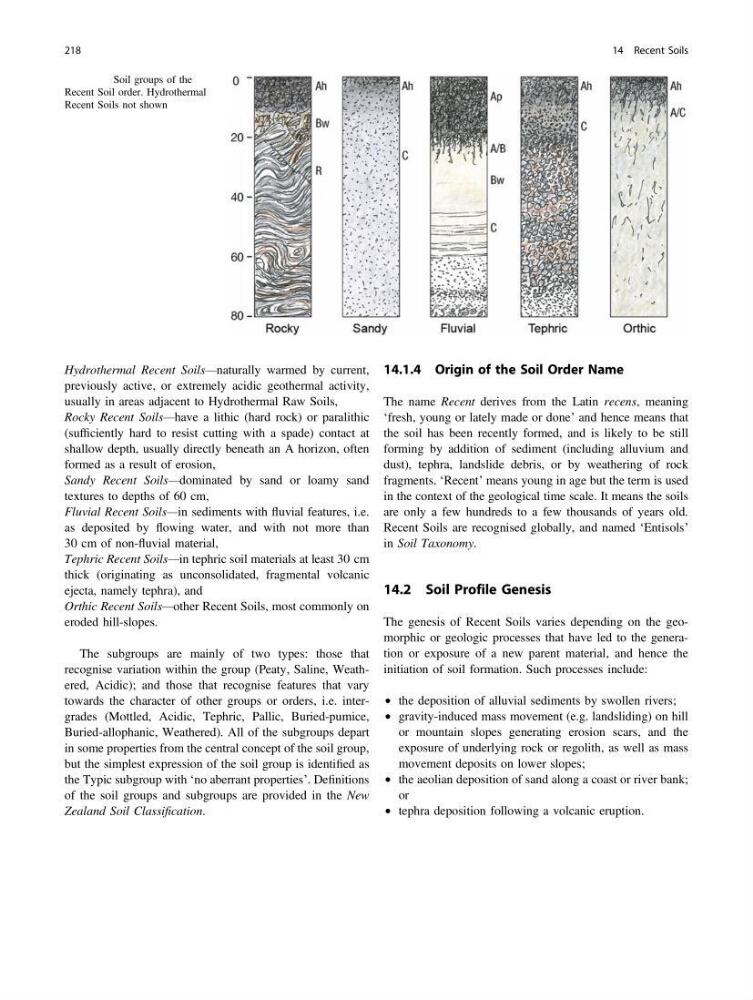
Rocky Recent Soils—have a lithic (hard rock) or paralithic
(sufficiently hard to resist cutting with a spade) contact at
shallow depth, usually directly beneath an A horizon, often
formed as a result of erosion,
Sandy Recent Soils—dominated by sand or loamy sand
textures to depths of 60 cm,
Fluvial Recent Soils—in sediments with fluvial features, i.e.
as deposited by flowing water, and with not more than
30 cm of non-fluvial material,
Tephric Recent Soils—in tephric soil materials at least 30 cm
thick (originating as unconsolidated, fragmental volcanic
ejecta, namely tephra), and
Orthic Recent Soils—other Recent Soils, most commonly on
eroded hill-slopes.
The subgroups are mainly of two types: those that
recognise variation within the group (Peaty, Saline, Weathered, Acidic); and those that recognise features that vary
towards the character of other groups or orders, i.e. intergrades (Mottled, Acidic, Tephric, Pallic, Buried-pumice,
Buried-allophanic, Weathered). All of the subgroups depart
in some properties from the central concept of the soil group,
but the simplest expression of the soil group is identified as
the Typic subgroup with ‘no aberrant properties’. Definitions
of the soil groups and subgroups are provided in the New
Zealand Soil Classification.
14.1.4 Origin of the Soil Order Name
The name Recent derives from the Latin recens, meaning
‘fresh, young or lately made or done’ and hence means that
the soil has been recently formed, and is likely to be still
forming by addition of sediment (including alluvium and
dust), tephra, landslide debris, or by weathering of rock
fragments. ‘Recent’ means young in age but the term is used
in the context of the geological time scale. It means the soils
are only a few hundreds to a few thousands of years old.
Recent Soils are recognised globally, and named ‘Entisols’
in Soil Taxonomy.
14.2 Soil Profile Genesis
The genesis of Recent Soils varies depending on the geomorphic or geologic processes that have led to the generation or exposure of a new parent material, and hence the
initiation of soil formation. Such processes include:
• the deposition of alluvial sediments by swollen rivers;
• gravity-induced mass movement (e.g. landsliding) on hill
or mountain slopes generating erosion scars, and the
exposure of underlying rock or regolith, as well as mass
movement deposits on lower slopes;
• the aeolian deposition of sand along a coast or river bank;
or
• tephra deposition following a volcanic eruption.
Fig. 14.3 Soil groups of the
Recent Soil order. Hydrothermal
Recent Soils not shown
218
14 Recent Soils
previously active, or extremely acidic geothermal activity,
usually in areas adjacent to Hydrothermal Raw Soils,
Rocky Recent Soils—have a lithic (hard rock) or paralithic
(sufficiently hard to resist cutting with a spade) contact at
shallow depth, usually directly beneath an A horizon, often
formed as a result of erosion,
Sandy Recent Soils—dominated by sand or loamy sand
textures to depths of 60 cm,
Fluvial Recent Soils—in sediments with fluvial features, i.e.
as deposited by flowing water, and with not more than
30 cm of non-fluvial material,
Tephric Recent Soils—in tephric soil materials at least 30 cm
thick (originating as unconsolidated, fragmental volcanic
ejecta, namely tephra), and
Orthic Recent Soils—other Recent Soils, most commonly on
eroded hill-slopes.
The subgroups are mainly of two types: those that
recognise variation within the group (Peaty, Saline, Weathered, Acidic); and those that recognise features that vary
towards the character of other groups or orders, i.e. intergrades (Mottled, Acidic, Tephric, Pallic, Buried-pumice,
Buried-allophanic, Weathered). All of the subgroups depart
in some properties from the central concept of the soil group,
but the simplest expression of the soil group is identified as
the Typic subgroup with ‘no aberrant properties’. Definitions
of the soil groups and subgroups are provided in the New
Zealand Soil Classification.
14.1.4 Origin of the Soil Order Name
The name Recent derives from the Latin recens, meaning
‘fresh, young or lately made or done’ and hence means that
the soil has been recently formed, and is likely to be still
forming by addition of sediment (including alluvium and
dust), tephra, landslide debris, or by weathering of rock
fragments. ‘Recent’ means young in age but the term is used
in the context of the geological time scale. It means the soils
are only a few hundreds to a few thousands of years old.
Recent Soils are recognised globally, and named ‘Entisols’
in Soil Taxonomy.
14.2 Soil Profile Genesis
The genesis of Recent Soils varies depending on the geomorphic or geologic processes that have led to the generation or exposure of a new parent material, and hence the
initiation of soil formation. Such processes include:
• the deposition of alluvial sediments by swollen rivers;
• gravity-induced mass movement (e.g. landsliding) on hill
or mountain slopes generating erosion scars, and the
exposure of underlying rock or regolith, as well as mass
movement deposits on lower slopes;
• the aeolian deposition of sand along a coast or river bank;
or
• tephra deposition following a volcanic eruption.
Fig. 14.3 Soil groups of the
Recent Soil order. Hydrothermal
Recent Soils not shown
218
14 Recent Soils