

subsequent modification, by pedogenesis, of the freshly
added sediment is an example of developmental upbuilding
(i.e. the ongoing formation of soil via topdown soil-forming
processes while new materials are periodically added to the
land surface by geological processes). In contrast, where a
thicker layer of alluvium is deposited that deeply buries the
previous soil (turning it into a paleosol), the soil’s evolution
is reset to a new time zero forming a Raw Soil.
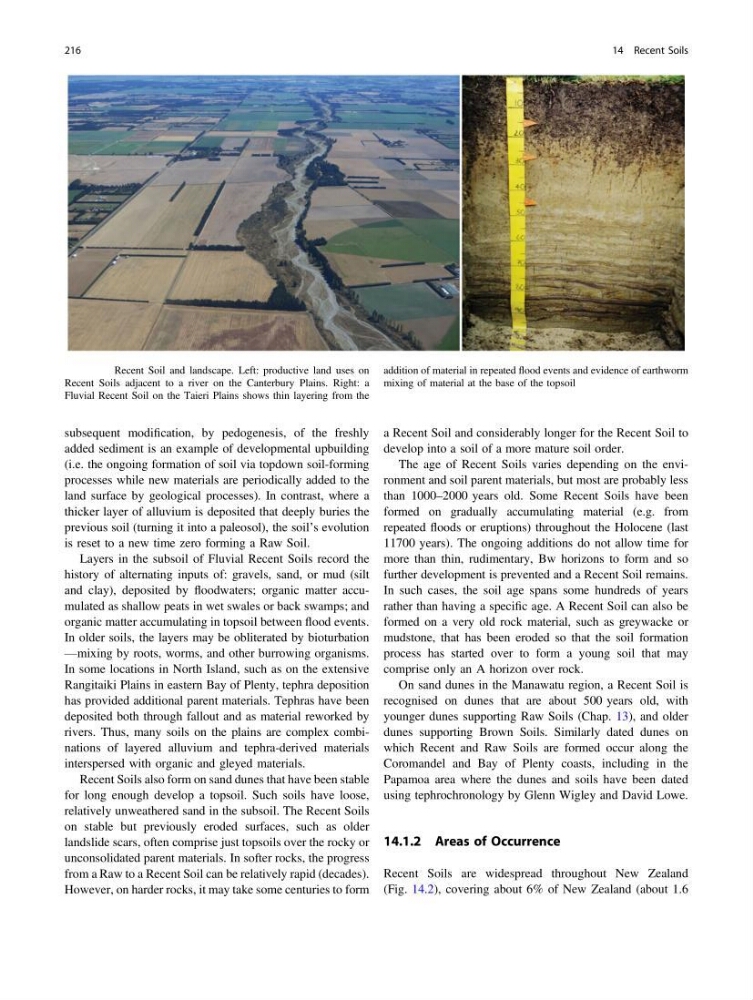
Layers in the subsoil of Fluvial Recent Soils record the
history of alternating inputs of: gravels, sand, or mud (silt
and clay), deposited by floodwaters; organic matter accumulated as shallow peats in wet swales or back swamps; and
organic matter accumulating in topsoil between flood events.
In older soils, the layers may be obliterated by bioturbation
—mixing by roots, worms, and other burrowing organisms.
In some locations in North Island, such as on the extensive
Rangitaiki Plains in eastern Bay of Plenty, tephra deposition
has provided additional parent materials. Tephras have been
deposited both through fallout and as material reworked by
rivers. Thus, many soils on the plains are complex combinations of layered alluvium and tephra-derived materials
interspersed with organic and gleyed materials.
Recent Soils also form on sand dunes that have been stable
for long enough develop a topsoil. Such soils have loose,
relatively unweathered sand in the subsoil. The Recent Soils
on stable but previously eroded surfaces, such as older
landslide scars, often comprise just topsoils over the rocky or
unconsolidated parent materials. In softer rocks, the progress
from a Raw to a Recent Soil can be relatively rapid (decades).
However, on harder rocks, it may take some centuries to form
a Recent Soil and considerably longer for the Recent Soil to
develop into a soil of a more mature soil order.
The age of Recent Soils varies depending on the environment and soil parent materials, but most are probably less
than 1000–2000 years old. Some Recent Soils have been
formed on gradually accumulating material (e.g. from
repeated floods or eruptions) throughout the Holocene (last
11700 years). The ongoing additions do not allow time for
more than thin, rudimentary, Bw horizons to form and so
further development is prevented and a Recent Soil remains.
In such cases, the soil age spans some hundreds of years
rather than having a specific age. A Recent Soil can also be
formed on a very old rock material, such as greywacke or
mudstone, that has been eroded so that the soil formation
process has started over to form a young soil that may
comprise only an A horizon over rock.
On sand dunes in the Manawatu region, a Recent Soil is
recognised on dunes that are about 500 years old, with
younger dunes supporting Raw Soils (Chap. 13), and older
dunes supporting Brown Soils. Similarly dated dunes on
which Recent and Raw Soils are formed occur along the
Coromandel and Bay of Plenty coasts, including in the
Papamoa area where the dunes and soils have been dated
using tephrochronology by Glenn Wigley and David Lowe.
14.1.2 Areas of Occurrence
Recent Soils are widespread throughout New Zealand
(Fig. 14.2), covering about 6% of New Zealand (about 1.6
Fig. 14.1 Recent Soil and landscape. Left: productive land uses on
Recent Soils adjacent to a river on the Canterbury Plains. Right: a
Fluvial Recent Soil on the Taieri Plains shows thin layering from the
addition of material in repeated flood events and evidence of earthworm
mixing of material at the base of the topsoil
216
14 Recent Soils
added sediment is an example of developmental upbuilding
(i.e. the ongoing formation of soil via topdown soil-forming
processes while new materials are periodically added to the
land surface by geological processes). In contrast, where a
thicker layer of alluvium is deposited that deeply buries the
previous soil (turning it into a paleosol), the soil’s evolution
is reset to a new time zero forming a Raw Soil.
Layers in the subsoil of Fluvial Recent Soils record the
history of alternating inputs of: gravels, sand, or mud (silt
and clay), deposited by floodwaters; organic matter accumulated as shallow peats in wet swales or back swamps; and
organic matter accumulating in topsoil between flood events.
In older soils, the layers may be obliterated by bioturbation
—mixing by roots, worms, and other burrowing organisms.
In some locations in North Island, such as on the extensive
Rangitaiki Plains in eastern Bay of Plenty, tephra deposition
has provided additional parent materials. Tephras have been
deposited both through fallout and as material reworked by
rivers. Thus, many soils on the plains are complex combinations of layered alluvium and tephra-derived materials
interspersed with organic and gleyed materials.
Recent Soils also form on sand dunes that have been stable
for long enough develop a topsoil. Such soils have loose,
relatively unweathered sand in the subsoil. The Recent Soils
on stable but previously eroded surfaces, such as older
landslide scars, often comprise just topsoils over the rocky or
unconsolidated parent materials. In softer rocks, the progress
from a Raw to a Recent Soil can be relatively rapid (decades).
However, on harder rocks, it may take some centuries to form
a Recent Soil and considerably longer for the Recent Soil to
develop into a soil of a more mature soil order.
The age of Recent Soils varies depending on the environment and soil parent materials, but most are probably less
than 1000–2000 years old. Some Recent Soils have been
formed on gradually accumulating material (e.g. from
repeated floods or eruptions) throughout the Holocene (last
11700 years). The ongoing additions do not allow time for
more than thin, rudimentary, Bw horizons to form and so
further development is prevented and a Recent Soil remains.
In such cases, the soil age spans some hundreds of years
rather than having a specific age. A Recent Soil can also be
formed on a very old rock material, such as greywacke or
mudstone, that has been eroded so that the soil formation
process has started over to form a young soil that may
comprise only an A horizon over rock.
On sand dunes in the Manawatu region, a Recent Soil is
recognised on dunes that are about 500 years old, with
younger dunes supporting Raw Soils (Chap. 13), and older
dunes supporting Brown Soils. Similarly dated dunes on
which Recent and Raw Soils are formed occur along the
Coromandel and Bay of Plenty coasts, including in the
Papamoa area where the dunes and soils have been dated
using tephrochronology by Glenn Wigley and David Lowe.
14.1.2 Areas of Occurrence
Recent Soils are widespread throughout New Zealand
(Fig. 14.2), covering about 6% of New Zealand (about 1.6
Fig. 14.1 Recent Soil and landscape. Left: productive land uses on
Recent Soils adjacent to a river on the Canterbury Plains. Right: a
Fluvial Recent Soil on the Taieri Plains shows thin layering from the
addition of material in repeated flood events and evidence of earthworm
mixing of material at the base of the topsoil
216
14 Recent Soils