

environment’. Therefore the ground surface materials
in Antarctica, and on planets, moons, and asteroids in
space, could be recognised as ‘soils’. Back in New
Zealand, the updated definition meant we can now
formally identify all our Raw Soils as ‘soils’.
Finally, it is certain that ‘soil’ is not ‘dirt’. This may
seem a subtle distinction for most people but not for
soil scientists. The association derives from Old
French term, soillier/suillier (from Latin sus, a sow)
meaning to ‘soil’ in the sense of ‘defile’. Dirt refers to
unhygienic or unwanted material. The term ‘dirt’
derives from the Old Norse (and still used in modern
Norway) word, drit, meaning excrement. By contrast,
soil, rather than being ‘unclean’, paradoxically is a
universal purifier, cleaning and regulating water flow
everywhere it occurs. Many of the most widely used
antibiotics have come from the soil. As well, soil is
essential for supporting life on Earth, providing the
foundation of diverse ecosystems and the basis of all
civilisations. The relationship of soil to dirt is akin to
that of plants to weeds, or animals to pests. This may
be a nicety, but the important thing is that we should
never, ever, treat soils like dirt!
13.5 Distinguishing Between Raw Soils
and Related Soil Orders
‘Raw’ means that the soil is undeveloped, and is dominated
by the properties of the geologic substrate materials of which
it is formed. Raw Soils lack distinct topsoil development
(meaning that they have no topsoil, or the topsoil, including
organic horizons if present, is less than 5 cm thick) or they
are fluid and wet at a shallow depth. At older more stable
sites, Raw Soils merge into Recent Soils, with formation of
distinct topsoil at least 5 cm thick. Organic soils can be fluid
at a shallow depth but their high organic matter content
excludes them from the Raw Soils.
If a soil has been eroded then the remaining ‘not-eroded’
soil can still be allocated to the original soil order if sufficient
soil profile remains to allocate it to a soil order in the key to
the New Zealand Soil Classification. Because the Raw Soils
are placed right at the end of the key, any soil that is not
allocated to an order earlier will be caught in the Raw Soils.
13.6 Correlation with Other Classification
Systems
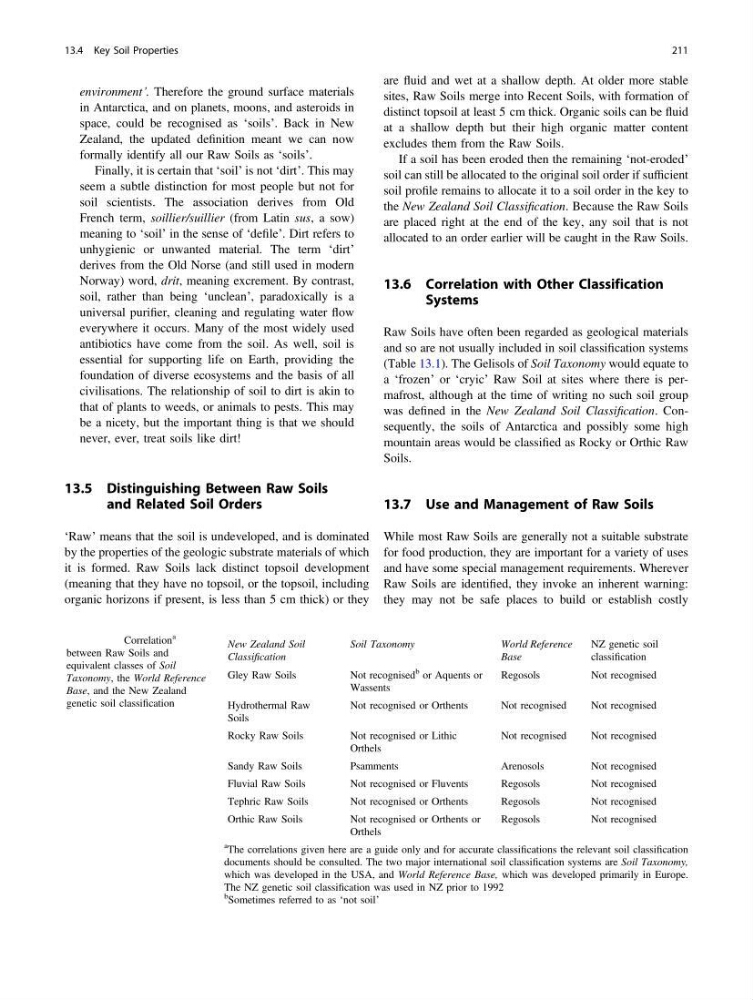
Raw Soils have often been regarded as geological materials
and so are not usually included in soil classification systems
(Table 13.1). The Gelisols of Soil Taxonomy would equate to
a ‘frozen’ or ‘cryic’ Raw Soil at sites where there is permafrost, although at the time of writing no such soil group
was defined in the New Zealand Soil Classification. Consequently, the soils of Antarctica and possibly some high
mountain areas would be classified as Rocky or Orthic Raw
Soils.
13.7 Use and Management of Raw Soils
While most Raw Soils are generally not a suitable substrate
for food production, they are important for a variety of uses
and have some special management requirements. Wherever
Raw Soils are identified, they invoke an inherent warning:
they may not be safe places to build or establish costly
Table 13.1 Correlation
a
between Raw Soils and
equivalent classes of Soil
Taxonomy, the World Reference
Base, and the New Zealand
genetic soil classification
New Zealand Soil
Classification
Soil Taxonomy
World Reference
Base
NZ genetic soil
classification
Gley Raw Soils
Not recognised
b or Aquents or
Wassents
Regosols
Not recognised
Hydrothermal Raw
Soils
Not recognised or Orthents
Not recognised
Not recognised
Rocky Raw Soils
Not recognised or Lithic
Orthels
Not recognised
Not recognised
Sandy Raw Soils
Psamments
Arenosols
Not recognised
Fluvial Raw Soils
Not recognised or Fluvents
Regosols
Not recognised
Tephric Raw Soils
Not recognised or Orthents
Regosols
Not recognised
Orthic Raw Soils
Not recognised or Orthents or
Orthels
Regosols
Not recognised
a The correlations given here are a guide only and for accurate classifications the relevant soil classification
documents should be consulted. The two major international soil classification systems are Soil Taxonomy,
which was developed in the USA, and World Reference Base, which was developed primarily in Europe.
The NZ genetic soil classification was used in NZ prior to 1992
b
Sometimes referred to as ‘not soil’
13.4 Key Soil Properties
211
in Antarctica, and on planets, moons, and asteroids in
space, could be recognised as ‘soils’. Back in New
Zealand, the updated definition meant we can now
formally identify all our Raw Soils as ‘soils’.
Finally, it is certain that ‘soil’ is not ‘dirt’. This may
seem a subtle distinction for most people but not for
soil scientists. The association derives from Old
French term, soillier/suillier (from Latin sus, a sow)
meaning to ‘soil’ in the sense of ‘defile’. Dirt refers to
unhygienic or unwanted material. The term ‘dirt’
derives from the Old Norse (and still used in modern
Norway) word, drit, meaning excrement. By contrast,
soil, rather than being ‘unclean’, paradoxically is a
universal purifier, cleaning and regulating water flow
everywhere it occurs. Many of the most widely used
antibiotics have come from the soil. As well, soil is
essential for supporting life on Earth, providing the
foundation of diverse ecosystems and the basis of all
civilisations. The relationship of soil to dirt is akin to
that of plants to weeds, or animals to pests. This may
be a nicety, but the important thing is that we should
never, ever, treat soils like dirt!
13.5 Distinguishing Between Raw Soils
and Related Soil Orders
‘Raw’ means that the soil is undeveloped, and is dominated
by the properties of the geologic substrate materials of which
it is formed. Raw Soils lack distinct topsoil development
(meaning that they have no topsoil, or the topsoil, including
organic horizons if present, is less than 5 cm thick) or they
are fluid and wet at a shallow depth. At older more stable
sites, Raw Soils merge into Recent Soils, with formation of
distinct topsoil at least 5 cm thick. Organic soils can be fluid
at a shallow depth but their high organic matter content
excludes them from the Raw Soils.
If a soil has been eroded then the remaining ‘not-eroded’
soil can still be allocated to the original soil order if sufficient
soil profile remains to allocate it to a soil order in the key to
the New Zealand Soil Classification. Because the Raw Soils
are placed right at the end of the key, any soil that is not
allocated to an order earlier will be caught in the Raw Soils.
13.6 Correlation with Other Classification
Systems
Raw Soils have often been regarded as geological materials
and so are not usually included in soil classification systems
(Table 13.1). The Gelisols of Soil Taxonomy would equate to
a ‘frozen’ or ‘cryic’ Raw Soil at sites where there is permafrost, although at the time of writing no such soil group
was defined in the New Zealand Soil Classification. Consequently, the soils of Antarctica and possibly some high
mountain areas would be classified as Rocky or Orthic Raw
Soils.
13.7 Use and Management of Raw Soils
While most Raw Soils are generally not a suitable substrate
for food production, they are important for a variety of uses
and have some special management requirements. Wherever
Raw Soils are identified, they invoke an inherent warning:
they may not be safe places to build or establish costly
Table 13.1 Correlation
a
between Raw Soils and
equivalent classes of Soil
Taxonomy, the World Reference
Base, and the New Zealand
genetic soil classification
New Zealand Soil
Classification
Soil Taxonomy
World Reference
Base
NZ genetic soil
classification
Gley Raw Soils
Not recognised
b or Aquents or
Wassents
Regosols
Not recognised
Hydrothermal Raw
Soils
Not recognised or Orthents
Not recognised
Not recognised
Rocky Raw Soils
Not recognised or Lithic
Orthels
Not recognised
Not recognised
Sandy Raw Soils
Psamments
Arenosols
Not recognised
Fluvial Raw Soils
Not recognised or Fluvents
Regosols
Not recognised
Tephric Raw Soils
Not recognised or Orthents
Regosols
Not recognised
Orthic Raw Soils
Not recognised or Orthents or
Orthels
Regosols
Not recognised
a The correlations given here are a guide only and for accurate classifications the relevant soil classification
documents should be consulted. The two major international soil classification systems are Soil Taxonomy,
which was developed in the USA, and World Reference Base, which was developed primarily in Europe.
The NZ genetic soil classification was used in NZ prior to 1992
b
Sometimes referred to as ‘not soil’
13.4 Key Soil Properties
211