

as the plates have crumpled upwards to form the Southern
Alps, which are among the fastest-rising mountains of the
world. Maximum rock uplift rates are about 10 mm/year.
Lateral movement, where the plates grind past each other,
has resulted in the separation of rocks on opposite sides of
the Alpine Fault by about 480 km over the past 23 million
years. The crumpling, uplift, and lateral movement are
marked by hills, mountain ranges, and multiple faults, in
both the North and South Islands.
The oldest rocks in New Zealand are the granites, schists,
and marble rocks of Fiordland and trilobite-fossil-bearing
sedimentary rocks of northwest Nelson (dated at 510 million
years old in Cobb Valley) which trace their origins back to
ancient Gondwana. Much of New Zealand is underlain by
hard, but highly fractured, sandstone (greywacke), and siltstone (argillite) rocks here collectively referred to as greywacke and as ‘basement’ rocks. The greywacke rocks were
formed from silt- and sand-layered sediments that accumulated in the sea off the coast of Gondwana mainly during the
Jurassic Period (about 200–145 million years ago). During the
Cretaceous Period (at around 85 million years ago) a plate
tectonic spreading zone started to operate in what is now the
Tasman Sea, pushing the land that now makes up New Zealand away from what is now Australia. As a result, the greywacke sediments were lithified and uplifted out of the sea and
then gradually eroded into a fairly low-lying, flat, landmass.
Over time, the land gradually subsided relative to sea
level. Initially a lot of sediment was eroded off the land and
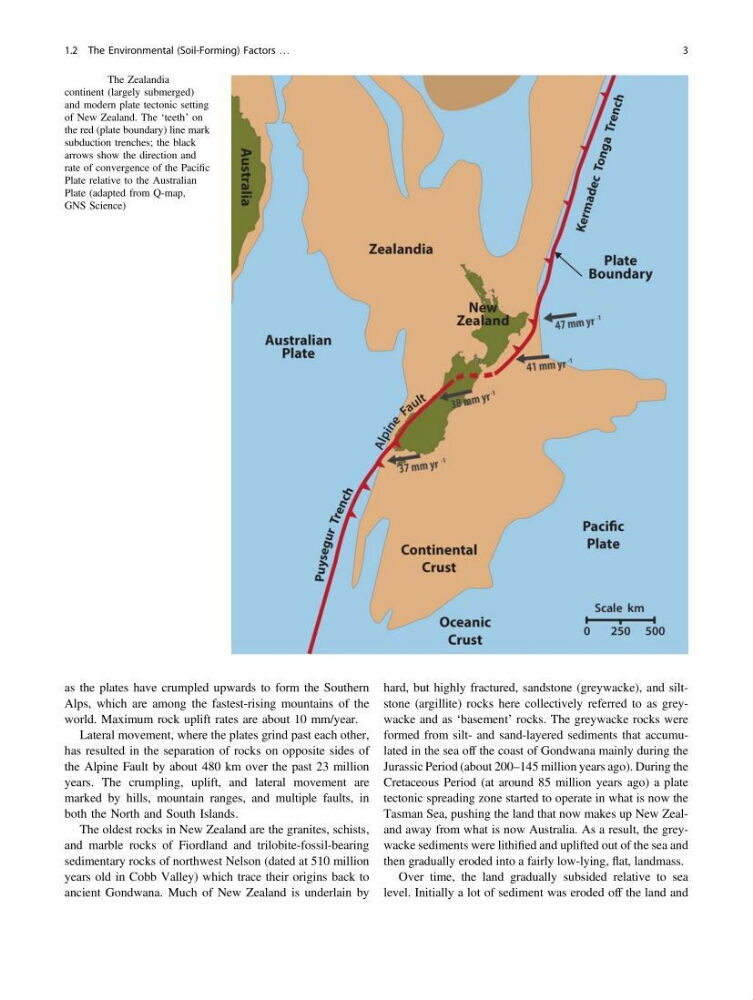
Fig. 1.1 The Zealandia
continent (largely submerged)
and modern plate tectonic setting
of New Zealand. The ‘teeth’ on
the red (plate boundary) line mark
subduction trenches; the black
arrows show the direction and
rate of convergence of the Pacific
Plate relative to the Australian
Plate (adapted from Q-map,
GNS Science)
1.2 The Environmental (Soil-Forming) Factors …
3
Alps, which are among the fastest-rising mountains of the
world. Maximum rock uplift rates are about 10 mm/year.
Lateral movement, where the plates grind past each other,
has resulted in the separation of rocks on opposite sides of
the Alpine Fault by about 480 km over the past 23 million
years. The crumpling, uplift, and lateral movement are
marked by hills, mountain ranges, and multiple faults, in
both the North and South Islands.
The oldest rocks in New Zealand are the granites, schists,
and marble rocks of Fiordland and trilobite-fossil-bearing
sedimentary rocks of northwest Nelson (dated at 510 million
years old in Cobb Valley) which trace their origins back to
ancient Gondwana. Much of New Zealand is underlain by
hard, but highly fractured, sandstone (greywacke), and siltstone (argillite) rocks here collectively referred to as greywacke and as ‘basement’ rocks. The greywacke rocks were
formed from silt- and sand-layered sediments that accumulated in the sea off the coast of Gondwana mainly during the
Jurassic Period (about 200–145 million years ago). During the
Cretaceous Period (at around 85 million years ago) a plate
tectonic spreading zone started to operate in what is now the
Tasman Sea, pushing the land that now makes up New Zealand away from what is now Australia. As a result, the greywacke sediments were lithified and uplifted out of the sea and
then gradually eroded into a fairly low-lying, flat, landmass.
Over time, the land gradually subsided relative to sea
level. Initially a lot of sediment was eroded off the land and
Fig. 1.1 The Zealandia
continent (largely submerged)
and modern plate tectonic setting
of New Zealand. The ‘teeth’ on
the red (plate boundary) line mark
subduction trenches; the black
arrows show the direction and
rate of convergence of the Pacific
Plate relative to the Australian
Plate (adapted from Q-map,
GNS Science)
1.2 The Environmental (Soil-Forming) Factors …
3