

as ignimbrites. The term is different, however, in meaning to
the subgroup term ‘welded’ used in the New Zealand Soil
Classification which applies to compact, tightly packed but
nevertheless unconsolidated (and usually non-cemented)
pumice clasts.
Because of its extreme violence and energy release
(150 ± 50 megaton TNT explosive yield, cf. Hiroshima
bomb 0.015 Mt), and by analogy with the 1883 Krakatau
event, it is likely that the Taupo ignimbrite-emplacement
phase generated a volcano-meteorological tsunami (essentially the collapsing eruption column displaced a large volume of air laterally, forming pressure waves) that may have
reached coastal areas worldwide.
12.2.4 Kaharoa Eruption and Its Products
The Kaharoa eruption was the most recent rhyolite eruption
in New Zealand and forms the dominant parent material for
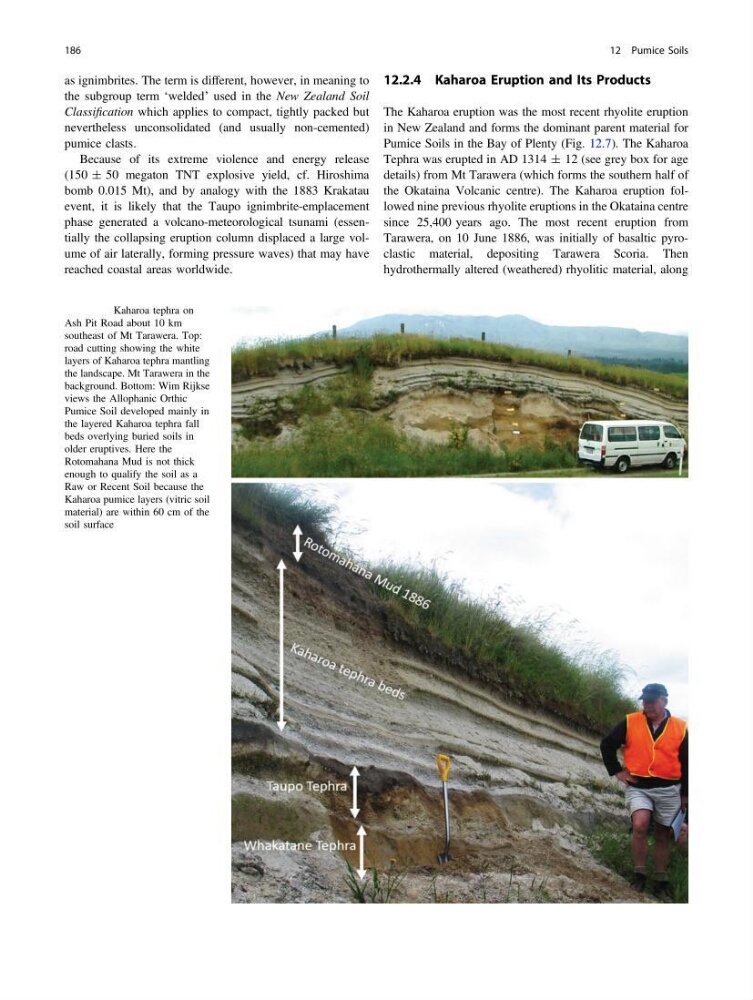
Pumice Soils in the Bay of Plenty (Fig. 12.7). The Kaharoa
Tephra was erupted in AD 1314 ± 12 (see grey box for age
details) from Mt Tarawera (which forms the southern half of
the Okataina Volcanic centre). The Kaharoa eruption followed nine previous rhyolite eruptions in the Okataina centre
since 25,400 years ago. The most recent eruption from
Tarawera, on 10 June 1886, was initially of basaltic pyroclastic material, depositing Tarawera Scoria. Then
hydrothermally altered (weathered) rhyolitic material, along
Fig. 12.7 Kaharoa tephra on
Ash Pit Road about 10 km
southeast of Mt Tarawera. Top:
road cutting showing the white
layers of Kaharoa tephra mantling
the landscape. Mt Tarawera in the
background. Bottom: Wim Rijkse
views the Allophanic Orthic
Pumice Soil developed mainly in
the layered Kaharoa tephra fall
beds overlying buried soils in
older eruptives. Here the
Rotomahana Mud is not thick
enough to qualify the soil as a
Raw or Recent Soil because the
Kaharoa pumice layers (vitric soil
material) are within 60 cm of the
soil surface
186
12 Pumice Soils
the subgroup term ‘welded’ used in the New Zealand Soil
Classification which applies to compact, tightly packed but
nevertheless unconsolidated (and usually non-cemented)
pumice clasts.
Because of its extreme violence and energy release
(150 ± 50 megaton TNT explosive yield, cf. Hiroshima
bomb 0.015 Mt), and by analogy with the 1883 Krakatau
event, it is likely that the Taupo ignimbrite-emplacement
phase generated a volcano-meteorological tsunami (essentially the collapsing eruption column displaced a large volume of air laterally, forming pressure waves) that may have
reached coastal areas worldwide.
12.2.4 Kaharoa Eruption and Its Products
The Kaharoa eruption was the most recent rhyolite eruption
in New Zealand and forms the dominant parent material for
Pumice Soils in the Bay of Plenty (Fig. 12.7). The Kaharoa
Tephra was erupted in AD 1314 ± 12 (see grey box for age
details) from Mt Tarawera (which forms the southern half of
the Okataina Volcanic centre). The Kaharoa eruption followed nine previous rhyolite eruptions in the Okataina centre
since 25,400 years ago. The most recent eruption from
Tarawera, on 10 June 1886, was initially of basaltic pyroclastic material, depositing Tarawera Scoria. Then
hydrothermally altered (weathered) rhyolitic material, along
Fig. 12.7 Kaharoa tephra on
Ash Pit Road about 10 km
southeast of Mt Tarawera. Top:
road cutting showing the white
layers of Kaharoa tephra mantling
the landscape. Mt Tarawera in the
background. Bottom: Wim Rijkse
views the Allophanic Orthic
Pumice Soil developed mainly in
the layered Kaharoa tephra fall
beds overlying buried soils in
older eruptives. Here the
Rotomahana Mud is not thick
enough to qualify the soil as a
Raw or Recent Soil because the
Kaharoa pumice layers (vitric soil
material) are within 60 cm of the
soil surface
186
12 Pumice Soils