

Orthic Pumice Soil). The relationship between Brown, Gley,
and Podzol Soils is often related to position in the landscape.
While it may appear complex, at some sites, there may also
be a catenary relationship on hillslopes, for instance, with
Podzol Soils on stable summit and shoulder slopes, Gley
Soils on poorly drained lower slopes and Recent or Organic
Soils on valley floors.
11.6 Correlation with Other Classification
Systems
The Podzol Soil groups mainly correlate with the Spodosols
of Soil Taxonomy and were formerly classified as Podzols in
New Zealand (Table 11.3).
11.7 Use and Management of Podzol Soils
The Podzol Soils are limited in natural fertility and require
substantial fertiliser (N, P, K, Ca, and micronutrients) and
lime additions to bring them into economic agricultural
production. Where the pH is below 4.8 then many plant
species will suffer from Al toxicity and other key nutrients
will have limited availability. Thus the need for lime. Pan
Podzol Soils have humus- or ortstein-pans (Bhm, Bsm) or
placic horizons (Bfm) that may present abrupt rooting barriers as well as limiting downward moisture movement.
Thus actions to break up pans such as ripping may be
needed.
In the South Island, the largest areas of Podzol Soils are
in the high rainfall zones within the Southern Alps and south
Westland and so remain in native forest under conservation
management. Native conservation ecosystems are valuable
as they support biodiversity and tourism and prevent erosion.
The forested catchments also have an important role in
slowing floodwater runoff, and thus moderating flood peaks
in the intense rainfall-prone region. In some areas, the forests
have been milled and then allowed to regenerate or have
been planted into Pinus radiata or Douglas fir production
forestry.
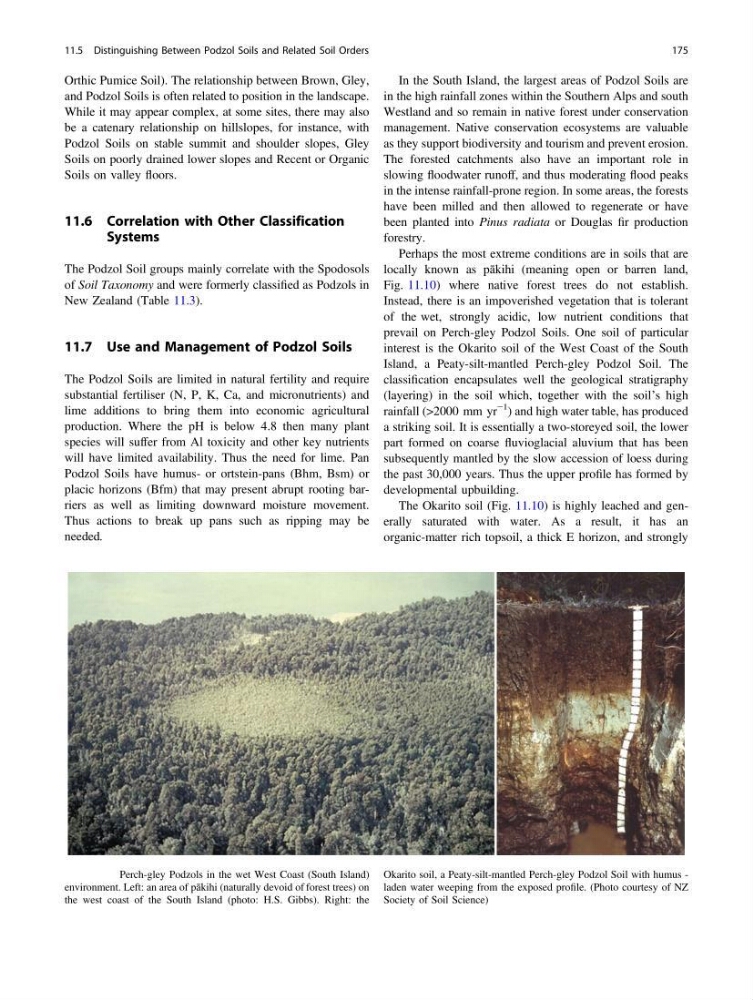
Perhaps the most extreme conditions are in soils that are
locally known as pākihi (meaning open or barren land,
Fig. 11.10) where native forest trees do not establish.
Instead, there is an impoverished vegetation that is tolerant
of the wet, strongly acidic, low nutrient conditions that
prevail on Perch-gley Podzol Soils. One soil of particular
interest is the Okarito soil of the West Coast of the South
Island, a Peaty-silt-mantled Perch-gley Podzol Soil. The
classification encapsulates well the geological stratigraphy
(layering) in the soil which, together with the soil’s high
rainfall (>2000 mm yr
−1 ) and high water table, has produced
a striking soil. It is essentially a two-storeyed soil, the lower
part formed on coarse fluvioglacial aluvium that has been
subsequently mantled by the slow accession of loess during
the past 30,000 years. Thus the upper profile has formed by
developmental upbuilding.
The Okarito soil (Fig. 11.10) is highly leached and generally saturated with water. As a result, it has an
organic-matter rich topsoil, a thick E horizon, and strongly
Fig. 11.10 Perch-gley Podzols in the wet West Coast (South Island)
environment. Left: an area of pākihi (naturally devoid of forest trees) on
the west coast of the South Island (photo: H.S. Gibbs). Right: the
Okarito soil, a Peaty-silt-mantled Perch-gley Podzol Soil with humus -
laden water weeping from the exposed profile. (Photo courtesy of NZ
Society of Soil Science)
11.5 Distinguishing Between Podzol Soils and Related Soil Orders
175
and Podzol Soils is often related to position in the landscape.
While it may appear complex, at some sites, there may also
be a catenary relationship on hillslopes, for instance, with
Podzol Soils on stable summit and shoulder slopes, Gley
Soils on poorly drained lower slopes and Recent or Organic
Soils on valley floors.
11.6 Correlation with Other Classification
Systems
The Podzol Soil groups mainly correlate with the Spodosols
of Soil Taxonomy and were formerly classified as Podzols in
New Zealand (Table 11.3).
11.7 Use and Management of Podzol Soils
The Podzol Soils are limited in natural fertility and require
substantial fertiliser (N, P, K, Ca, and micronutrients) and
lime additions to bring them into economic agricultural
production. Where the pH is below 4.8 then many plant
species will suffer from Al toxicity and other key nutrients
will have limited availability. Thus the need for lime. Pan
Podzol Soils have humus- or ortstein-pans (Bhm, Bsm) or
placic horizons (Bfm) that may present abrupt rooting barriers as well as limiting downward moisture movement.
Thus actions to break up pans such as ripping may be
needed.
In the South Island, the largest areas of Podzol Soils are
in the high rainfall zones within the Southern Alps and south
Westland and so remain in native forest under conservation
management. Native conservation ecosystems are valuable
as they support biodiversity and tourism and prevent erosion.
The forested catchments also have an important role in
slowing floodwater runoff, and thus moderating flood peaks
in the intense rainfall-prone region. In some areas, the forests
have been milled and then allowed to regenerate or have
been planted into Pinus radiata or Douglas fir production
forestry.
Perhaps the most extreme conditions are in soils that are
locally known as pākihi (meaning open or barren land,
Fig. 11.10) where native forest trees do not establish.
Instead, there is an impoverished vegetation that is tolerant
of the wet, strongly acidic, low nutrient conditions that
prevail on Perch-gley Podzol Soils. One soil of particular
interest is the Okarito soil of the West Coast of the South
Island, a Peaty-silt-mantled Perch-gley Podzol Soil. The
classification encapsulates well the geological stratigraphy
(layering) in the soil which, together with the soil’s high
rainfall (>2000 mm yr
−1 ) and high water table, has produced
a striking soil. It is essentially a two-storeyed soil, the lower
part formed on coarse fluvioglacial aluvium that has been
subsequently mantled by the slow accession of loess during
the past 30,000 years. Thus the upper profile has formed by
developmental upbuilding.
The Okarito soil (Fig. 11.10) is highly leached and generally saturated with water. As a result, it has an
organic-matter rich topsoil, a thick E horizon, and strongly
Fig. 11.10 Perch-gley Podzols in the wet West Coast (South Island)
environment. Left: an area of pākihi (naturally devoid of forest trees) on
the west coast of the South Island (photo: H.S. Gibbs). Right: the
Okarito soil, a Peaty-silt-mantled Perch-gley Podzol Soil with humus -
laden water weeping from the exposed profile. (Photo courtesy of NZ
Society of Soil Science)
11.5 Distinguishing Between Podzol Soils and Related Soil Orders
175