

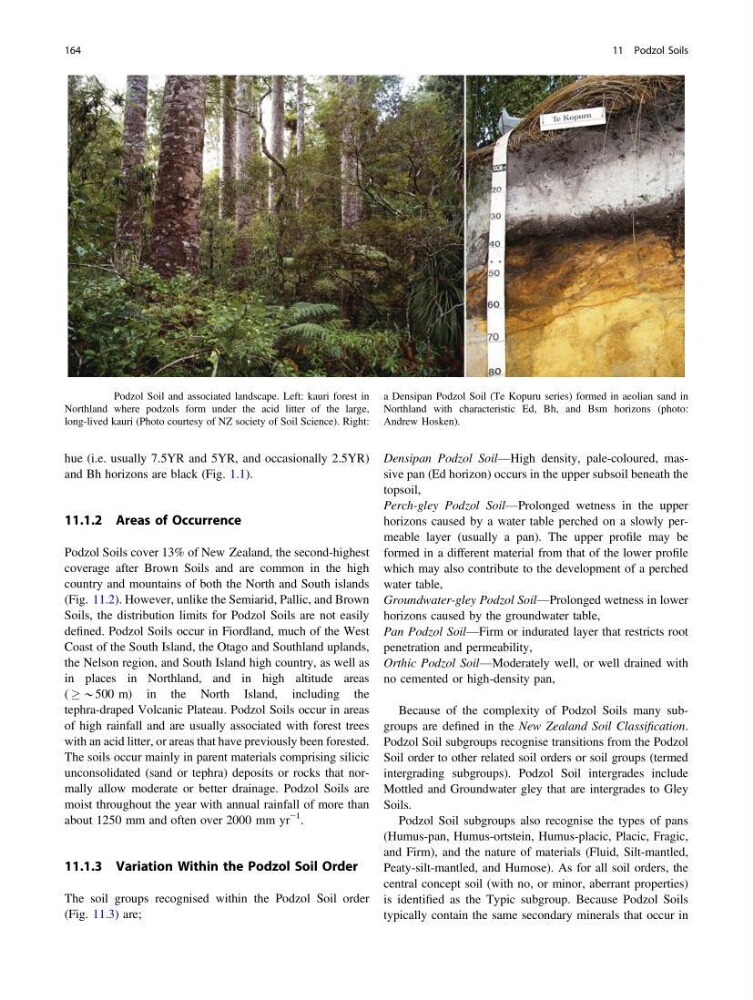
Fig. 11.1 Podzol Soil and associated landscape. Left: kauri forest in
Northland where podzols form under the acid litter of the large,
long-lived kauri (Photo courtesy of NZ society of Soil Science). Right:
a Densipan Podzol Soil (Te Kopuru series) formed in aeolian sand in
Northland with characteristic Ed, Bh, and Bsm horizons (photo:
Andrew Hosken).
hue (i.e. usually 7.5YR and 5YR, and occasionally 2.5YR)
and Bh horizons are black (Fig. 1.1).
11.1.2 Areas of Occurrence
Podzol Soils cover 13% of New Zealand, the second-highest
coverage after Brown Soils and are common in the high
country and mountains of both the North and South islands
(Fig. 11.2). However, unlike the Semiarid, Pallic, and Brown
Soils, the distribution limits for Podzol Soils are not easily
defined. Podzol Soils occur in Fiordland, much of the West
Coast of the South Island, the Otago and Southland uplands,
the Nelson region, and South Island high country, as well as
in places in Northland, and in high altitude areas
( *500 m) in the North Island, including the
tephra-draped Volcanic Plateau. Podzol Soils occur in areas
of high rainfall and are usually associated with forest trees
with an acid litter, or areas that have previously been forested.
The soils occur mainly in parent materials comprising silicic
unconsolidated (sand or tephra) deposits or rocks that normally allow moderate or better drainage. Podzol Soils are
moist throughout the year with annual rainfall of more than
about 1250 mm and often over 2000 mm yr
−1 .
11.1.3 Variation Within the Podzol Soil Order
The soil groups recognised within the Podzol Soil order
(Fig. 11.3) are;
Densipan Podzol Soil—High density, pale-coloured, massive pan (Ed horizon) occurs in the upper subsoil beneath the
topsoil,
Perch-gley Podzol Soil—Prolonged wetness in the upper
horizons caused by a water table perched on a slowly permeable layer (usually a pan). The upper profile may be
formed in a different material from that of the lower profile
which may also contribute to the development of a perched
water table,
Groundwater-gley Podzol Soil—Prolonged wetness in lower
horizons caused by the groundwater table,
Pan Podzol Soil—Firm or indurated layer that restricts root
penetration and permeability,
Orthic Podzol Soil—Moderately well, or well drained with
no cemented or high-density pan,
Because of the complexity of Podzol Soils many subgroups are defined in the New Zealand Soil Classification.
Podzol Soil subgroups recognise transitions from the Podzol
Soil order to other related soil orders or soil groups (termed
intergrading subgroups). Podzol Soil intergrades include
Mottled and Groundwater gley that are intergrades to Gley
Soils.
Podzol Soil subgroups also recognise the types of pans
(Humus-pan, Humus-ortstein, Humus-placic, Placic, Fragic,
and Firm), and the nature of materials (Fluid, Silt-mantled,
Peaty-silt-mantled, and Humose). As for all soil orders, the
central concept soil (with no, or minor, aberrant properties)
is identified as the Typic subgroup. Because Podzol Soils
typically contain the same secondary minerals that occur in
164
11 Podzol Soils
Northland where podzols form under the acid litter of the large,
long-lived kauri (Photo courtesy of NZ society of Soil Science). Right:
a Densipan Podzol Soil (Te Kopuru series) formed in aeolian sand in
Northland with characteristic Ed, Bh, and Bsm horizons (photo:
Andrew Hosken).
hue (i.e. usually 7.5YR and 5YR, and occasionally 2.5YR)
and Bh horizons are black (Fig. 1.1).
11.1.2 Areas of Occurrence
Podzol Soils cover 13% of New Zealand, the second-highest
coverage after Brown Soils and are common in the high
country and mountains of both the North and South islands
(Fig. 11.2). However, unlike the Semiarid, Pallic, and Brown
Soils, the distribution limits for Podzol Soils are not easily
defined. Podzol Soils occur in Fiordland, much of the West
Coast of the South Island, the Otago and Southland uplands,
the Nelson region, and South Island high country, as well as
in places in Northland, and in high altitude areas
( *500 m) in the North Island, including the
tephra-draped Volcanic Plateau. Podzol Soils occur in areas
of high rainfall and are usually associated with forest trees
with an acid litter, or areas that have previously been forested.
The soils occur mainly in parent materials comprising silicic
unconsolidated (sand or tephra) deposits or rocks that normally allow moderate or better drainage. Podzol Soils are
moist throughout the year with annual rainfall of more than
about 1250 mm and often over 2000 mm yr
−1 .
11.1.3 Variation Within the Podzol Soil Order
The soil groups recognised within the Podzol Soil order
(Fig. 11.3) are;
Densipan Podzol Soil—High density, pale-coloured, massive pan (Ed horizon) occurs in the upper subsoil beneath the
topsoil,
Perch-gley Podzol Soil—Prolonged wetness in the upper
horizons caused by a water table perched on a slowly permeable layer (usually a pan). The upper profile may be
formed in a different material from that of the lower profile
which may also contribute to the development of a perched
water table,
Groundwater-gley Podzol Soil—Prolonged wetness in lower
horizons caused by the groundwater table,
Pan Podzol Soil—Firm or indurated layer that restricts root
penetration and permeability,
Orthic Podzol Soil—Moderately well, or well drained with
no cemented or high-density pan,
Because of the complexity of Podzol Soils many subgroups are defined in the New Zealand Soil Classification.
Podzol Soil subgroups recognise transitions from the Podzol
Soil order to other related soil orders or soil groups (termed
intergrading subgroups). Podzol Soil intergrades include
Mottled and Groundwater gley that are intergrades to Gley
Soils.
Podzol Soil subgroups also recognise the types of pans
(Humus-pan, Humus-ortstein, Humus-placic, Placic, Fragic,
and Firm), and the nature of materials (Fluid, Silt-mantled,
Peaty-silt-mantled, and Humose). As for all soil orders, the
central concept soil (with no, or minor, aberrant properties)
is identified as the Typic subgroup. Because Podzol Soils
typically contain the same secondary minerals that occur in
164
11 Podzol Soils