

and restricted root depth. Root exploration is limited
(although less so in the Immature, Laminar, and Argillic
Pallic groups), especially in subsoils with low porosity. The
subsoil macro-porosity is frequently less than 10% and
strongly restricts root aeration, and access to plant available
water in dry periods. The same horizons that limit root
penetration also limit water movement and hence perched
water tables often form in winter and spring. Infiltration rates
and hydraulic conductivities in the fragipans are very low
(1 mm hr
−1 ) to nil.
There is a high potential for slaking and dispersion in B
horizons in most Pallic Soils. On the other hand, silica
cementation is common in Duric Pallic Soils. Fragipans are
generally regarded as uncemented but are relatively stable as
a result of their high density and tight particle packing. Alan
Palmer reports that some Pallic Soils (Tokomaru) can have a
cemented iron pan c. 5–10 cm thick (ortstein-pan) at around
40–50 cm depth in addition to a dense fragipan below c. 70–
80 cm.
10.4.3 Chemical Properties
The moderate pH, low carbon content, and low phosphorus
retention (Fig. 10.10 and Table 10.2) all attest to the generally low leaching and weak weathering of Pallic Soils.
Subsoil pH values are slightly to moderately acid. The pH of
topsoil is, as with base saturation, strongly affected by fertiliser use. The cation exchange capacities of Pallic Soils are
generally medium in topsoils and low in subsoils. Base
saturation values in subsoils are generally medium with most
values more than 50%, except in perch-gleyed soils, where
values may be lower in horizons overlying fragipans.
Total P values are all very high, indicating the low
weathering of the soil and parent material. A high proportion
of the inorganic phosphorus is readily available
(non-occluded) and a relatively high proportion of total
phosphorus is in an organic form. P retention values are low
(usually <30% in topsoils and subsoils) because of weak soil
weathering and low contents of secondary iron oxides—as
indicated by pale soil colours. The low P retention (an
indicator of anion exchange) limits sulphur adsorption. An
important sulphur input is by atmospheric deposition with
higher amounts nearer the coast.
KCl-extractable-Al values are predominantly very low,
except for high values in some of the Perch-gley Pallic
and Duric Pallic Soils where some values are >2
cmol
(+) kg
−1 .
Although New Zealand soils are generally not impacted
by sodium accumulation, significant sodium saturation ratios
occur in many soils that have fragipans or duripans, particularly in coastal land, and in an argillic group in Marlborough. Calcium carbonate is not normally present in New
Zealand’s loess parent materials apart from a few exceptions
(see grey text box and Sect. 10.4.1).
10.4.4 Biological Properties
The major potential impact on biological habitat in Pallic
Soils is the strong annual cycle from summer water deficit to
winter wetness. The perched water table in the upper profile
during winter often leads to anaerobic conditions which
impacts both soil microbial and fauna populations and on
plant roots. Some plants that are sensitive to wet roots, for
example, walnut trees, do not survive well on Pallic Soils
that have fragipans. Pallic Soils are frequently strongly
worm-mixed, with prominent topsoil worm casts. A distinct
worm-mixed horizon often occurs in the transition from the
A to B horizons. Topsoil earthworm activity is greatly
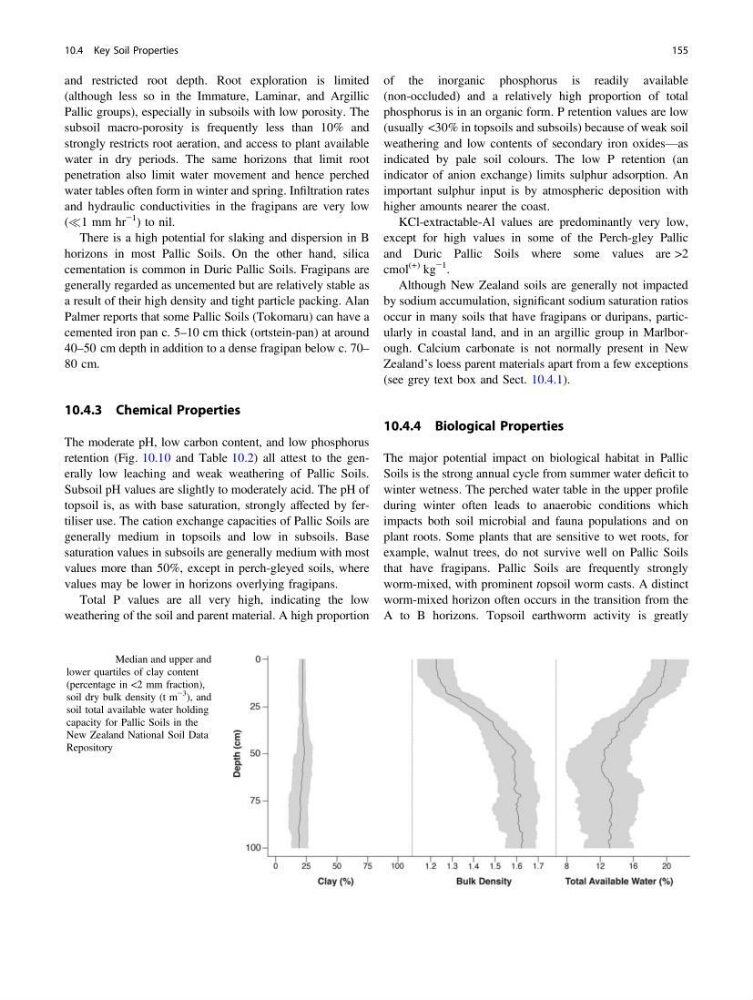
Fig. 10.9 Median and upper and
lower quartiles of clay content
(percentage in <2 mm fraction),
soil dry bulk density (t m
−3
), and
soil total available water holding
capacity for Pallic Soils in the
New Zealand National Soil Data
Repository
10.4 Key Soil Properties
155
(although less so in the Immature, Laminar, and Argillic
Pallic groups), especially in subsoils with low porosity. The
subsoil macro-porosity is frequently less than 10% and
strongly restricts root aeration, and access to plant available
water in dry periods. The same horizons that limit root
penetration also limit water movement and hence perched
water tables often form in winter and spring. Infiltration rates
and hydraulic conductivities in the fragipans are very low
(1 mm hr
−1 ) to nil.
There is a high potential for slaking and dispersion in B
horizons in most Pallic Soils. On the other hand, silica
cementation is common in Duric Pallic Soils. Fragipans are
generally regarded as uncemented but are relatively stable as
a result of their high density and tight particle packing. Alan
Palmer reports that some Pallic Soils (Tokomaru) can have a
cemented iron pan c. 5–10 cm thick (ortstein-pan) at around
40–50 cm depth in addition to a dense fragipan below c. 70–
80 cm.
10.4.3 Chemical Properties
The moderate pH, low carbon content, and low phosphorus
retention (Fig. 10.10 and Table 10.2) all attest to the generally low leaching and weak weathering of Pallic Soils.
Subsoil pH values are slightly to moderately acid. The pH of
topsoil is, as with base saturation, strongly affected by fertiliser use. The cation exchange capacities of Pallic Soils are
generally medium in topsoils and low in subsoils. Base
saturation values in subsoils are generally medium with most
values more than 50%, except in perch-gleyed soils, where
values may be lower in horizons overlying fragipans.
Total P values are all very high, indicating the low
weathering of the soil and parent material. A high proportion
of the inorganic phosphorus is readily available
(non-occluded) and a relatively high proportion of total
phosphorus is in an organic form. P retention values are low
(usually <30% in topsoils and subsoils) because of weak soil
weathering and low contents of secondary iron oxides—as
indicated by pale soil colours. The low P retention (an
indicator of anion exchange) limits sulphur adsorption. An
important sulphur input is by atmospheric deposition with
higher amounts nearer the coast.
KCl-extractable-Al values are predominantly very low,
except for high values in some of the Perch-gley Pallic
and Duric Pallic Soils where some values are >2
cmol
(+) kg
−1 .
Although New Zealand soils are generally not impacted
by sodium accumulation, significant sodium saturation ratios
occur in many soils that have fragipans or duripans, particularly in coastal land, and in an argillic group in Marlborough. Calcium carbonate is not normally present in New
Zealand’s loess parent materials apart from a few exceptions
(see grey text box and Sect. 10.4.1).
10.4.4 Biological Properties
The major potential impact on biological habitat in Pallic
Soils is the strong annual cycle from summer water deficit to
winter wetness. The perched water table in the upper profile
during winter often leads to anaerobic conditions which
impacts both soil microbial and fauna populations and on
plant roots. Some plants that are sensitive to wet roots, for
example, walnut trees, do not survive well on Pallic Soils
that have fragipans. Pallic Soils are frequently strongly
worm-mixed, with prominent topsoil worm casts. A distinct
worm-mixed horizon often occurs in the transition from the
A to B horizons. Topsoil earthworm activity is greatly
Fig. 10.9 Median and upper and
lower quartiles of clay content
(percentage in <2 mm fraction),
soil dry bulk density (t m
−3
), and
soil total available water holding
capacity for Pallic Soils in the
New Zealand National Soil Data
Repository
10.4 Key Soil Properties
155