

are dry in summer and many have an annual water deficit of
about 90–200 mm. However, the soils may be wet in winter
or spring when a surplus of soil water is common. Pallic
Soils have pale-coloured subsoils, primarily because of low
contents of iron oxides. In Pallic Soils that have a winter/
spring perched water table, the consequent gleying also
contributes to the pale colours.
As a result of the loess-dominated parent material, Pallic
Soils typically have silt loam textures, weak structure, low
porosities, and dense subsoils. In some situations, a distinct, high bulk density pan, called a fragipan, forms in the
subsoil. The fragipan may be over a metre thick and generally has a distinct extremely coarse prismatic structure
with grey, gleyed, material in the cracks between the
prisms, sometimes with reddish, oxidised, material on the
aggregate surfaces where oxygen moves down open cracks
during summer dry periods. Under pasture, topsoils are
dark coloured and distinct. The B horizons often contain
evidence of clay movement (translocation) down the profile
with clay coatings on ped surfaces in lower horizons. In
soils with a fragipan, a perched water table often forms
above the fragipan in winter. The resulting anaerobic
conditions lead to gleying in the upper B horizons with
mottles and/or a net-like (gammate or reticulate) pattern of
pale grey veins evident. The degree of gammation and
gleying increases with increasing rainfall.
10.1.2 Areas of Occurrence
Pallic Soils cover 12% of New Zealand (Fig. 10.2) and are
the third-most commonly occurring soil order in New
Zealand (after Brown and Podzol Soils). In the North Island
they stretch from East Cape, southward along the east coast
to the Wairarapa, and from the Manawatu to the Kapiti
Coast. In the South Island, Pallic Soils occur through coastal
Nelson, Marlborough, Canterbury, Otago, and Southland.
Pallic Soils form predominantly on lower altitude rolling
hills and terraces. They are prominent in plains, downlands,
and inland basins and are also extensive in dry hill country.
10.1.3 Variation Within the Pallic Soil Order
Six soil groups are recognised within the Pallic Soil order
(Fig. 10.3):
Perch-gley Pallic Soils—prolonged periodic wetness caused
by a perched water table,
Duric Pallic Soils—silica-cemented pan (duripan) in the
subsoil,
Fragic Pallic Soils—a dense, brittle fragipan in the subsoil,
Laminar Pallic Soils—clay accumulation (via translocation)
as thin subsoil bands (lamellae),
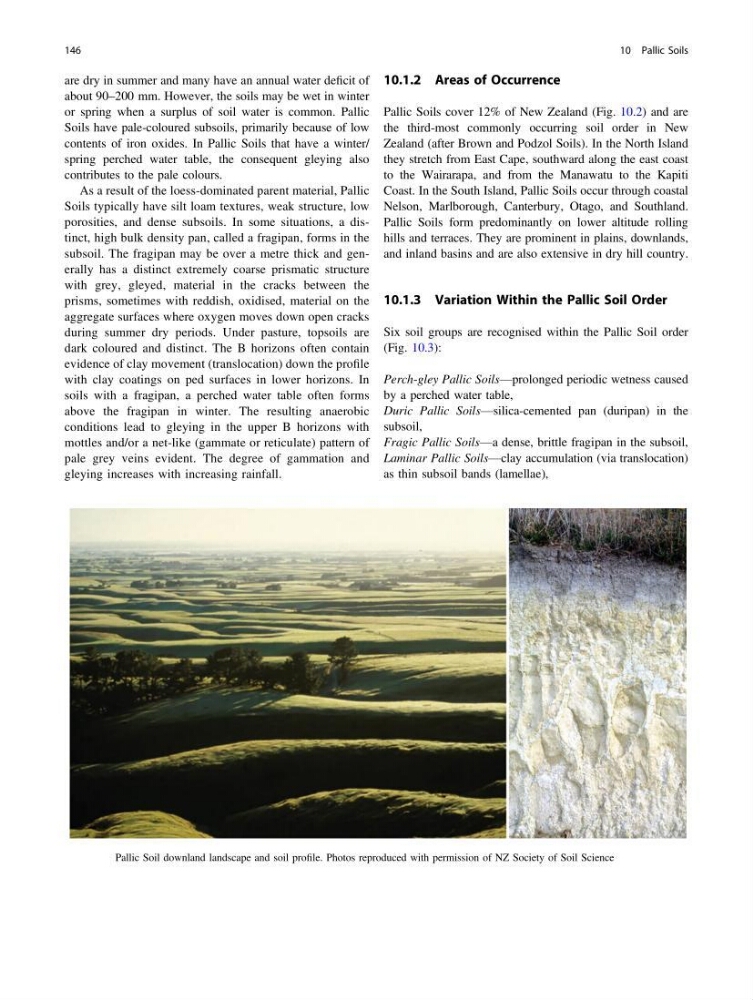
Fig. 10.1 Pallic Soil downland landscape and soil profile. Photos reproduced with permission of NZ Society of Soil Science
146
10 Pallic Soils
about 90–200 mm. However, the soils may be wet in winter
or spring when a surplus of soil water is common. Pallic
Soils have pale-coloured subsoils, primarily because of low
contents of iron oxides. In Pallic Soils that have a winter/
spring perched water table, the consequent gleying also
contributes to the pale colours.
As a result of the loess-dominated parent material, Pallic
Soils typically have silt loam textures, weak structure, low
porosities, and dense subsoils. In some situations, a distinct, high bulk density pan, called a fragipan, forms in the
subsoil. The fragipan may be over a metre thick and generally has a distinct extremely coarse prismatic structure
with grey, gleyed, material in the cracks between the
prisms, sometimes with reddish, oxidised, material on the
aggregate surfaces where oxygen moves down open cracks
during summer dry periods. Under pasture, topsoils are
dark coloured and distinct. The B horizons often contain
evidence of clay movement (translocation) down the profile
with clay coatings on ped surfaces in lower horizons. In
soils with a fragipan, a perched water table often forms
above the fragipan in winter. The resulting anaerobic
conditions lead to gleying in the upper B horizons with
mottles and/or a net-like (gammate or reticulate) pattern of
pale grey veins evident. The degree of gammation and
gleying increases with increasing rainfall.
10.1.2 Areas of Occurrence
Pallic Soils cover 12% of New Zealand (Fig. 10.2) and are
the third-most commonly occurring soil order in New
Zealand (after Brown and Podzol Soils). In the North Island
they stretch from East Cape, southward along the east coast
to the Wairarapa, and from the Manawatu to the Kapiti
Coast. In the South Island, Pallic Soils occur through coastal
Nelson, Marlborough, Canterbury, Otago, and Southland.
Pallic Soils form predominantly on lower altitude rolling
hills and terraces. They are prominent in plains, downlands,
and inland basins and are also extensive in dry hill country.
10.1.3 Variation Within the Pallic Soil Order
Six soil groups are recognised within the Pallic Soil order
(Fig. 10.3):
Perch-gley Pallic Soils—prolonged periodic wetness caused
by a perched water table,
Duric Pallic Soils—silica-cemented pan (duripan) in the
subsoil,
Fragic Pallic Soils—a dense, brittle fragipan in the subsoil,
Laminar Pallic Soils—clay accumulation (via translocation)
as thin subsoil bands (lamellae),
Fig. 10.1 Pallic Soil downland landscape and soil profile. Photos reproduced with permission of NZ Society of Soil Science
146
10 Pallic Soils