

hazards to vehicles and trains. Buildings on peat material are
usually built on piles (that reach through to the underlying
mineral substrate) or on a concrete base designed to ‘float’
on the surface of the peat. Pre-loading with large piles of
rock materials to compress sites is now commonly undertaken for months, if not years, before road construction is
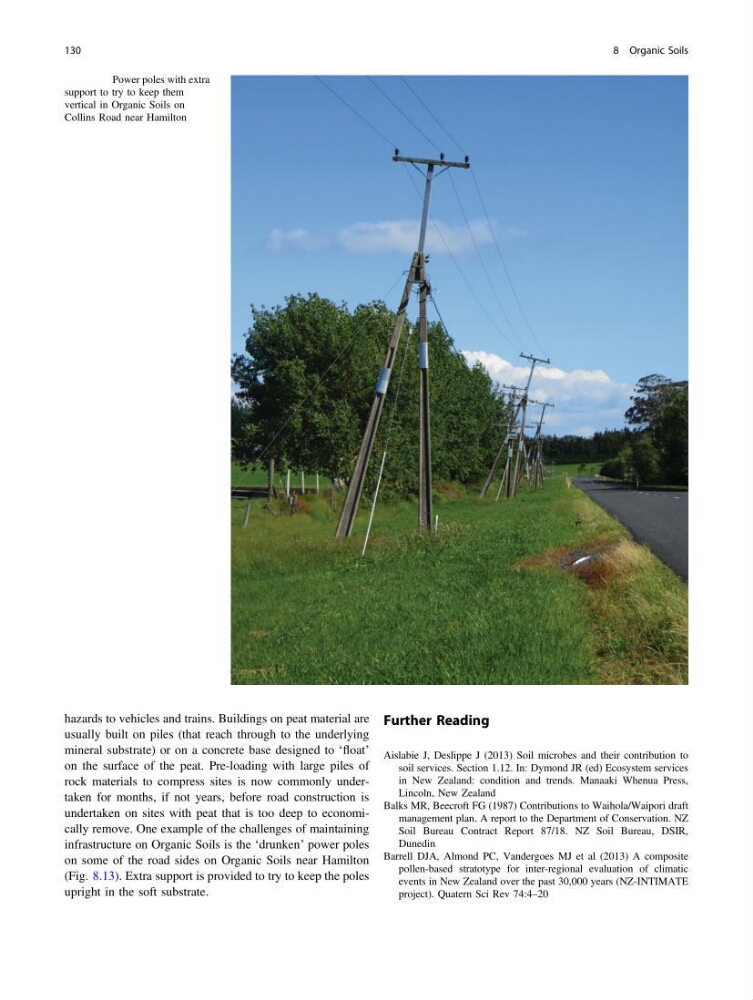
undertaken on sites with peat that is too deep to economically remove. One example of the challenges of maintaining
infrastructure on Organic Soils is the ‘drunken’ power poles
on some of the road sides on Organic Soils near Hamilton
(Fig. 8.13). Extra support is provided to try to keep the poles
upright in the soft substrate.
Further Reading
Aislabie J, Deslippe J (2013) Soil microbes and their contribution to
soil services. Section 1.12. In: Dymond JR (ed) Ecosystem services
in New Zealand: condition and trends. Manaaki Whenua Press,
Lincoln, New Zealand
Balks MR, Beecroft FG (1987) Contributions to Waihola/Waipori draft
management plan. A report to the Department of Conservation. NZ
Soil Bureau Contract Report 87/18. NZ Soil Bureau, DSIR,
Dunedin
Barrell DJA, Almond PC, Vandergoes MJ et al (2013) A composite
pollen-based stratotype for inter-regional evaluation of climatic
events in New Zealand over the past 30,000 years (NZ-INTIMATE
project). Quatern Sci Rev 74:4–20
Fig. 8.13 Power poles with extra
support to try to keep them
vertical in Organic Soils on
Collins Road near Hamilton
130
8 Organic Soils
usually built on piles (that reach through to the underlying
mineral substrate) or on a concrete base designed to ‘float’
on the surface of the peat. Pre-loading with large piles of
rock materials to compress sites is now commonly undertaken for months, if not years, before road construction is
undertaken on sites with peat that is too deep to economically remove. One example of the challenges of maintaining
infrastructure on Organic Soils is the ‘drunken’ power poles
on some of the road sides on Organic Soils near Hamilton
(Fig. 8.13). Extra support is provided to try to keep the poles
upright in the soft substrate.
Further Reading
Aislabie J, Deslippe J (2013) Soil microbes and their contribution to
soil services. Section 1.12. In: Dymond JR (ed) Ecosystem services
in New Zealand: condition and trends. Manaaki Whenua Press,
Lincoln, New Zealand
Balks MR, Beecroft FG (1987) Contributions to Waihola/Waipori draft
management plan. A report to the Department of Conservation. NZ
Soil Bureau Contract Report 87/18. NZ Soil Bureau, DSIR,
Dunedin
Barrell DJA, Almond PC, Vandergoes MJ et al (2013) A composite
pollen-based stratotype for inter-regional evaluation of climatic
events in New Zealand over the past 30,000 years (NZ-INTIMATE
project). Quatern Sci Rev 74:4–20
Fig. 8.13 Power poles with extra
support to try to keep them
vertical in Organic Soils on
Collins Road near Hamilton
130
8 Organic Soils