

main limit to biodegradation of plant materials—air is
replaced by stagnant or slowly moving water. The process is
sometimes called paludisation (from the Latin palus meaning
swamp or marsh). In forest litter environments, such as under
kauri or pine trees, it is most often the availability of nutrients, especially nitrogen, along with low pH, and sometimes
also lack of moisture, which limit biodegradation. Thus
Organic Soils form where limits to degradation of plant
material lead to organic matter accumulation. Plant materials
that may accumulate to form Organic Soils vary widely from
soft-tissue sphagnum and rush to woody material.
Many Organic Soils form as a natural progression from a
lake or wetland where water lies permanently on the ground
surface. Plants may grow in or near the shallow water
margins and gradually fall into the water. When they start to
decompose, the microbes deplete the available oxygen, and
thus the degradation process slows or stops and the plant
materials gradually accumulate. Plants tolerant of the wet,
nutrient-poor environment become established on the surface and, in turn, eventually become incorporated into the
peat. Over a long period, shallow lakes may be gradually
infilled as the peat material accumulates around the lake
margins developing zones of ‘quaking bog’, ultimately
leading to extinction of the lake. Thus there may be a progression from a lake to a mire then ultimately, if climatic
conditions are suitable, to a raised bog.
However, infilling and extinction do not always occur and
some lakes that have been in existence for *20,000 years or
more can remain open despite being surrounded by peat, as
is evident in some of the Waikato peat lakes such as Lake
Maratoto near Hamilton (Sect. 8.3.2). Counterintuitively,
John Green and David Lowe showed that Maratoto maintained its area and increased in depth despite massive peat
growth in the catchment. To explain this unusual status, they
suggested that the lake receives mineral- and nutrient-rich
water from adjacent land that has enhanced microbial
breakdown of encroaching peat; wind-induced wave action
(produced by prevailing southwest and northerly winds)
causes erosion of peat margins especially at the north and
south ends of the lake; and wind-induced currents stir and
aerate the lake waters for most of the year and so the lake
waters are usually saturated with oxygen which will enhance
organic breakdown.
It is often possible to date materials within an Organic
Soil profile using radiocarbon dating, and in North Island
identification of tephras of known ages within the peat
(tephrochronology), to gain an estimate of the rate and
timing of peat accumulation. Such methods may also help to
determine the rate of subsidence following drainage. Soil
organic matter decomposition is important as it is part of the
process of cycling materials from dead organisms and
releasing the nutrients to support new life. This process is
true of all soils, but especially Organic Soils because the
outputs of partial decomposition produce the very substance
of the soil material itself. Decomposition is the breakdown
of dead plant material and biochemical transformation of
complex organic molecules into simpler inorganic molecules. The process releases methane, carbon dioxide, and
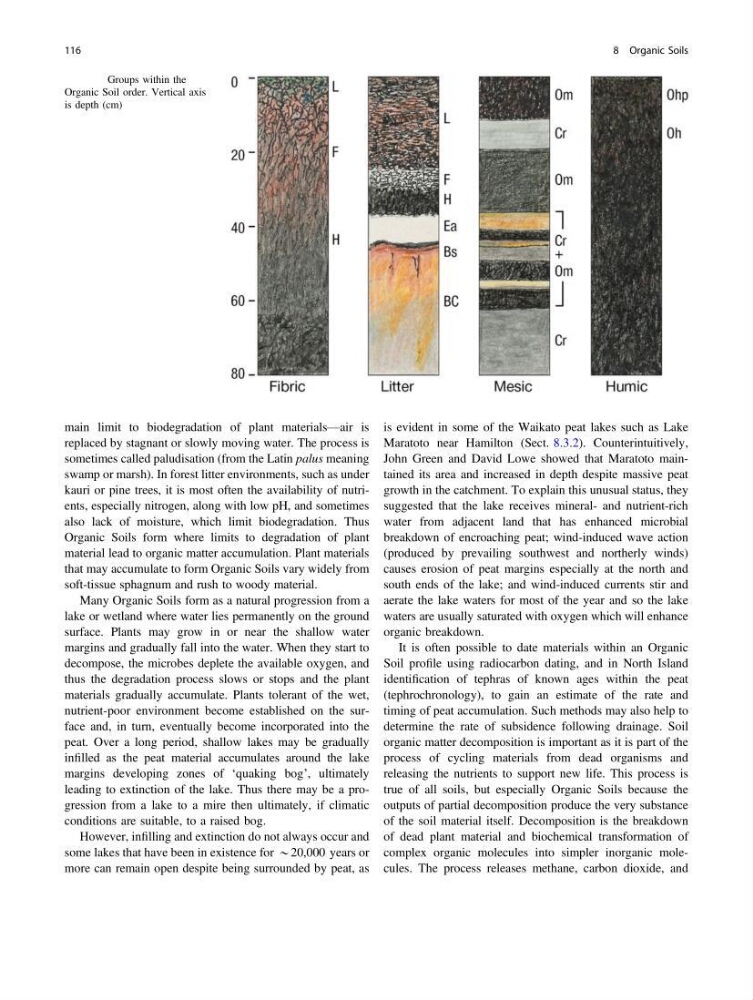
Fig. 8.3 Groups within the
Organic Soil order. Vertical axis
is depth (cm)
116
8 Organic Soils
replaced by stagnant or slowly moving water. The process is
sometimes called paludisation (from the Latin palus meaning
swamp or marsh). In forest litter environments, such as under
kauri or pine trees, it is most often the availability of nutrients, especially nitrogen, along with low pH, and sometimes
also lack of moisture, which limit biodegradation. Thus
Organic Soils form where limits to degradation of plant
material lead to organic matter accumulation. Plant materials
that may accumulate to form Organic Soils vary widely from
soft-tissue sphagnum and rush to woody material.
Many Organic Soils form as a natural progression from a
lake or wetland where water lies permanently on the ground
surface. Plants may grow in or near the shallow water
margins and gradually fall into the water. When they start to
decompose, the microbes deplete the available oxygen, and
thus the degradation process slows or stops and the plant
materials gradually accumulate. Plants tolerant of the wet,
nutrient-poor environment become established on the surface and, in turn, eventually become incorporated into the
peat. Over a long period, shallow lakes may be gradually
infilled as the peat material accumulates around the lake
margins developing zones of ‘quaking bog’, ultimately
leading to extinction of the lake. Thus there may be a progression from a lake to a mire then ultimately, if climatic
conditions are suitable, to a raised bog.
However, infilling and extinction do not always occur and
some lakes that have been in existence for *20,000 years or
more can remain open despite being surrounded by peat, as
is evident in some of the Waikato peat lakes such as Lake
Maratoto near Hamilton (Sect. 8.3.2). Counterintuitively,
John Green and David Lowe showed that Maratoto maintained its area and increased in depth despite massive peat
growth in the catchment. To explain this unusual status, they
suggested that the lake receives mineral- and nutrient-rich
water from adjacent land that has enhanced microbial
breakdown of encroaching peat; wind-induced wave action
(produced by prevailing southwest and northerly winds)
causes erosion of peat margins especially at the north and
south ends of the lake; and wind-induced currents stir and
aerate the lake waters for most of the year and so the lake
waters are usually saturated with oxygen which will enhance
organic breakdown.
It is often possible to date materials within an Organic
Soil profile using radiocarbon dating, and in North Island
identification of tephras of known ages within the peat
(tephrochronology), to gain an estimate of the rate and
timing of peat accumulation. Such methods may also help to
determine the rate of subsidence following drainage. Soil
organic matter decomposition is important as it is part of the
process of cycling materials from dead organisms and
releasing the nutrients to support new life. This process is
true of all soils, but especially Organic Soils because the
outputs of partial decomposition produce the very substance
of the soil material itself. Decomposition is the breakdown
of dead plant material and biochemical transformation of
complex organic molecules into simpler inorganic molecules. The process releases methane, carbon dioxide, and
Fig. 8.3 Groups within the
Organic Soil order. Vertical axis
is depth (cm)
116
8 Organic Soils