

2.4 General Applications of Bioactive Natural Products
2.4.1 Traditional Medicine
The practise of traditional medicine is worldwide in spread, China, Japan, India,
Pakistan, Thailand and Sri Lanka inclusive. Folklore and traditional systems of
medicine bequeathed from generation to generation is rich in domestic recipes and
communal practice. Medicinal plants have the great potential used in various traditional systems of medicine like in the Ayurveda, Siddha, Unani, in the Tibetan, in
the Srilankan, and in the Homeopathy systems of alternative and complementary
medicine (Meenupriya et al. 2014). The best known examples of traditional medicine, differing in concept and protocol, are well-developed systems such as ayurvedic and acupuncture medicine that have been widely used to conserve human
health in India, China and native Indians from Brazil in the Amazonian region
(Meenupriya et al. 2014). In Chinese medicinal folk practice, the search for new
medicines to treat emergent and old diseases such as AIDS and malaria, attention is
now being geared towards discovering the active ingredients encountered in the
treasury of over 5,000 Chinese plants, herbs and roots that have been used routinely
and traditionally. Chaihu and Quinghaosu are two such examples. Whereas the
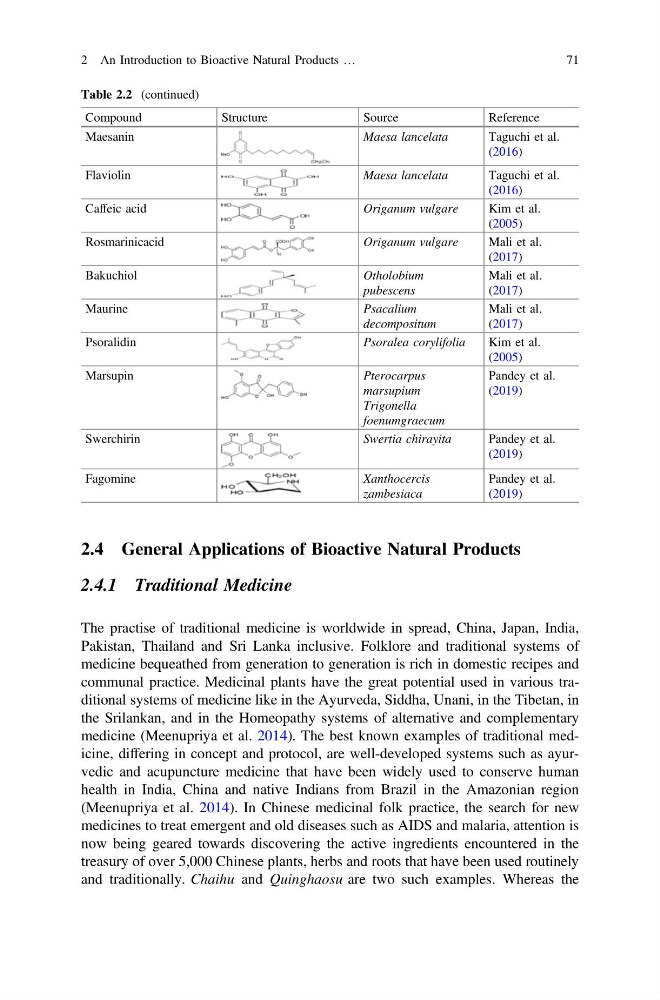
Table 2.2 (continued)
Compound
Structure
Source
Reference
Maesanin
Maesa lancelata
Taguchi et al.
(2016)
Flaviolin
Maesa lancelata
Taguchi et al.
(2016)
Caffeic acid
Origanum vulgare
Kim et al.
(2005)
Rosmarinicacid
Origanum vulgare
Mali et al.
(2017)
Bakuchiol
Otholobium
pubescens
Mali et al.
(2017)
Maurine
Psacalium
decompositum
Mali et al.
(2017)
Psoralidin
Psoralea corylifolia
Kim et al.
(2005)
Marsupin
Pterocarpus
marsupium
Trigonella
foenumgraecum
Pandey et al.
(2019)
Swerchirin
Swertia chirayita
Pandey et al.
(2019)
Fagomine
Xanthocercis
zambesiaca
Pandey et al.
(2019)
2 An Introduction to Bioactive Natural Products …
71
2.4.1 Traditional Medicine
The practise of traditional medicine is worldwide in spread, China, Japan, India,
Pakistan, Thailand and Sri Lanka inclusive. Folklore and traditional systems of
medicine bequeathed from generation to generation is rich in domestic recipes and
communal practice. Medicinal plants have the great potential used in various traditional systems of medicine like in the Ayurveda, Siddha, Unani, in the Tibetan, in
the Srilankan, and in the Homeopathy systems of alternative and complementary
medicine (Meenupriya et al. 2014). The best known examples of traditional medicine, differing in concept and protocol, are well-developed systems such as ayurvedic and acupuncture medicine that have been widely used to conserve human
health in India, China and native Indians from Brazil in the Amazonian region
(Meenupriya et al. 2014). In Chinese medicinal folk practice, the search for new
medicines to treat emergent and old diseases such as AIDS and malaria, attention is
now being geared towards discovering the active ingredients encountered in the
treasury of over 5,000 Chinese plants, herbs and roots that have been used routinely
and traditionally. Chaihu and Quinghaosu are two such examples. Whereas the
Table 2.2 (continued)
Compound
Structure
Source
Reference
Maesanin
Maesa lancelata
Taguchi et al.
(2016)
Flaviolin
Maesa lancelata
Taguchi et al.
(2016)
Caffeic acid
Origanum vulgare
Kim et al.
(2005)
Rosmarinicacid
Origanum vulgare
Mali et al.
(2017)
Bakuchiol
Otholobium
pubescens
Mali et al.
(2017)
Maurine
Psacalium
decompositum
Mali et al.
(2017)
Psoralidin
Psoralea corylifolia
Kim et al.
(2005)
Marsupin
Pterocarpus
marsupium
Trigonella
foenumgraecum
Pandey et al.
(2019)
Swerchirin
Swertia chirayita
Pandey et al.
(2019)
Fagomine
Xanthocercis
zambesiaca
Pandey et al.
(2019)
2 An Introduction to Bioactive Natural Products …
71