

are used for amplifying the GABA production. Few such synthetic methods are
given below:
Usually, GABA is synthesized using 4-bromobutyric acid ester with pthalimide
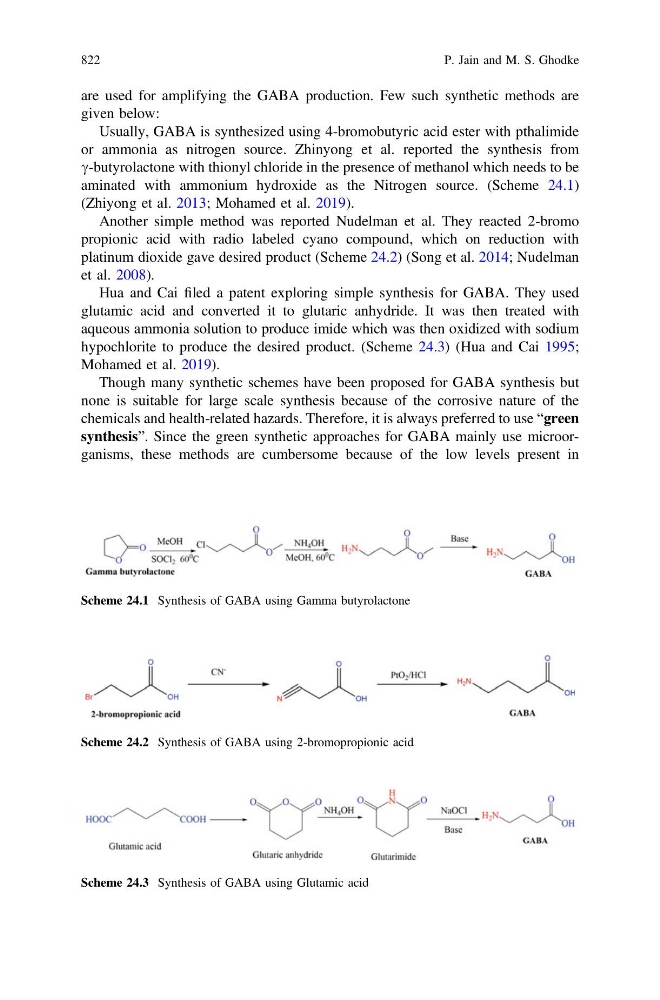
or ammonia as nitrogen source. Zhinyong et al. reported the synthesis from
c-butyrolactone with thionyl chloride in the presence of methanol which needs to be
aminated with ammonium hydroxide as the Nitrogen source. (Scheme 24.1)
(Zhiyong et al. 2013; Mohamed et al. 2019).
Another simple method was reported Nudelman et al. They reacted 2-bromo
propionic acid with radio labeled cyano compound, which on reduction with
platinum dioxide gave desired product (Scheme 24.2) (Song et al. 2014; Nudelman
et al. 2008).
Hua and Cai filed a patent exploring simple synthesis for GABA. They used
glutamic acid and converted it to glutaric anhydride. It was then treated with
aqueous ammonia solution to produce imide which was then oxidized with sodium
hypochlorite to produce the desired product. (Scheme 24.3) (Hua and Cai 1995;
Mohamed et al. 2019).
Though many synthetic schemes have been proposed for GABA synthesis but
none is suitable for large scale synthesis because of the corrosive nature of the
chemicals and health-related hazards. Therefore, it is always preferred to use “green
synthesis”. Since the green synthetic approaches for GABA mainly use microorganisms, these methods are cumbersome because of the low levels present in
Scheme 24.1 Synthesis of GABA using Gamma butyrolactone
Scheme 24.2 Synthesis of GABA using 2-bromopropionic acid
Scheme 24.3 Synthesis of GABA using Glutamic acid
822
P. Jain and M. S. Ghodke