

23.1.2 Elemental Composition of Proteins
p
R
t are predominantly formed by five major elements in following proportion
Hydrogen: 6–7.3%,
Carbon: 50–55%, Nitrogen: 13–19%, Oxygen: 19–24%, Sulfur: 0–4%. Essential
A m
a are the chief constituents of p
R
t found in naturally occurring organic compounds containing A m
a and carboxyl groups, and necessary for and animal growth
and nutrition, Hence the source of essential A m
a is rich food consumption as a H
u
M
B
D
Y does not produce them. p
R
t or poly P E
pt are the substance made by A m
a which
are joined by P E
pt bonds (Millward 1999). It highlights the roles of the various A m
a
in Table 23.4.
Table 23.3 Examples of C o
Nj
T p
R
t
p
R
t
Properties
Examples
Nucleo
p
R
t
Here prosthetic group is nucleic acid, either
RNA or DNA
Nucleohistones,
nucleoprotamines
Glyco
p
R
t
Here prosthetic group is carbohydrate
Mucin (saliva), ovomucoid (egg
white)
Lipo p
R
t
Prosthetic group is lipid
Serum lipo p
R
t , membrane lipo
p
R
t
Phospho
p
R
t
Prosthetic group is phosphoric acid
Vitelline (egg yolk), Casein
(milk)
Chromo
p
R
t
It colors prosthetic group substance
Hemoglobin, cytochromes
Metallo
p
R
t
p
R
t contain metal ions such as Co, Cu, Mg,
Fe, Zn
Carbonic anhydrase (Zn),
Ceruloplasmin (Cu)
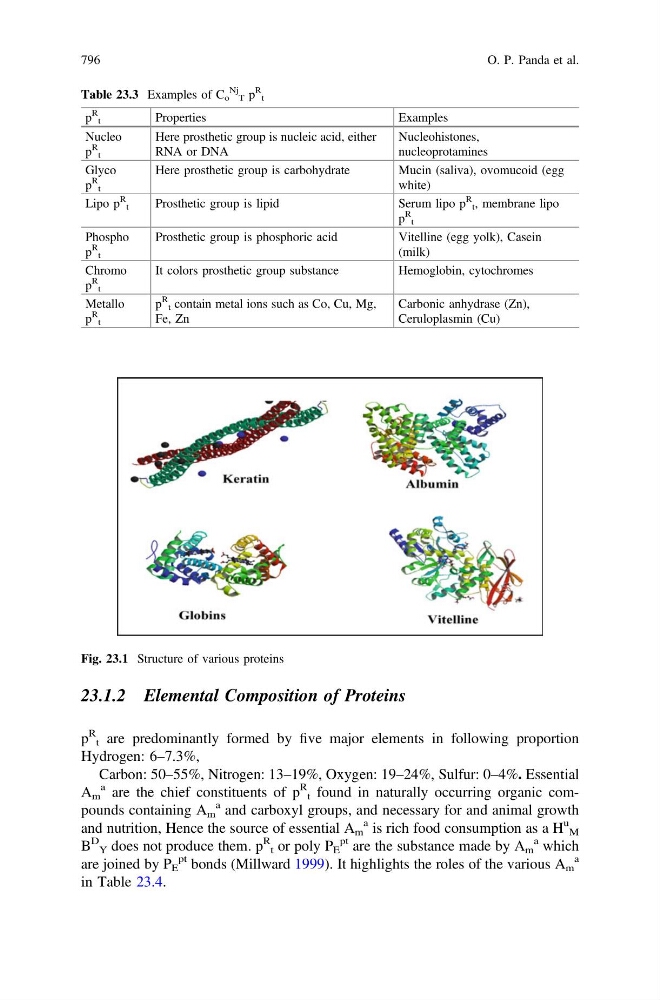
Fig. 23.1 Structure of various proteins
796
O. P. Panda et al.
p
R
t are predominantly formed by five major elements in following proportion
Hydrogen: 6–7.3%,
Carbon: 50–55%, Nitrogen: 13–19%, Oxygen: 19–24%, Sulfur: 0–4%. Essential
A m
a are the chief constituents of p
R
t found in naturally occurring organic compounds containing A m
a and carboxyl groups, and necessary for and animal growth
and nutrition, Hence the source of essential A m
a is rich food consumption as a H
u
M
B
D
Y does not produce them. p
R
t or poly P E
pt are the substance made by A m
a which
are joined by P E
pt bonds (Millward 1999). It highlights the roles of the various A m
a
in Table 23.4.
Table 23.3 Examples of C o
Nj
T p
R
t
p
R
t
Properties
Examples
Nucleo
p
R
t
Here prosthetic group is nucleic acid, either
RNA or DNA
Nucleohistones,
nucleoprotamines
Glyco
p
R
t
Here prosthetic group is carbohydrate
Mucin (saliva), ovomucoid (egg
white)
Lipo p
R
t
Prosthetic group is lipid
Serum lipo p
R
t , membrane lipo
p
R
t
Phospho
p
R
t
Prosthetic group is phosphoric acid
Vitelline (egg yolk), Casein
(milk)
Chromo
p
R
t
It colors prosthetic group substance
Hemoglobin, cytochromes
Metallo
p
R
t
p
R
t contain metal ions such as Co, Cu, Mg,
Fe, Zn
Carbonic anhydrase (Zn),
Ceruloplasmin (Cu)
Fig. 23.1 Structure of various proteins
796
O. P. Panda et al.