

20.3.2.7 Electrodynamic Processes
In recent years, electrodynamic encapsulation processes such as electrospraying and
electrospinning have received increasing attention as an alternative to the more
established and commonly employed techniques such as microencapsulation
(Alehosseini et al. 2018; Jacobsen et al. 2018). During electrospraying, the high
voltage electrostatic force converts the drug-loaded liquid solutions into fine droplets and gets evaporated during their flight toward the ground electrode
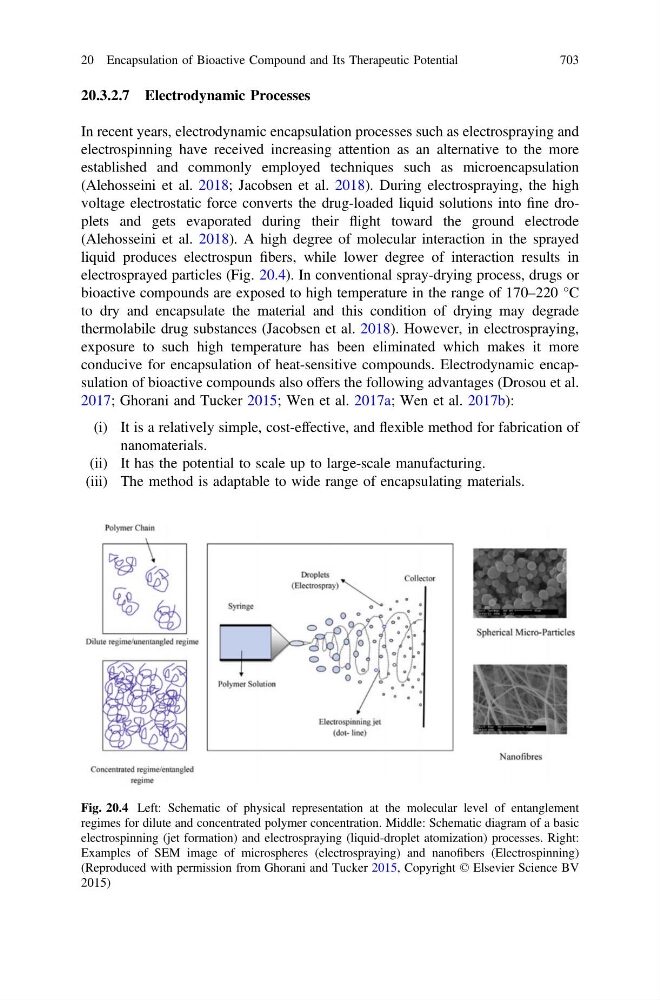
(Alehosseini et al. 2018). A high degree of molecular interaction in the sprayed
liquid produces electrospun fibers, while lower degree of interaction results in
electrosprayed particles (Fig. 20.4). In conventional spray-drying process, drugs or
bioactive compounds are exposed to high temperature in the range of 170–220 °C
to dry and encapsulate the material and this condition of drying may degrade
thermolabile drug substances (Jacobsen et al. 2018). However, in electrospraying,
exposure to such high temperature has been eliminated which makes it more
conducive for encapsulation of heat-sensitive compounds. Electrodynamic encapsulation of bioactive compounds also offers the following advantages (Drosou et al.
2017; Ghorani and Tucker 2015; Wen et al. 2017a; Wen et al. 2017b):
(i) It is a relatively simple, cost-effective, and flexible method for fabrication of
nanomaterials.
(ii) It has the potential to scale up to large-scale manufacturing.
(iii) The method is adaptable to wide range of encapsulating materials.
Fig. 20.4 Left: Schematic of physical representation at the molecular level of entanglement
regimes for dilute and concentrated polymer concentration. Middle: Schematic diagram of a basic
electrospinning (jet formation) and electrospraying (liquid-droplet atomization) processes. Right:
Examples of SEM image of microspheres (electrospraying) and nanofibers (Electrospinning)
(Reproduced with permission from Ghorani and Tucker 2015, Copyright © Elsevier Science BV
2015)
20 Encapsulation of Bioactive Compound and Its Therapeutic Potential
703