

its derivatives are used for skin emollient, hair conditioners, pleasant aroma, and
skin elasticity. Essential oils are composed of terpenoids, phenylpropanoids, and
fatty acids. Terpenoids belong to mainly mono, di, and sesquiterpenes. These largest terpenoids more than 30,000 groups are synthesized by isopentenyl diphosphate and other chemical constituents are present such as small chain alcohols and
aldehydes, it is formed by conversion of fatty acids and phospholipids. Essential
oils show different medicinal and cosmetic properties (Reddy 2019) as well as some
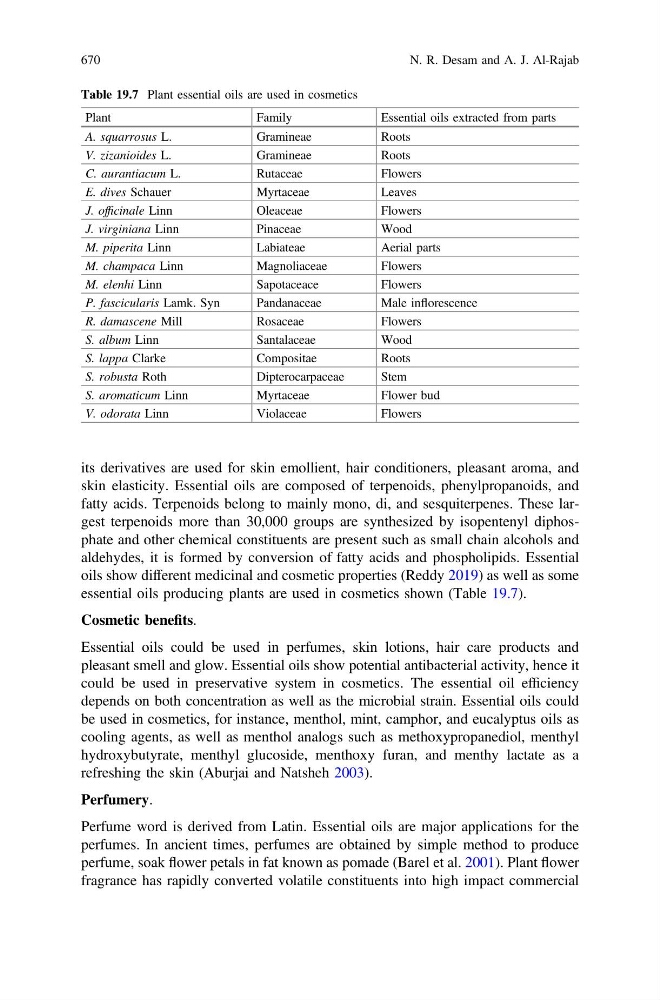
essential oils producing plants are used in cosmetics shown (Table 19.7).
Cosmetic benefits.
Essential oils could be used in perfumes, skin lotions, hair care products and
pleasant smell and glow. Essential oils show potential antibacterial activity, hence it
could be used in preservative system in cosmetics. The essential oil efficiency
depends on both concentration as well as the microbial strain. Essential oils could
be used in cosmetics, for instance, menthol, mint, camphor, and eucalyptus oils as
cooling agents, as well as menthol analogs such as methoxypropanediol, menthyl
hydroxybutyrate, menthyl glucoside, menthoxy furan, and menthy lactate as a
refreshing the skin (Aburjai and Natsheh 2003).
Perfumery.
Perfume word is derived from Latin. Essential oils are major applications for the
perfumes. In ancient times, perfumes are obtained by simple method to produce
perfume, soak flower petals in fat known as pomade (Barel et al. 2001). Plant flower
fragrance has rapidly converted volatile constituents into high impact commercial
Table 19.7 Plant essential oils are used in cosmetics
Plant
Family
Essential oils extracted from parts
A. squarrosus L.
Gramineae
Roots
V. zizanioides L.
Gramineae
Roots
C. aurantiacum L.
Rutaceae
Flowers
E. dives Schauer
Myrtaceae
Leaves
J. officinale Linn
Oleaceae
Flowers
J. virginiana Linn
Pinaceae
Wood
M. piperita Linn
Labiateae
Aerial parts
M. champaca Linn
Magnoliaceae
Flowers
M. elenhi Linn
Sapotaceace
Flowers
P. fascicularis Lamk. Syn
Pandanaceae
Male inflorescence
R. damascene Mill
Rosaceae
Flowers
S. album Linn
Santalaceae
Wood
S. lappa Clarke
Compositae
Roots
S. robusta Roth
Dipterocarpaceae
Stem
S. aromaticum Linn
Myrtaceae
Flower bud
V. odorata Linn
Violaceae
Flowers
670
N. R. Desam and A. J. Al-Rajab