

(3-hydroxyoctanoate) is a medium chain length polyhydroxyalkanoate produced by
bacterial fermentation. Poly (3-hydroxyoctanoate) polymer was found to support cell
viability, proliferation and adhesion and resembled cardiac tissues in terms of their
mechanical properties (Bagdadi et al. 2016). In another study, Mussel-inspired
conductive Ti2C cryogel was shown to promote the functional maturation of CMs
(Ye et al. 2020). The cryogel was developed as 3D vessels-shape framework and
when seeded with CMs, they remarkable aligned sarcomere with primitive intercalated disc between the CMs and showed synchronous beating. Transplanted of the
Ti2C cryogel into MI rat model, could improve cardiac function (Ye et al. 2020).
More recently, Walker et al. (2019) engineered an adhesive and electroconductive cardiac patch by electrospinning of gelatin methacryloyl (GelMA) and
conjugation of a choline-based bio-ionic liquid (Bio-IL). These patches strongly
adhered to the myocardium by forming ionic bonds and did not require suturing.
Culture of primary CMs and fibroblasts could form contractile tissue constructs and
established gap junction with superior mechanical and electroconductivity. List of
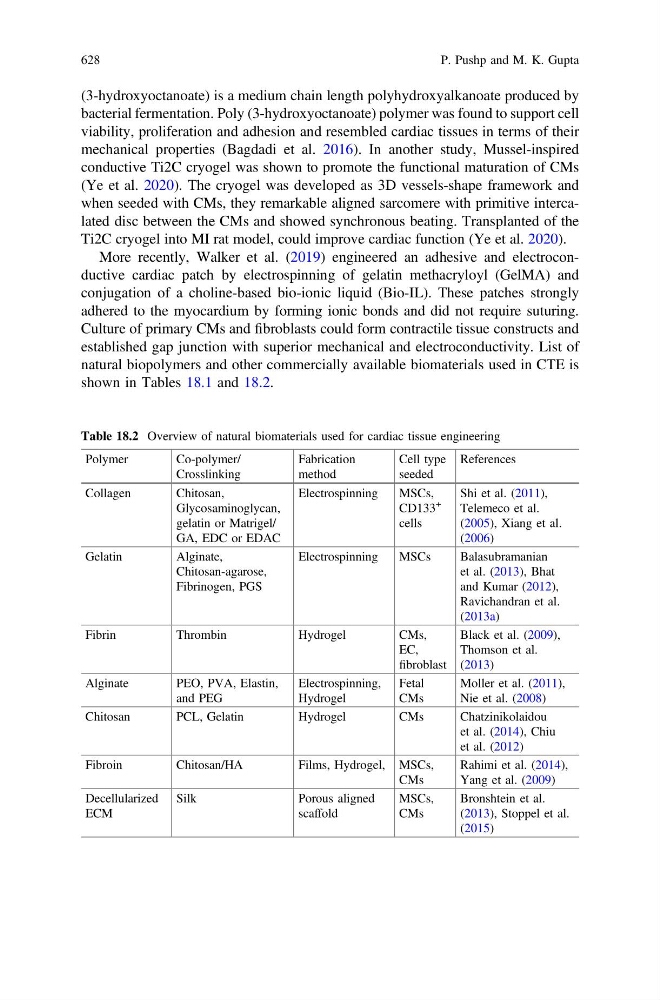
natural biopolymers and other commercially available biomaterials used in CTE is
shown in Tables 18.1 and 18.2.
Table 18.2 Overview of natural biomaterials used for cardiac tissue engineering
Polymer
Co-polymer/
Crosslinking
Fabrication
method
Cell type
seeded
References
Collagen
Chitosan,
Glycosaminoglycan,
gelatin or Matrigel/
GA, EDC or EDAC
Electrospinning
MSCs,
CD133
+
cells
Shi et al. (2011),
Telemeco et al.
(2005), Xiang et al.
(2006)
Gelatin
Alginate,
Chitosan-agarose,
Fibrinogen, PGS
Electrospinning
MSCs
Balasubramanian
et al. (2013), Bhat
and Kumar (2012),
Ravichandran et al.
(2013a)
Fibrin
Thrombin
Hydrogel
CMs,
EC,
fibroblast
Black et al. (2009),
Thomson et al.
(2013)
Alginate
PEO, PVA, Elastin,
and PEG
Electrospinning,
Hydrogel
Fetal
CMs
Moller et al. (2011),
Nie et al. (2008)
Chitosan
PCL, Gelatin
Hydrogel
CMs
Chatzinikolaidou
et al. (2014), Chiu
et al. (2012)
Fibroin
Chitosan/HA
Films, Hydrogel, MSCs,
CMs
Rahimi et al. (2014),
Yang et al. (2009)
Decellularized
ECM
Silk
Porous aligned
scaffold
MSCs,
CMs
Bronshtein et al.
(2013), Stoppel et al.
(2015)
628
P. Pushp and M. K. Gupta