

18.1 Introduction
Cardiovascular diseases (CVDs) such as myocardial infarction (MI), atherosclerosis, cardiomyopathies, heart valve diseases, and long-QT syndromes (LQTS) are the
major causes of death worldwide. They are generally associated with apoptotic and
necrotic changes in the cardiac tissue and loss of functional cardiomyocytes (CMs).
Since the self-renewal or regenerative potential of CMs is extremely limited, the
lost CMs are challenging to be compensated by therapeutic approaches. Thus,
despite significant research in diagnosis and treatment, CVDs remain major therapeutic challenges in the medical field. In recent years, cardiac tissue engineering
(CTE) has been emerging as a potential therapeutic strategy for the treatment of
CVDs. These CTE approaches involve isolation and expansion of autologous
patient cells, including stem cells such as mesenchymal stem cells (MSCs) or
induced pluripotent stem cells (iPSCs) and their differentiation into cardiac tissue
on an appropriate extracellular matrix (ECM) for in vitro incubation followed by
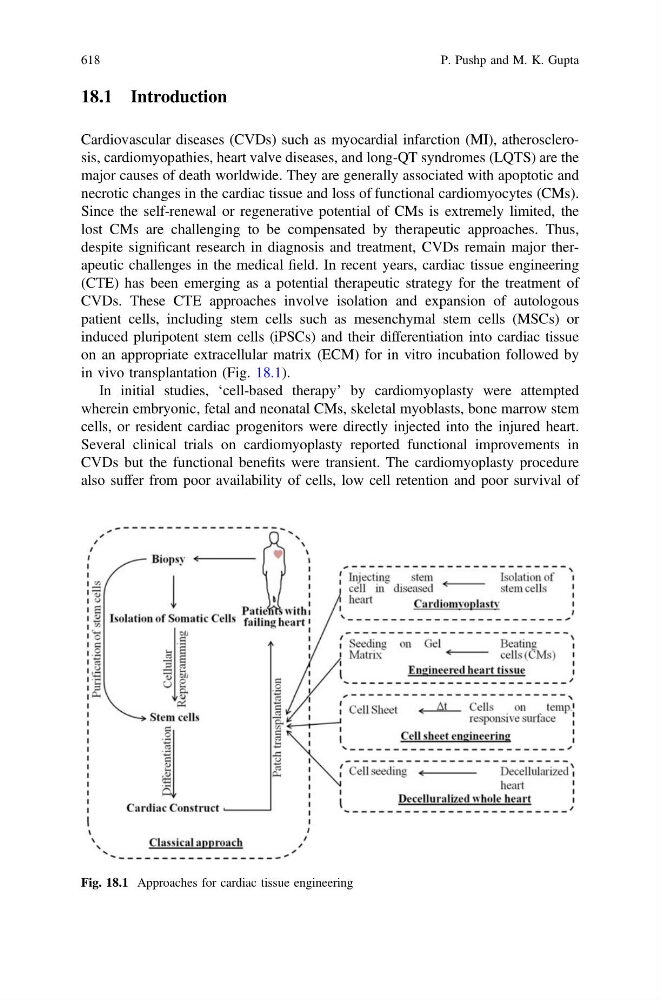
in vivo transplantation (Fig. 18.1).
In initial studies, ‘cell-based therapy’ by cardiomyoplasty were attempted
wherein embryonic, fetal and neonatal CMs, skeletal myoblasts, bone marrow stem
cells, or resident cardiac progenitors were directly injected into the injured heart.
Several clinical trials on cardiomyoplasty reported functional improvements in
CVDs but the functional benefits were transient. The cardiomyoplasty procedure
also suffer from poor availability of cells, low cell retention and poor survival of
Fig. 18.1 Approaches for cardiac tissue engineering
618
P. Pushp and M. K. Gupta