

17.2.5 Antioxidants
Today food industry has been more focused towards the development of antioxidants from the natural sources as it is a safer option in comparison to many synthetic commercial anti- oxidants. Antioxidants are those agents which prevents the
oxidation of lipids due to which there is no spoilage of food. Lipid oxidation is
caused by reactive oxygen species (ROS) e.g. hydrogen peroxide, free radicals, etc.
and its leads to the deterioration of nutritional values of lipid content of food. Thus
to reduce lipid peroxidation. Antioxidants like propyl gallate, butylated hydroxytoluene, butylated hydroxytoluene, tert-butylhydroquinone, etc. are used
(Wijesekara et al. 2011; Pal and Nandi 2005; Soni et al. 2008) to prevent oxidation.
The main problem with synthetic antioxidants is that they are not safe: may include
serious side effects. That’s why researchers are now more focused on naturally
derived anti-oxidants with proper utilisations. Apart from deterioration of food
products, these ROS are also responsible for causing various diseases such as
cancer, neurodegenerative disease, inflammatory diseases, etc. (Rinaudo et al. 2006,
Pal 2013; Nimse and Pal 2015).
The reaction of ROS with biomolecules like proteins, membrane lipids and DNA
result in cellular or tissue level injuries. Equilibrium between endogenous
anti-oxidant systems and oxidant formation protect cellular biomolecules, however
a disturbance in this balance can lead to oxidative stress. Therefore, anti-oxidants
play a vital role in maintaining the cellular redox state and protecting the body
against damage caused by ROS (Mata et al. 2010, Pal 2013; Nimse and Pal 2015)
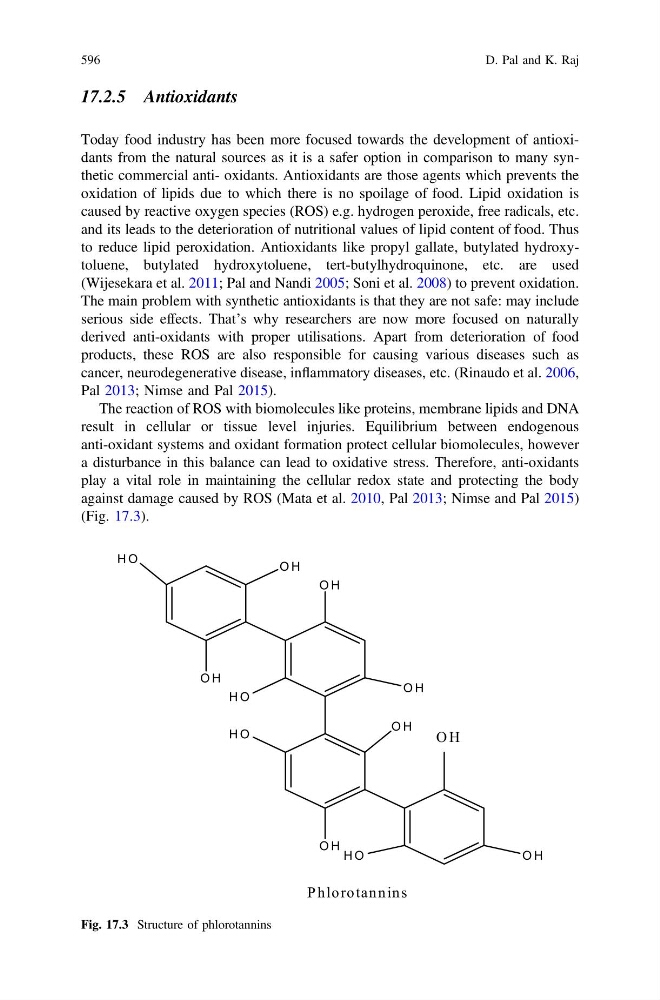
(Fig. 17.3).
H O
O H
O H
H O
O H
O H
H O
O H
O H
H O
O H
O H
P hlorotannins
Fig. 17.3 Structure of phlorotannins
596
D. Pal and K. Raj
Today food industry has been more focused towards the development of antioxidants from the natural sources as it is a safer option in comparison to many synthetic commercial anti- oxidants. Antioxidants are those agents which prevents the
oxidation of lipids due to which there is no spoilage of food. Lipid oxidation is
caused by reactive oxygen species (ROS) e.g. hydrogen peroxide, free radicals, etc.
and its leads to the deterioration of nutritional values of lipid content of food. Thus
to reduce lipid peroxidation. Antioxidants like propyl gallate, butylated hydroxytoluene, butylated hydroxytoluene, tert-butylhydroquinone, etc. are used
(Wijesekara et al. 2011; Pal and Nandi 2005; Soni et al. 2008) to prevent oxidation.
The main problem with synthetic antioxidants is that they are not safe: may include
serious side effects. That’s why researchers are now more focused on naturally
derived anti-oxidants with proper utilisations. Apart from deterioration of food
products, these ROS are also responsible for causing various diseases such as
cancer, neurodegenerative disease, inflammatory diseases, etc. (Rinaudo et al. 2006,
Pal 2013; Nimse and Pal 2015).
The reaction of ROS with biomolecules like proteins, membrane lipids and DNA
result in cellular or tissue level injuries. Equilibrium between endogenous
anti-oxidant systems and oxidant formation protect cellular biomolecules, however
a disturbance in this balance can lead to oxidative stress. Therefore, anti-oxidants
play a vital role in maintaining the cellular redox state and protecting the body
against damage caused by ROS (Mata et al. 2010, Pal 2013; Nimse and Pal 2015)
(Fig. 17.3).
H O
O H
O H
H O
O H
O H
H O
O H
O H
H O
O H
O H
P hlorotannins
Fig. 17.3 Structure of phlorotannins
596
D. Pal and K. Raj