

14.3.2.4 Neuroleptic Activity
Chatterjee and Dey evaluated the neuroleptic activity of 116 (from A. macrophylla)
by calculating the brain serotonin level in mice (Chatterjee and Dey 1964).
Intraperitoneal administration of 116 (20 mg/kg) has shown an effect in the central
nervous system. Brain serotonin content was identified as 0.64 and 1.64 µg/g after
15, 30 min of villalstonine administration.
14.3.2.5 Contraceptive Effects
Chattopadhyay et al. screened the effects of methanolic extract and its subsequent
n-butanol fractions of A. macrophylla leaves on the forward motility (FM) of
mammalian (goat and human) spermatozoa (Chattopadhyay et al. 2005). n-butanol
fractions exhibited a higher potential than the mother methanolic extract. Further,
fractionation resulted in three fractions, such as 58 (fraction A), 41 (fraction B) and
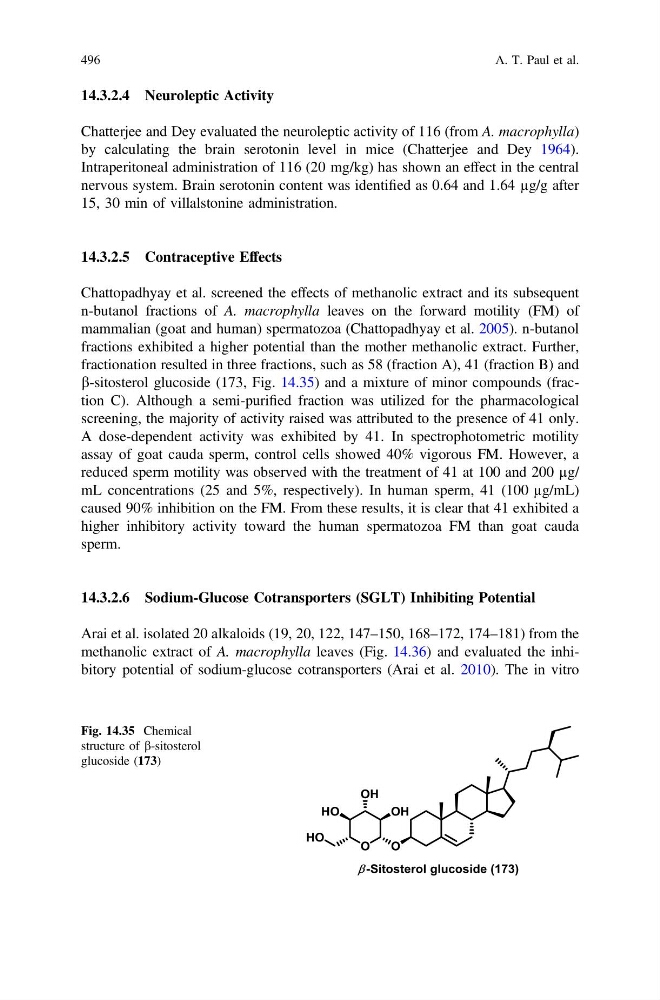
b-sitosterol glucoside (173, Fig. 14.35) and a mixture of minor compounds (fraction C). Although a semi-purified fraction was utilized for the pharmacological
screening, the majority of activity raised was attributed to the presence of 41 only.
A dose-dependent activity was exhibited by 41. In spectrophotometric motility
assay of goat cauda sperm, control cells showed 40% vigorous FM. However, a
reduced sperm motility was observed with the treatment of 41 at 100 and 200 µg/
mL concentrations (25 and 5%, respectively). In human sperm, 41 (100 µg/mL)
caused 90% inhibition on the FM. From these results, it is clear that 41 exhibited a
higher inhibitory activity toward the human spermatozoa FM than goat cauda
sperm.
14.3.2.6 Sodium-Glucose Cotransporters (SGLT) Inhibiting Potential
Arai et al. isolated 20 alkaloids (19, 20, 122, 147–150, 168–172, 174–181) from the
methanolic extract of A. macrophylla leaves (Fig. 14.36) and evaluated the inhibitory potential of sodium-glucose cotransporters (Arai et al. 2010). The in vitro
O
O
HO
HO
OH
OH
-Sitosterol glucoside (173)
Fig. 14.35 Chemical
structure of b-sitosterol
glucoside (173)
496
A. T. Paul et al.
Chatterjee and Dey evaluated the neuroleptic activity of 116 (from A. macrophylla)
by calculating the brain serotonin level in mice (Chatterjee and Dey 1964).
Intraperitoneal administration of 116 (20 mg/kg) has shown an effect in the central
nervous system. Brain serotonin content was identified as 0.64 and 1.64 µg/g after
15, 30 min of villalstonine administration.
14.3.2.5 Contraceptive Effects
Chattopadhyay et al. screened the effects of methanolic extract and its subsequent
n-butanol fractions of A. macrophylla leaves on the forward motility (FM) of
mammalian (goat and human) spermatozoa (Chattopadhyay et al. 2005). n-butanol
fractions exhibited a higher potential than the mother methanolic extract. Further,
fractionation resulted in three fractions, such as 58 (fraction A), 41 (fraction B) and
b-sitosterol glucoside (173, Fig. 14.35) and a mixture of minor compounds (fraction C). Although a semi-purified fraction was utilized for the pharmacological
screening, the majority of activity raised was attributed to the presence of 41 only.
A dose-dependent activity was exhibited by 41. In spectrophotometric motility
assay of goat cauda sperm, control cells showed 40% vigorous FM. However, a
reduced sperm motility was observed with the treatment of 41 at 100 and 200 µg/
mL concentrations (25 and 5%, respectively). In human sperm, 41 (100 µg/mL)
caused 90% inhibition on the FM. From these results, it is clear that 41 exhibited a
higher inhibitory activity toward the human spermatozoa FM than goat cauda
sperm.
14.3.2.6 Sodium-Glucose Cotransporters (SGLT) Inhibiting Potential
Arai et al. isolated 20 alkaloids (19, 20, 122, 147–150, 168–172, 174–181) from the
methanolic extract of A. macrophylla leaves (Fig. 14.36) and evaluated the inhibitory potential of sodium-glucose cotransporters (Arai et al. 2010). The in vitro
O
O
HO
HO
OH
OH
-Sitosterol glucoside (173)
Fig. 14.35 Chemical
structure of b-sitosterol
glucoside (173)
496
A. T. Paul et al.