

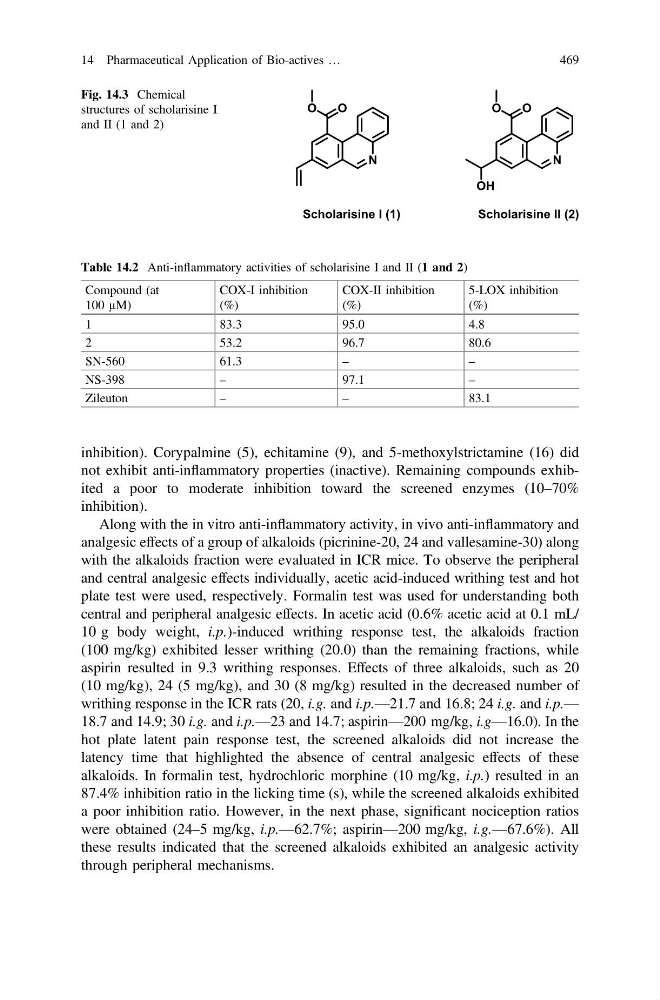
inhibition). Corypalmine (5), echitamine (9), and 5-methoxylstrictamine (16) did
not exhibit anti-inflammatory properties (inactive). Remaining compounds exhibited a poor to moderate inhibition toward the screened enzymes (10–70%
inhibition).
Along with the in vitro anti-inflammatory activity, in vivo anti-inflammatory and
analgesic effects of a group of alkaloids (picrinine-20, 24 and vallesamine-30) along
with the alkaloids fraction were evaluated in ICR mice. To observe the peripheral
and central analgesic effects individually, acetic acid-induced writhing test and hot
plate test were used, respectively. Formalin test was used for understanding both
central and peripheral analgesic effects. In acetic acid (0.6% acetic acid at 0.1 mL/
10 g body weight, i.p.)-induced writhing response test, the alkaloids fraction
(100 mg/kg) exhibited lesser writhing (20.0) than the remaining fractions, while
aspirin resulted in 9.3 writhing responses. Effects of three alkaloids, such as 20
(10 mg/kg), 24 (5 mg/kg), and 30 (8 mg/kg) resulted in the decreased number of
writhing response in the ICR rats (20, i.g. and i.p.—21.7 and 16.8; 24 i.g. and i.p.—
18.7 and 14.9; 30 i.g. and i.p.—23 and 14.7; aspirin—200 mg/kg, i.g—16.0). In the
hot plate latent pain response test, the screened alkaloids did not increase the
latency time that highlighted the absence of central analgesic effects of these
alkaloids. In formalin test, hydrochloric morphine (10 mg/kg, i.p.) resulted in an
87.4% inhibition ratio in the licking time (s), while the screened alkaloids exhibited
a poor inhibition ratio. However, in the next phase, significant nociception ratios
were obtained (24–5 mg/kg, i.p.—62.7%; aspirin—200 mg/kg, i.g.—67.6%). All
these results indicated that the screened alkaloids exhibited an analgesic activity
through peripheral mechanisms.
Scholarisine II (2)
N
O
O
OH
Scholarisine I (1)
N
O
O
Fig. 14.3 Chemical
structures of scholarisine I
and II (1 and 2)
Table 14.2 Anti-inflammatory activities of scholarisine I and II (1 and 2)
Compound (at
100 µM)
COX-I inhibition
(%)
COX-II inhibition
(%)
5-LOX inhibition
(%)
1
83.3
95.0
4.8
2
53.2
96.7
80.6
SN-560
61.3
–
–
NS-398
–
97.1
–
Zileuton
–
–
83.1
14 Pharmaceutical Application of Bio-actives …
469
not exhibit anti-inflammatory properties (inactive). Remaining compounds exhibited a poor to moderate inhibition toward the screened enzymes (10–70%
inhibition).
Along with the in vitro anti-inflammatory activity, in vivo anti-inflammatory and
analgesic effects of a group of alkaloids (picrinine-20, 24 and vallesamine-30) along
with the alkaloids fraction were evaluated in ICR mice. To observe the peripheral
and central analgesic effects individually, acetic acid-induced writhing test and hot
plate test were used, respectively. Formalin test was used for understanding both
central and peripheral analgesic effects. In acetic acid (0.6% acetic acid at 0.1 mL/
10 g body weight, i.p.)-induced writhing response test, the alkaloids fraction
(100 mg/kg) exhibited lesser writhing (20.0) than the remaining fractions, while
aspirin resulted in 9.3 writhing responses. Effects of three alkaloids, such as 20
(10 mg/kg), 24 (5 mg/kg), and 30 (8 mg/kg) resulted in the decreased number of
writhing response in the ICR rats (20, i.g. and i.p.—21.7 and 16.8; 24 i.g. and i.p.—
18.7 and 14.9; 30 i.g. and i.p.—23 and 14.7; aspirin—200 mg/kg, i.g—16.0). In the
hot plate latent pain response test, the screened alkaloids did not increase the
latency time that highlighted the absence of central analgesic effects of these
alkaloids. In formalin test, hydrochloric morphine (10 mg/kg, i.p.) resulted in an
87.4% inhibition ratio in the licking time (s), while the screened alkaloids exhibited
a poor inhibition ratio. However, in the next phase, significant nociception ratios
were obtained (24–5 mg/kg, i.p.—62.7%; aspirin—200 mg/kg, i.g.—67.6%). All
these results indicated that the screened alkaloids exhibited an analgesic activity
through peripheral mechanisms.
Scholarisine II (2)
N
O
O
OH
Scholarisine I (1)
N
O
O
Fig. 14.3 Chemical
structures of scholarisine I
and II (1 and 2)
Table 14.2 Anti-inflammatory activities of scholarisine I and II (1 and 2)
Compound (at
100 µM)
COX-I inhibition
(%)
COX-II inhibition
(%)
5-LOX inhibition
(%)
1
83.3
95.0
4.8
2
53.2
96.7
80.6
SN-560
61.3
–
–
NS-398
–
97.1
–
Zileuton
–
–
83.1
14 Pharmaceutical Application of Bio-actives …
469