

(GC-MS) analysis (Cáceres et al. 2020). Current techniques for the structural elucidation of carvacrol are spectroscopic instruments including high-resolution mass
spectrometry (MS) and nuclear magnetic resonance (NMR). These approaches may
be used either individually or in combination with chromatographic processes
(Cáceres et al. 2020).
13.4 Biosynthesis of Carvacrol
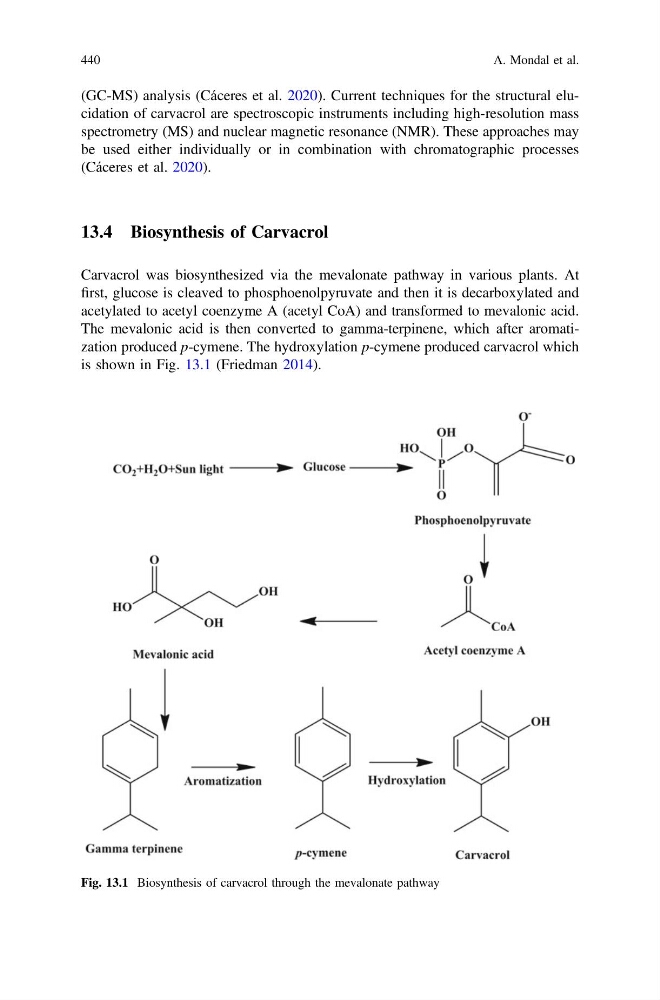
Carvacrol was biosynthesized via the mevalonate pathway in various plants. At
first, glucose is cleaved to phosphoenolpyruvate and then it is decarboxylated and
acetylated to acetyl coenzyme A (acetyl CoA) and transformed to mevalonic acid.
The mevalonic acid is then converted to gamma-terpinene, which after aromatization produced p-cymene. The hydroxylation p-cymene produced carvacrol which
is shown in Fig. 13.1 (Friedman 2014).
Fig. 13.1 Biosynthesis of carvacrol through the mevalonate pathway
440
A. Mondal et al.
spectrometry (MS) and nuclear magnetic resonance (NMR). These approaches may
be used either individually or in combination with chromatographic processes
(Cáceres et al. 2020).
13.4 Biosynthesis of Carvacrol
Carvacrol was biosynthesized via the mevalonate pathway in various plants. At
first, glucose is cleaved to phosphoenolpyruvate and then it is decarboxylated and
acetylated to acetyl coenzyme A (acetyl CoA) and transformed to mevalonic acid.
The mevalonic acid is then converted to gamma-terpinene, which after aromatization produced p-cymene. The hydroxylation p-cymene produced carvacrol which
is shown in Fig. 13.1 (Friedman 2014).
Fig. 13.1 Biosynthesis of carvacrol through the mevalonate pathway
440
A. Mondal et al.