

while increasing shear stress and temperature which cause a decline in the viscosity
of solution (Wei et al. 2015). Wei et al. observed a drop in viscosity of aqueous
fenugreek gum solution in steady shear flow conditions (Wei et al. 2015).
Disentanglement of the polymer chain and distortion of the supramolecular structure of gum which might be responsible for this physical change (Singh et al. 2009;
Jian et al. 2014). Fenugreek gum, when dissolved in water, undergoes sol–gel
transition with an increase in gum concentration (Wei et al. 2015). Fenugreek gum
at a concentration of 0.05% (w/v) evinces sol–gel transition whereas gel-like
properties have been observed above 1% (w/v) concentration (Wei et al. 2015).
Thermogram analysis showed that biopolymer extracted from the fenugreek seeds
has a melting range of 66−139 °C and degradation temperature of about 296.45 °C
(Rashid et al. 2018). Previous study reported that galactomannan extracted from
fenugreek seeds can be effectively recovered from aqueous solution using less
amount of isopropanol than ethanol due to its lower dielectric potential (Rashid
et al. 2018). It was also observed that precipitation of galactomannan-based gums in
polar organic solvents depends on their molecular weight and high density of
hydrogen bonding due to large number of galactose substitution (Jian et al. 2014).
Viscosity of fenugreek gum rises as hydration time extends to a certain point (12 h)
and after that it starts decreasing (Jiang et al. 2007); whereas intrinsic viscosity of
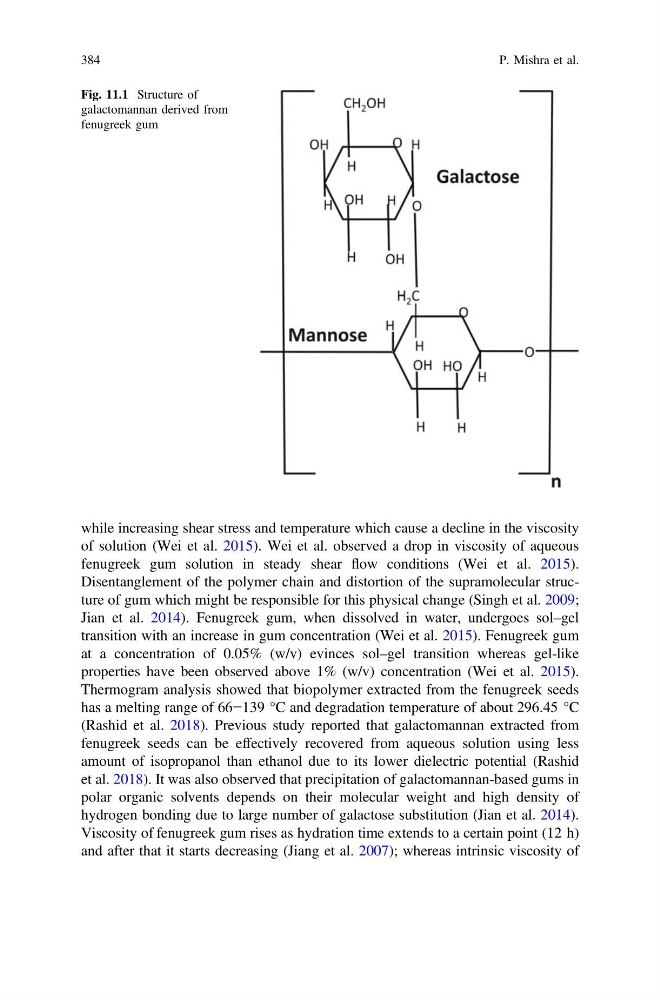
Fig. 11.1 Structure of
galactomannan derived from
fenugreek gum
384
P. Mishra et al.
of solution (Wei et al. 2015). Wei et al. observed a drop in viscosity of aqueous
fenugreek gum solution in steady shear flow conditions (Wei et al. 2015).
Disentanglement of the polymer chain and distortion of the supramolecular structure of gum which might be responsible for this physical change (Singh et al. 2009;
Jian et al. 2014). Fenugreek gum, when dissolved in water, undergoes sol–gel
transition with an increase in gum concentration (Wei et al. 2015). Fenugreek gum
at a concentration of 0.05% (w/v) evinces sol–gel transition whereas gel-like
properties have been observed above 1% (w/v) concentration (Wei et al. 2015).
Thermogram analysis showed that biopolymer extracted from the fenugreek seeds
has a melting range of 66−139 °C and degradation temperature of about 296.45 °C
(Rashid et al. 2018). Previous study reported that galactomannan extracted from
fenugreek seeds can be effectively recovered from aqueous solution using less
amount of isopropanol than ethanol due to its lower dielectric potential (Rashid
et al. 2018). It was also observed that precipitation of galactomannan-based gums in
polar organic solvents depends on their molecular weight and high density of
hydrogen bonding due to large number of galactose substitution (Jian et al. 2014).
Viscosity of fenugreek gum rises as hydration time extends to a certain point (12 h)
and after that it starts decreasing (Jiang et al. 2007); whereas intrinsic viscosity of
Fig. 11.1 Structure of
galactomannan derived from
fenugreek gum
384
P. Mishra et al.