

whereas animal waxes include beeswax, wool, spermaceti wax. The vegetable
waxes contain more amount of the mixture of unesterified hydrocarbons over
esterified hydrocarbons. The composition of wax depends upon the species of the
plants, as well as the geographical location of the plants (Baker 1982). Jojoba wax,
a mixture of liquid wax obtained from seeds of Simmondsia chinensis, consists of
ester of C-18, C-20, C-22, and C-24 carbon chain monounsaturated acids with
alcohols (Wilhelm et al. 2012). Jojoba wax shows various pharmacological activities such as anti-aging, wound healing activities, as well as anti-inflammatory
property, and it is also used in several skin diseases due to wound healing property.
Jojoba wax has pharmaceutical applications in the preparation of topical medicaments to increase the absorption of drug molecules, i.e., to be a good carrier in
dermatological products. It is also used in cosmetics products such as sunscreens
and moisturizers. Carnauba wax, the hardest wax, is the exudates of leaves of the
Brazilian palm tree, Copernicia prunifera, and Copernicia cerifera belonging to the
family Palmae. Carnauba wax consists of carnaubic acid, cerotic acid, and melissyl
cerotate. It is useful for the preparation of cosmetic products and deodorant sticks. It
is applied as automobile wax and high-quality shoe polish. It is employed for the
coating of tablets (Kokate et al. 2005; Wallis 2005).
10.7.3 Phospholipids
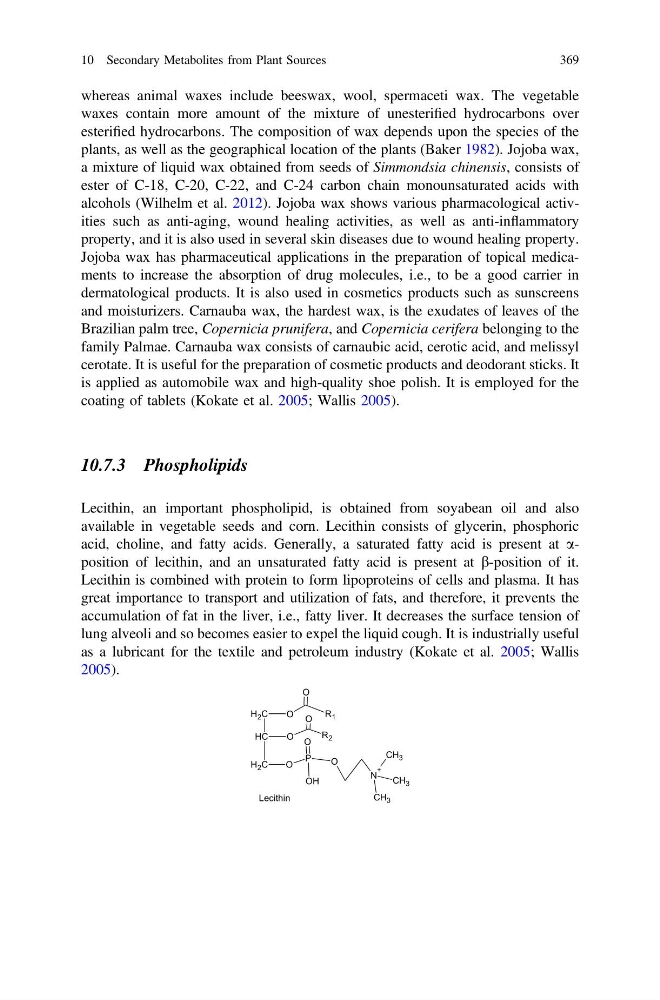
Lecithin, an important phospholipid, is obtained from soyabean oil and also
available in vegetable seeds and corn. Lecithin consists of glycerin, phosphoric
acid, choline, and fatty acids. Generally, a saturated fatty acid is present at aposition of lecithin, and an unsaturated fatty acid is present at b-position of it.
Lecithin is combined with protein to form lipoproteins of cells and plasma. It has
great importance to transport and utilization of fats, and therefore, it prevents the
accumulation of fat in the liver, i.e., fatty liver. It decreases the surface tension of
lung alveoli and so becomes easier to expel the liquid cough. It is industrially useful
as a lubricant for the textile and petroleum industry (Kokate et al. 2005; Wallis
2005).
H 2 C
HC
H 2 C
O
O
O
P
R 1
R 2
O
O
O
O
OH
N
+
CH 3
CH 3
CH 3
Lecithin
10 Secondary Metabolites from Plant Sources
369
waxes contain more amount of the mixture of unesterified hydrocarbons over
esterified hydrocarbons. The composition of wax depends upon the species of the
plants, as well as the geographical location of the plants (Baker 1982). Jojoba wax,
a mixture of liquid wax obtained from seeds of Simmondsia chinensis, consists of
ester of C-18, C-20, C-22, and C-24 carbon chain monounsaturated acids with
alcohols (Wilhelm et al. 2012). Jojoba wax shows various pharmacological activities such as anti-aging, wound healing activities, as well as anti-inflammatory
property, and it is also used in several skin diseases due to wound healing property.
Jojoba wax has pharmaceutical applications in the preparation of topical medicaments to increase the absorption of drug molecules, i.e., to be a good carrier in
dermatological products. It is also used in cosmetics products such as sunscreens
and moisturizers. Carnauba wax, the hardest wax, is the exudates of leaves of the
Brazilian palm tree, Copernicia prunifera, and Copernicia cerifera belonging to the
family Palmae. Carnauba wax consists of carnaubic acid, cerotic acid, and melissyl
cerotate. It is useful for the preparation of cosmetic products and deodorant sticks. It
is applied as automobile wax and high-quality shoe polish. It is employed for the
coating of tablets (Kokate et al. 2005; Wallis 2005).
10.7.3 Phospholipids
Lecithin, an important phospholipid, is obtained from soyabean oil and also
available in vegetable seeds and corn. Lecithin consists of glycerin, phosphoric
acid, choline, and fatty acids. Generally, a saturated fatty acid is present at aposition of lecithin, and an unsaturated fatty acid is present at b-position of it.
Lecithin is combined with protein to form lipoproteins of cells and plasma. It has
great importance to transport and utilization of fats, and therefore, it prevents the
accumulation of fat in the liver, i.e., fatty liver. It decreases the surface tension of
lung alveoli and so becomes easier to expel the liquid cough. It is industrially useful
as a lubricant for the textile and petroleum industry (Kokate et al. 2005; Wallis
2005).
H 2 C
HC
H 2 C
O
O
O
P
R 1
R 2
O
O
O
O
OH
N
+
CH 3
CH 3
CH 3
Lecithin
10 Secondary Metabolites from Plant Sources
369