

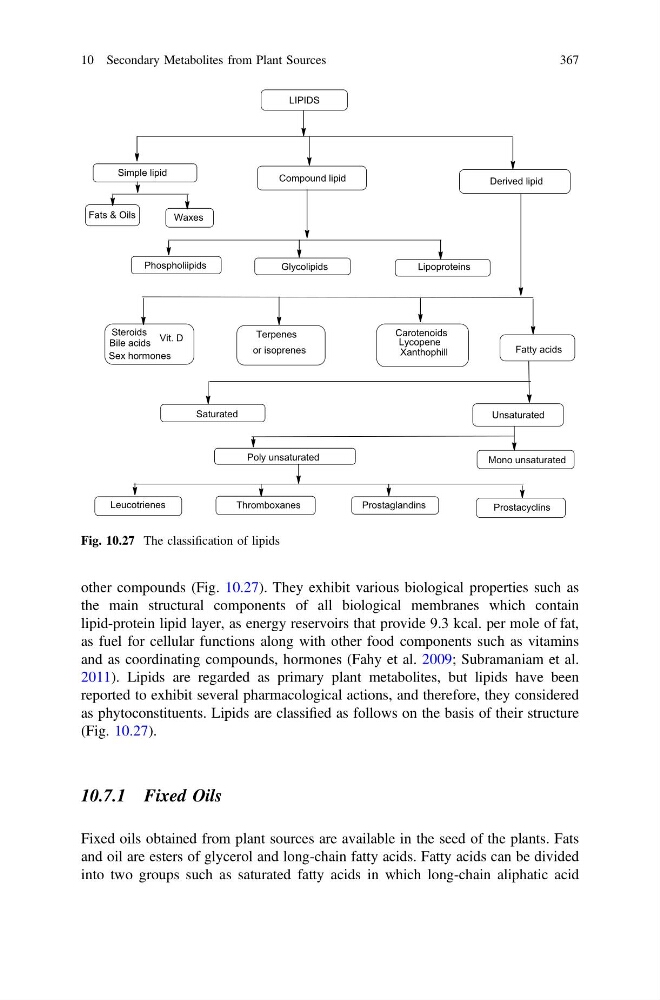
other compounds (Fig. 10.27). They exhibit various biological properties such as
the main structural components of all biological membranes which contain
lipid-protein lipid layer, as energy reservoirs that provide 9.3 kcal. per mole of fat,
as fuel for cellular functions along with other food components such as vitamins
and as coordinating compounds, hormones (Fahy et al. 2009; Subramaniam et al.
2011). Lipids are regarded as primary plant metabolites, but lipids have been
reported to exhibit several pharmacological actions, and therefore, they considered
as phytoconstituents. Lipids are classified as follows on the basis of their structure
(Fig. 10.27).
10.7.1 Fixed Oils
Fixed oils obtained from plant sources are available in the seed of the plants. Fats
and oil are esters of glycerol and long-chain fatty acids. Fatty acids can be divided
into two groups such as saturated fatty acids in which long-chain aliphatic acid
LIPIDS
Simple lipid
Compound lipid
Derived lipid
Fats & Oils
Waxes
Phospholiipids
Glycolipids
Lipoproteins
Steroids
Bile acids
Sex hormones
Vit. D
Terpenes
or isoprenes
Carotenoids
Lycopene
Xanthophill
Fatty acids
Saturated
Unsaturated
Poly unsaturated
Mono unsaturated
Leucotrienes
Thromboxanes
Prostaglandins
Prostacyclins
Fig. 10.27 The classification of lipids
10 Secondary Metabolites from Plant Sources
367
the main structural components of all biological membranes which contain
lipid-protein lipid layer, as energy reservoirs that provide 9.3 kcal. per mole of fat,
as fuel for cellular functions along with other food components such as vitamins
and as coordinating compounds, hormones (Fahy et al. 2009; Subramaniam et al.
2011). Lipids are regarded as primary plant metabolites, but lipids have been
reported to exhibit several pharmacological actions, and therefore, they considered
as phytoconstituents. Lipids are classified as follows on the basis of their structure
(Fig. 10.27).
10.7.1 Fixed Oils
Fixed oils obtained from plant sources are available in the seed of the plants. Fats
and oil are esters of glycerol and long-chain fatty acids. Fatty acids can be divided
into two groups such as saturated fatty acids in which long-chain aliphatic acid
LIPIDS
Simple lipid
Compound lipid
Derived lipid
Fats & Oils
Waxes
Phospholiipids
Glycolipids
Lipoproteins
Steroids
Bile acids
Sex hormones
Vit. D
Terpenes
or isoprenes
Carotenoids
Lycopene
Xanthophill
Fatty acids
Saturated
Unsaturated
Poly unsaturated
Mono unsaturated
Leucotrienes
Thromboxanes
Prostaglandins
Prostacyclins
Fig. 10.27 The classification of lipids
10 Secondary Metabolites from Plant Sources
367