

Monosaccharides
Disaccharides
Trisaccharides
Tetrasaccharides
Polysaccharides
Carbohydrates
Homo-polysaccharides
Hetero-polysaccharides
Depending upon reducing property, they are divided into two groups such as
(a) reducing sugars, e.g., all monosaccharides (e.g., glucose, fructose, galactose,
mannose, gulose, sorbose, etc.) and disaccharides (e.g., maltose, lactose) except
sucrose
(b) non-reducing sugars, e.g., oligosaccharides, polysaccharides.
Depending upon the hydrolytic product, they are grouped as pentosan (e.g.,
xylan) and hexosan (e.g., starch, cellulose, and inulin).
Cellulose consists of glucose units combined by b-1,4-glycosidic linkages which
are hydrolyzable by cellulase enzyme available in herbivorous animals or cattle
class.
Monosaccharides have three-carbon atoms to nine-carbon atoms and accordingly, they are known as triose, tetrose, pentose, hexose, heptose, etc. The simplest
carbohydrate is glyceraldehydes containing three-carbon atoms. But those
monosaccharides having five carbon atoms like pentoses, C 5 H 10 O 5 , and six carbon
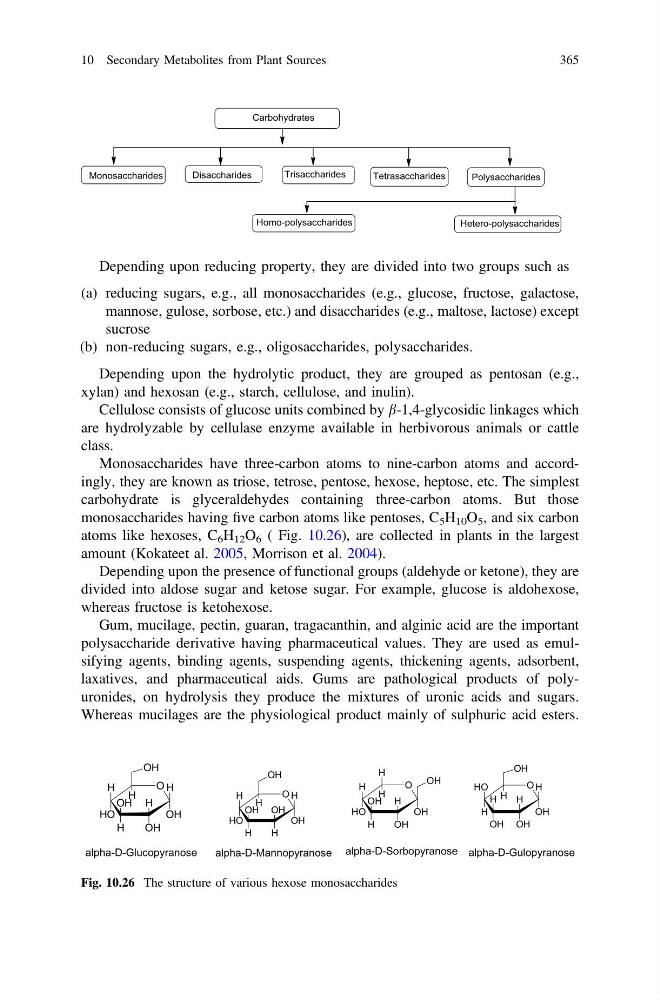
atoms like hexoses, C 6 H 12 O 6 ( Fig. 10.26), are collected in plants in the largest
amount (Kokateet al. 2005, Morrison et al. 2004).
Depending upon the presence of functional groups (aldehyde or ketone), they are
divided into aldose sugar and ketose sugar. For example, glucose is aldohexose,
whereas fructose is ketohexose.
Gum, mucilage, pectin, guaran, tragacanthin, and alginic acid are the important
polysaccharide derivative having pharmaceutical values. They are used as emulsifying agents, binding agents, suspending agents, thickening agents, adsorbent,
laxatives, and pharmaceutical aids. Gums are pathological products of polyuronides, on hydrolysis they produce the mixtures of uronic acids and sugars.
Whereas mucilages are the physiological product mainly of sulphuric acid esters.
O
OH
H
H
H
O
H
OH
H
OH
H
OH
O
OH
OH
H
H
O
H
OH
H
H
H
OH
O
OH
H
H
H
O
H
OH
H
O H
H
OH
O
OH
H
H
O
H
H
H
OH OH
H
OH
alpha-D-Glucopyranose
alpha-D-Mannopyranose alpha-D-Sorbopyranose alpha-D-Gulopyranose
Fig. 10.26 The structure of various hexose monosaccharides
10 Secondary Metabolites from Plant Sources
365
Disaccharides
Trisaccharides
Tetrasaccharides
Polysaccharides
Carbohydrates
Homo-polysaccharides
Hetero-polysaccharides
Depending upon reducing property, they are divided into two groups such as
(a) reducing sugars, e.g., all monosaccharides (e.g., glucose, fructose, galactose,
mannose, gulose, sorbose, etc.) and disaccharides (e.g., maltose, lactose) except
sucrose
(b) non-reducing sugars, e.g., oligosaccharides, polysaccharides.
Depending upon the hydrolytic product, they are grouped as pentosan (e.g.,
xylan) and hexosan (e.g., starch, cellulose, and inulin).
Cellulose consists of glucose units combined by b-1,4-glycosidic linkages which
are hydrolyzable by cellulase enzyme available in herbivorous animals or cattle
class.
Monosaccharides have three-carbon atoms to nine-carbon atoms and accordingly, they are known as triose, tetrose, pentose, hexose, heptose, etc. The simplest
carbohydrate is glyceraldehydes containing three-carbon atoms. But those
monosaccharides having five carbon atoms like pentoses, C 5 H 10 O 5 , and six carbon
atoms like hexoses, C 6 H 12 O 6 ( Fig. 10.26), are collected in plants in the largest
amount (Kokateet al. 2005, Morrison et al. 2004).
Depending upon the presence of functional groups (aldehyde or ketone), they are
divided into aldose sugar and ketose sugar. For example, glucose is aldohexose,
whereas fructose is ketohexose.
Gum, mucilage, pectin, guaran, tragacanthin, and alginic acid are the important
polysaccharide derivative having pharmaceutical values. They are used as emulsifying agents, binding agents, suspending agents, thickening agents, adsorbent,
laxatives, and pharmaceutical aids. Gums are pathological products of polyuronides, on hydrolysis they produce the mixtures of uronic acids and sugars.
Whereas mucilages are the physiological product mainly of sulphuric acid esters.
O
OH
H
H
H
O
H
OH
H
OH
H
OH
O
OH
OH
H
H
O
H
OH
H
H
H
OH
O
OH
H
H
H
O
H
OH
H
O H
H
OH
O
OH
H
H
O
H
H
H
OH OH
H
OH
alpha-D-Glucopyranose
alpha-D-Mannopyranose alpha-D-Sorbopyranose alpha-D-Gulopyranose
Fig. 10.26 The structure of various hexose monosaccharides
10 Secondary Metabolites from Plant Sources
365