

effect of the carbon atoms situated at 2, 3, 4 positions of pyran ring and the effect of
substituents on the ring structure. Few substances contain both the hydrolyzable and
non-hydrolyzable tannins, e.g., bark and leaves of Hamamelis virginiana and
leaves of Camellia sinensis popular as a tea (Goenka et al. 2013).
The drugs having tannins have a great medicinal value. They are useful for the
treatment of diarrhea, to check small hemorrhage in the gastrointestinal tract (g.i.t.),
as a mild antiseptic, and as antidotes in poisoning by heavy metals like lead, tin, and
alkaloids by precipitating them. It has reported that Epigallocatechin-3-gallate
obtained from tea, shows antiangiogenic activity in mice. The juice of Vaccinium
oxycoccos (cranberry) is used for long times as urinary antiseptic which is also
experimentally proven (Jepson et al. 2008).
10.4.6 Stilbenes
Stilbenes are another important phytoconstituents broadly distributed worldwide.
They are available as heartwood constituents of plant species. They are generally
found in the heartwood of trees like as, Eucalyptus belonging to the family
Myrtaceae, Madura belonging to the family Moraceae, and Pinus belonging to the
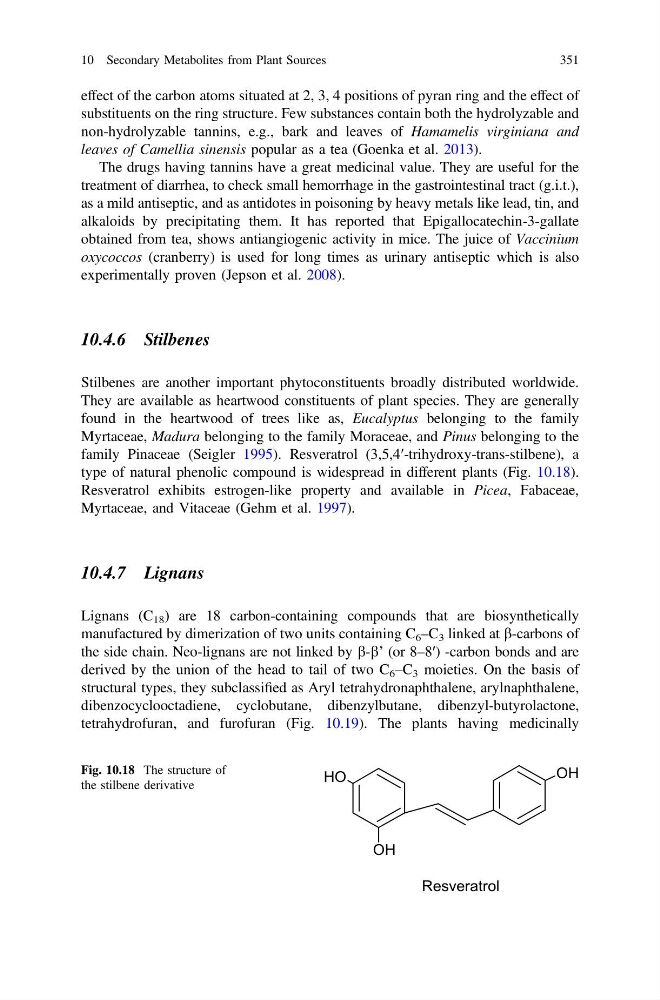
family Pinaceae (Seigler 1995). Resveratrol (3,5,4′-trihydroxy-trans-stilbene), a
type of natural phenolic compound is widespread in different plants (Fig. 10.18).
Resveratrol exhibits estrogen-like property and available in Picea, Fabaceae,
Myrtaceae, and Vitaceae (Gehm et al. 1997).
10.4.7 Lignans
Lignans (C 18 ) are 18 carbon-containing compounds that are biosynthetically
manufactured by dimerization of two units containing C 6 –C 3 linked at b-carbons of
the side chain. Neo-lignans are not linked by b-b’ (or 8–8′) -carbon bonds and are
derived by the union of the head to tail of two C 6 –C 3 moieties. On the basis of
structural types, they subclassified as Aryl tetrahydronaphthalene, arylnaphthalene,
dibenzocyclooctadiene, cyclobutane, dibenzylbutane, dibenzyl-butyrolactone,
tetrahydrofuran, and furofuran (Fig. 10.19). The plants having medicinally
O
H
OH
OH
Resveratrol
Fig. 10.18 The structure of
the stilbene derivative
10 Secondary Metabolites from Plant Sources
351
substituents on the ring structure. Few substances contain both the hydrolyzable and
non-hydrolyzable tannins, e.g., bark and leaves of Hamamelis virginiana and
leaves of Camellia sinensis popular as a tea (Goenka et al. 2013).
The drugs having tannins have a great medicinal value. They are useful for the
treatment of diarrhea, to check small hemorrhage in the gastrointestinal tract (g.i.t.),
as a mild antiseptic, and as antidotes in poisoning by heavy metals like lead, tin, and
alkaloids by precipitating them. It has reported that Epigallocatechin-3-gallate
obtained from tea, shows antiangiogenic activity in mice. The juice of Vaccinium
oxycoccos (cranberry) is used for long times as urinary antiseptic which is also
experimentally proven (Jepson et al. 2008).
10.4.6 Stilbenes
Stilbenes are another important phytoconstituents broadly distributed worldwide.
They are available as heartwood constituents of plant species. They are generally
found in the heartwood of trees like as, Eucalyptus belonging to the family
Myrtaceae, Madura belonging to the family Moraceae, and Pinus belonging to the
family Pinaceae (Seigler 1995). Resveratrol (3,5,4′-trihydroxy-trans-stilbene), a
type of natural phenolic compound is widespread in different plants (Fig. 10.18).
Resveratrol exhibits estrogen-like property and available in Picea, Fabaceae,
Myrtaceae, and Vitaceae (Gehm et al. 1997).
10.4.7 Lignans
Lignans (C 18 ) are 18 carbon-containing compounds that are biosynthetically
manufactured by dimerization of two units containing C 6 –C 3 linked at b-carbons of
the side chain. Neo-lignans are not linked by b-b’ (or 8–8′) -carbon bonds and are
derived by the union of the head to tail of two C 6 –C 3 moieties. On the basis of
structural types, they subclassified as Aryl tetrahydronaphthalene, arylnaphthalene,
dibenzocyclooctadiene, cyclobutane, dibenzylbutane, dibenzyl-butyrolactone,
tetrahydrofuran, and furofuran (Fig. 10.19). The plants having medicinally
O
H
OH
OH
Resveratrol
Fig. 10.18 The structure of
the stilbene derivative
10 Secondary Metabolites from Plant Sources
351