

exists as flavylium ion in which a positive charge is present on O–atom of chroman
ring (Kokateet al. 2005; Wang et al. 2018).
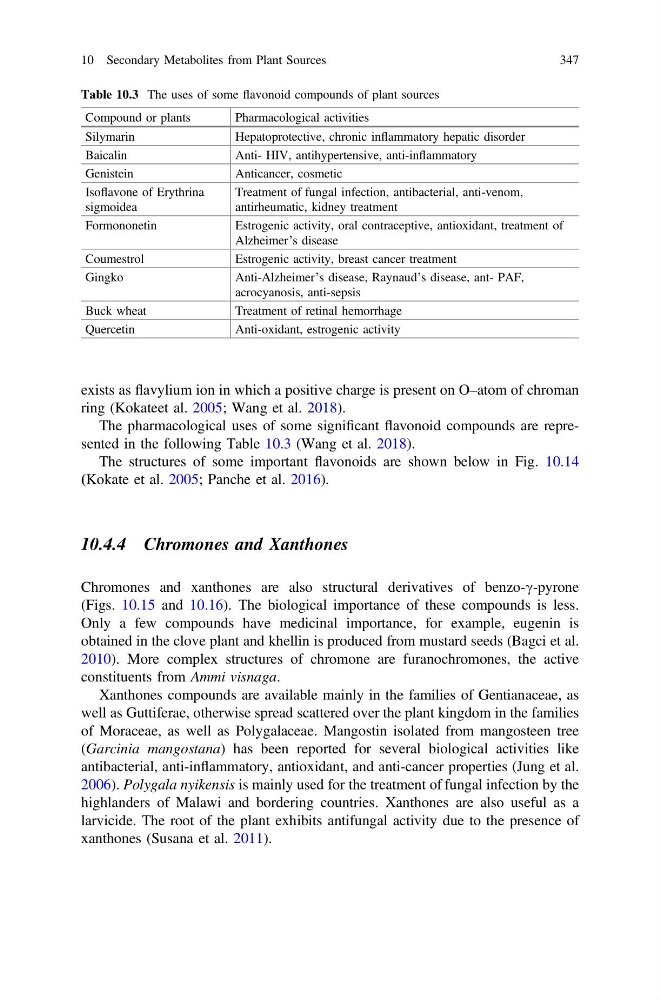
The pharmacological uses of some significant flavonoid compounds are represented in the following Table 10.3 (Wang et al. 2018).
The structures of some important flavonoids are shown below in Fig. 10.14
(Kokate et al. 2005; Panche et al. 2016).
10.4.4 Chromones and Xanthones
Chromones and xanthones are also structural derivatives of benzo-c-pyrone
(Figs. 10.15 and 10.16). The biological importance of these compounds is less.
Only a few compounds have medicinal importance, for example, eugenin is
obtained in the clove plant and khellin is produced from mustard seeds (Bagci et al.
2010). More complex structures of chromone are furanochromones, the active
constituents from Ammi visnaga.
Xanthones compounds are available mainly in the families of Gentianaceae, as
well as Guttiferae, otherwise spread scattered over the plant kingdom in the families
of Moraceae, as well as Polygalaceae. Mangostin isolated from mangosteen tree
(Garcinia mangostana) has been reported for several biological activities like
antibacterial, anti-inflammatory, antioxidant, and anti-cancer properties (Jung et al.
2006). Polygala nyikensis is mainly used for the treatment of fungal infection by the
highlanders of Malawi and bordering countries. Xanthones are also useful as a
larvicide. The root of the plant exhibits antifungal activity due to the presence of
xanthones (Susana et al. 2011).
Table 10.3 The uses of some flavonoid compounds of plant sources
Compound or plants
Pharmacological activities
Silymarin
Hepatoprotective, chronic inflammatory hepatic disorder
Baicalin
Anti- HIV, antihypertensive, anti-inflammatory
Genistein
Anticancer, cosmetic
Isoflavone of Erythrina
sigmoidea
Treatment of fungal infection, antibacterial, anti-venom,
antirheumatic, kidney treatment
Formononetin
Estrogenic activity, oral contraceptive, antioxidant, treatment of
Alzheimer’s disease
Coumestrol
Estrogenic activity, breast cancer treatment
Gingko
Anti-Alzheimer’s disease, Raynaud’s disease, ant- PAF,
acrocyanosis, anti-sepsis
Buck wheat
Treatment of retinal hemorrhage
Quercetin
Anti-oxidant, estrogenic activity
10 Secondary Metabolites from Plant Sources
347
ring (Kokateet al. 2005; Wang et al. 2018).
The pharmacological uses of some significant flavonoid compounds are represented in the following Table 10.3 (Wang et al. 2018).
The structures of some important flavonoids are shown below in Fig. 10.14
(Kokate et al. 2005; Panche et al. 2016).
10.4.4 Chromones and Xanthones
Chromones and xanthones are also structural derivatives of benzo-c-pyrone
(Figs. 10.15 and 10.16). The biological importance of these compounds is less.
Only a few compounds have medicinal importance, for example, eugenin is
obtained in the clove plant and khellin is produced from mustard seeds (Bagci et al.
2010). More complex structures of chromone are furanochromones, the active
constituents from Ammi visnaga.
Xanthones compounds are available mainly in the families of Gentianaceae, as
well as Guttiferae, otherwise spread scattered over the plant kingdom in the families
of Moraceae, as well as Polygalaceae. Mangostin isolated from mangosteen tree
(Garcinia mangostana) has been reported for several biological activities like
antibacterial, anti-inflammatory, antioxidant, and anti-cancer properties (Jung et al.
2006). Polygala nyikensis is mainly used for the treatment of fungal infection by the
highlanders of Malawi and bordering countries. Xanthones are also useful as a
larvicide. The root of the plant exhibits antifungal activity due to the presence of
xanthones (Susana et al. 2011).
Table 10.3 The uses of some flavonoid compounds of plant sources
Compound or plants
Pharmacological activities
Silymarin
Hepatoprotective, chronic inflammatory hepatic disorder
Baicalin
Anti- HIV, antihypertensive, anti-inflammatory
Genistein
Anticancer, cosmetic
Isoflavone of Erythrina
sigmoidea
Treatment of fungal infection, antibacterial, anti-venom,
antirheumatic, kidney treatment
Formononetin
Estrogenic activity, oral contraceptive, antioxidant, treatment of
Alzheimer’s disease
Coumestrol
Estrogenic activity, breast cancer treatment
Gingko
Anti-Alzheimer’s disease, Raynaud’s disease, ant- PAF,
acrocyanosis, anti-sepsis
Buck wheat
Treatment of retinal hemorrhage
Quercetin
Anti-oxidant, estrogenic activity
10 Secondary Metabolites from Plant Sources
347