

The schematic diagram of the biosynthesis of different alkaloids from various
amino acids (Figs. 10.4, 10.5, 10.6, 10.7) is depicted below (Kokate et al. 2005; Ali
2019, Evans and Mitch 1982).
10.3 Saponins
Plants having saponin glycosides are of economical importance, as well as
medicinal value. Saponins are those compounds which contain a polycyclic aglycone moiety known as a sapogenin. The aglycone part is either a steroidal nucleus
also called tetracyclic triterpenoid saponins or triterpenoid which contains five rings
also popular as pentacyclic triterpenoid saponins (Fig. 10.8). Pentacyclic saponins
are further differentiated into (a) a-amyrin type (b) b-amyrin type, and (c) lupeol.
The aglycone part is attached to a carbohydrate unit that may be a monosaccharide
unit like glucose, mannose, galactose, etc., or sometimes oligosaccharide chain like
glucose-gulose-mannose-rhamnose. This glycone part comprises various pentoses
and, hexoses sugars, or uronic acids. This hydrophobic-hydrophilic balance made
by these types of compounds lower the surface tension between two immiscible
liquids and also make lather in their aqueous solutions and hence behave like a
soap. Another important property of saponin is the ability to cause hemolytic of red
blood corpuscles (RBC) in vitro. The non-sugar part of the saponin compound is
known as genin or especially sapogenin due to the ability of the formation of foam.
Saponins are found widely among plants and reported more than 500 plants from
about 90 different families. These substances are extracted from most of the plant
parts like roots bulbs, leaves, stems, flowers, and fruits. The literature survey
reveals that saponins are usually found in the roots of various plants like
Chlorophytum borovillianum known as safed musali, Dioscorea deltoidea popular
as wild yam, Eleutherococcus senticosus called as Siberian ginseng, Asparagus
racemosus popular as Shatavari, Gentiana lutea generally called gentian,
Glycyrrhiza glabra popular as licorice and Panax ginseng called as Korean ginseng
(Assa et al. 1973).
OH
O
N
H 2
N
H 2
OH
O
N
H 2
NH 2
OH
O
N
H 2
OH
O
N
H 2
OH
Ornithine
Lysine
Phenyl alanine
Tyrosine
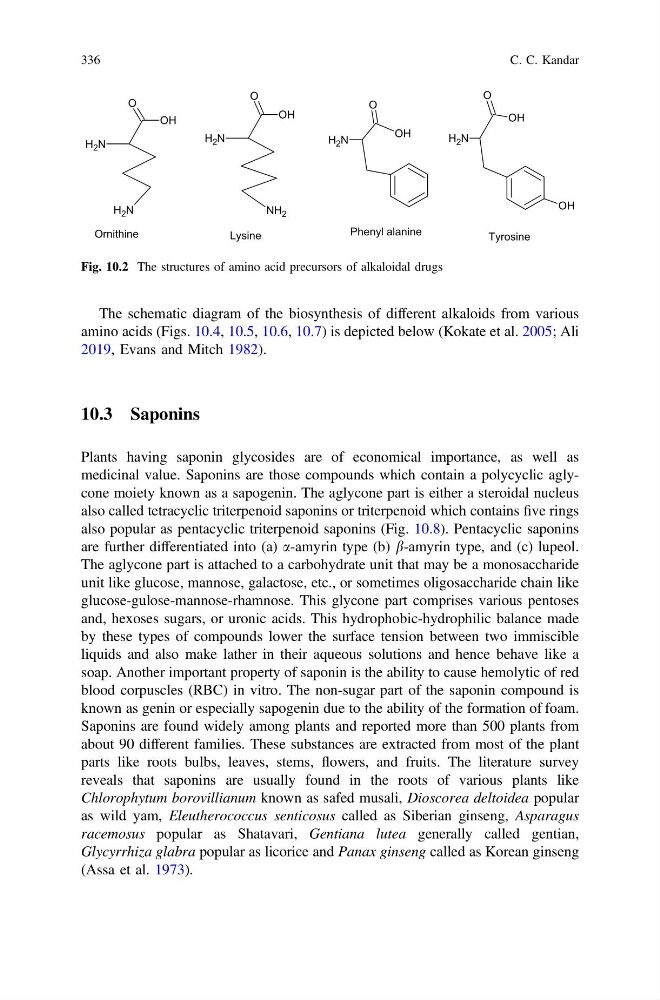
Fig. 10.2 The structures of amino acid precursors of alkaloidal drugs
336
C. C. Kandar
amino acids (Figs. 10.4, 10.5, 10.6, 10.7) is depicted below (Kokate et al. 2005; Ali
2019, Evans and Mitch 1982).
10.3 Saponins
Plants having saponin glycosides are of economical importance, as well as
medicinal value. Saponins are those compounds which contain a polycyclic aglycone moiety known as a sapogenin. The aglycone part is either a steroidal nucleus
also called tetracyclic triterpenoid saponins or triterpenoid which contains five rings
also popular as pentacyclic triterpenoid saponins (Fig. 10.8). Pentacyclic saponins
are further differentiated into (a) a-amyrin type (b) b-amyrin type, and (c) lupeol.
The aglycone part is attached to a carbohydrate unit that may be a monosaccharide
unit like glucose, mannose, galactose, etc., or sometimes oligosaccharide chain like
glucose-gulose-mannose-rhamnose. This glycone part comprises various pentoses
and, hexoses sugars, or uronic acids. This hydrophobic-hydrophilic balance made
by these types of compounds lower the surface tension between two immiscible
liquids and also make lather in their aqueous solutions and hence behave like a
soap. Another important property of saponin is the ability to cause hemolytic of red
blood corpuscles (RBC) in vitro. The non-sugar part of the saponin compound is
known as genin or especially sapogenin due to the ability of the formation of foam.
Saponins are found widely among plants and reported more than 500 plants from
about 90 different families. These substances are extracted from most of the plant
parts like roots bulbs, leaves, stems, flowers, and fruits. The literature survey
reveals that saponins are usually found in the roots of various plants like
Chlorophytum borovillianum known as safed musali, Dioscorea deltoidea popular
as wild yam, Eleutherococcus senticosus called as Siberian ginseng, Asparagus
racemosus popular as Shatavari, Gentiana lutea generally called gentian,
Glycyrrhiza glabra popular as licorice and Panax ginseng called as Korean ginseng
(Assa et al. 1973).
OH
O
N
H 2
N
H 2
OH
O
N
H 2
NH 2
OH
O
N
H 2
OH
O
N
H 2
OH
Ornithine
Lysine
Phenyl alanine
Tyrosine
Fig. 10.2 The structures of amino acid precursors of alkaloidal drugs
336
C. C. Kandar