

Infections caused by Candida spp. have shown a high level of incidence, where
Candida albicans and Candida tropicalis stand out, with notoriety for the former,
as agents capable of causing invasion. Their virulence factors provide adaptability,
since they allow the fulfillment of important criteria for survival, such as having
tolerance to high temperatures and invasive potential, promoting lysis and
absorption of human tissues and resisting immunological defenses. The current
context requires searches for bioactive substances with antifungal potential. New
therapeutic agents may be contained in plants and consequently, their extracts and
essential oils may serve as subsidies for in-depth studies and research that contemplate and target the formulation of new drugs. Research has been conducted to
promote the combination of commercial drugs, for which resistance phenomena
have already been verified, with natural products in the form of extracts, fractions,
essential oils or isolated constituents, in an attempt to circumvent the resistance of
Candida spp.
Recently, a medicinal plant Mesosphaerum suaveolens aqueous extracts of
leaves (AELMs) and aerial parts (AEAPMs) was evaluated against strains of the
genus Candida. The modulatory effect was observed with the drug fluconazole. The
AELMs have shown good results since modulated fluconazole activity decreased
fluconazole’s IC50 from 7.8 lg/mL to an IC50 of 4.7 lg/mL (CA LM 77 strain)
and from 28.8 lg/mL to 18.26 lg/mL (CA INCQS 40,006 strain) for the
C. albicans strains. For the C. tropicalis LM 23 strain, the AEPMs obtained an
IC50 of 25 lg/mL and the AELMs an IC50 of 359.9 lg/mL. The AEAPMs as well
as the AELMs presented clinically relevant activities for C. tropicalis strains (Costa
et al. 2020).
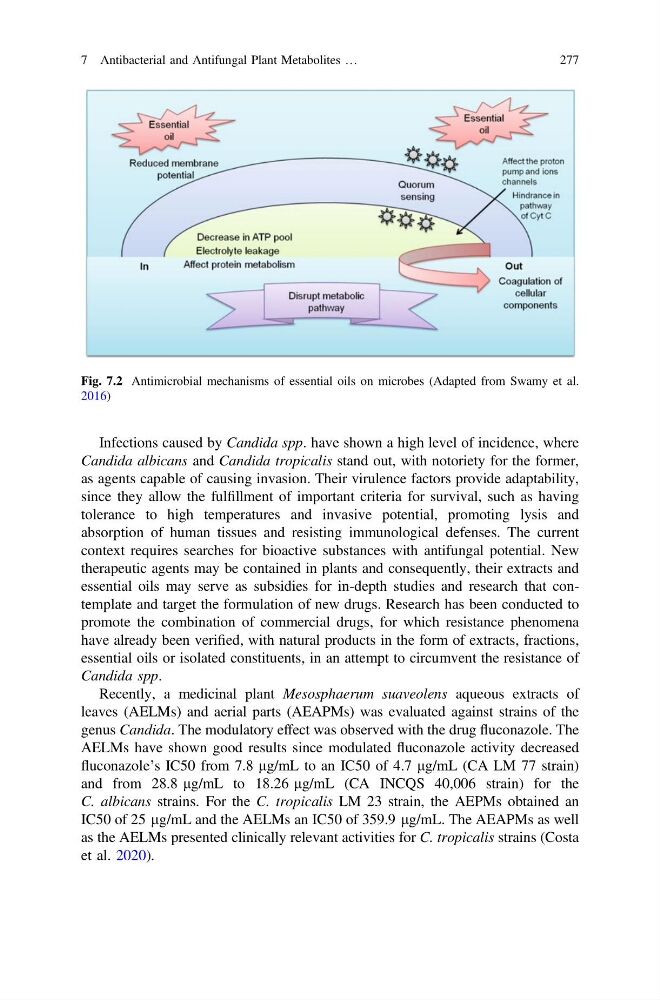
Fig. 7.2 Antimicrobial mechanisms of essential oils on microbes (Adapted from Swamy et al.
2016)
7 Antibacterial and Antifungal Plant Metabolites …
277
Candida albicans and Candida tropicalis stand out, with notoriety for the former,
as agents capable of causing invasion. Their virulence factors provide adaptability,
since they allow the fulfillment of important criteria for survival, such as having
tolerance to high temperatures and invasive potential, promoting lysis and
absorption of human tissues and resisting immunological defenses. The current
context requires searches for bioactive substances with antifungal potential. New
therapeutic agents may be contained in plants and consequently, their extracts and
essential oils may serve as subsidies for in-depth studies and research that contemplate and target the formulation of new drugs. Research has been conducted to
promote the combination of commercial drugs, for which resistance phenomena
have already been verified, with natural products in the form of extracts, fractions,
essential oils or isolated constituents, in an attempt to circumvent the resistance of
Candida spp.
Recently, a medicinal plant Mesosphaerum suaveolens aqueous extracts of
leaves (AELMs) and aerial parts (AEAPMs) was evaluated against strains of the
genus Candida. The modulatory effect was observed with the drug fluconazole. The
AELMs have shown good results since modulated fluconazole activity decreased
fluconazole’s IC50 from 7.8 lg/mL to an IC50 of 4.7 lg/mL (CA LM 77 strain)
and from 28.8 lg/mL to 18.26 lg/mL (CA INCQS 40,006 strain) for the
C. albicans strains. For the C. tropicalis LM 23 strain, the AEPMs obtained an
IC50 of 25 lg/mL and the AELMs an IC50 of 359.9 lg/mL. The AEAPMs as well
as the AELMs presented clinically relevant activities for C. tropicalis strains (Costa
et al. 2020).
Fig. 7.2 Antimicrobial mechanisms of essential oils on microbes (Adapted from Swamy et al.
2016)
7 Antibacterial and Antifungal Plant Metabolites …
277