

to develop useful or new antimicrobial agents’ ways to treat the resistant
microorganism (Negi and Dave 2010). In that case, a new form of therapy would be
the use of the combination of synergistic antimicrobial therapy between antimicrobial agents known and bioactive plant extracts. The combination therapy
between plant extracts and antibiotics can expand the antimicrobial spectrum,
prevent the emergence of mutant resistance, and minimize toxicity. Sometimes the
use of a single antibiotic does not produce the inhibitory effects desired effectiveness, but a combination of drugs often has an effect synergistic that surpasses your
individual performance. The synergistic effect can be due to the formation of the
right complex that becomes more effective in inhibiting a particular species of
microorganism, either by inhibition of the synthesis of the cell or causing its lysis or
death (Chanda and Rakholiya 2011). Thus, the most economically viable combination of natural products associated with available antibiotics shows as an alternative, since the synergistic effect between the two can provide an increased
antibacterial activity against sensitive and resistant microorganisms. Therefore, the
potentiated effect of these associations can serve as a new infection treatment
strategy, enabling drug use antimicrobial when it alone is not effective on certain
bacterial strains. The association of extracts from various plants with ampicillin,
chloramphenicol, and tetracycline against sensitive bacteria (S. aureus, Salmonella
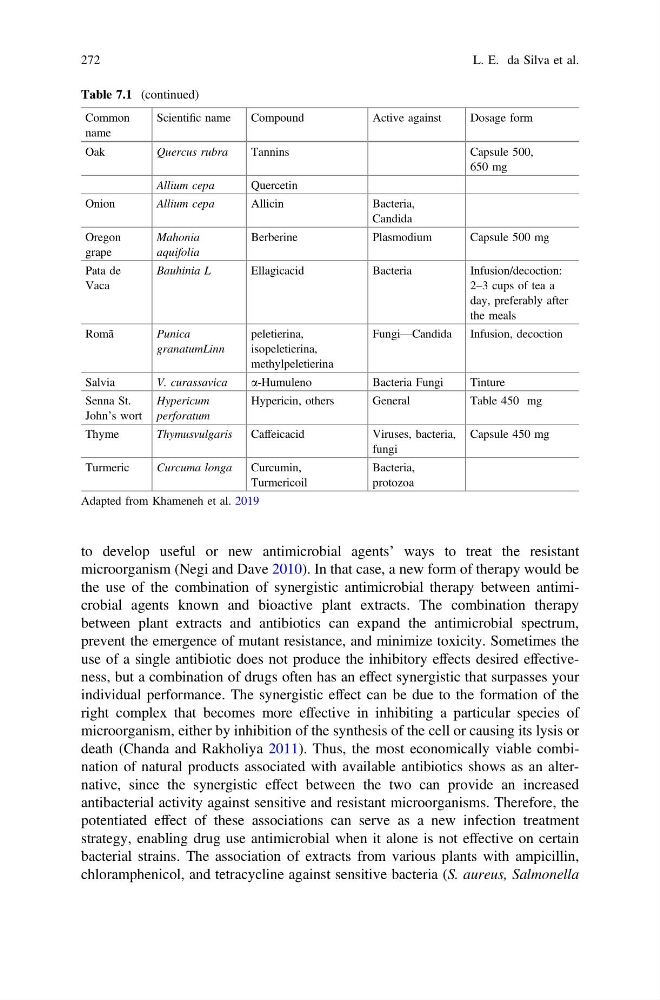
Table 7.1 (continued)
Common
name
Scientific name
Compound
Active against
Dosage form
Oak
Quercus rubra
Tannins
Capsule 500,
650 mg
Allium cepa
Quercetin
Onion
Allium cepa
Allicin
Bacteria,
Candida
Oregon
grape
Mahonia
aquifolia
Berberine
Plasmodium
Capsule 500 mg
Pata de
Vaca
Bauhinia L
Ellagicacid
Bacteria
Infusion/decoction:
2–3 cups of tea a
day, preferably after
the meals
Romã
Punica
granatumLinn
peletierina,
isopeletierina,
methylpeletierina
Fungi—Candida
Infusion, decoction
Salvia
V. curassavica
a-Humuleno
Bacteria Fungi
Tinture
Senna St.
John’s wort
Hypericum
perforatum
Hypericin, others
General
Table 450 mg
Thyme
Thymusvulgaris
Caffeicacid
Viruses, bacteria,
fungi
Capsule 450 mg
Turmeric
Curcuma longa
Curcumin,
Turmericoil
Bacteria,
protozoa
Adapted from Khameneh et al. 2019
272
L. E. da Silva et al.
microorganism (Negi and Dave 2010). In that case, a new form of therapy would be
the use of the combination of synergistic antimicrobial therapy between antimicrobial agents known and bioactive plant extracts. The combination therapy
between plant extracts and antibiotics can expand the antimicrobial spectrum,
prevent the emergence of mutant resistance, and minimize toxicity. Sometimes the
use of a single antibiotic does not produce the inhibitory effects desired effectiveness, but a combination of drugs often has an effect synergistic that surpasses your
individual performance. The synergistic effect can be due to the formation of the
right complex that becomes more effective in inhibiting a particular species of
microorganism, either by inhibition of the synthesis of the cell or causing its lysis or
death (Chanda and Rakholiya 2011). Thus, the most economically viable combination of natural products associated with available antibiotics shows as an alternative, since the synergistic effect between the two can provide an increased
antibacterial activity against sensitive and resistant microorganisms. Therefore, the
potentiated effect of these associations can serve as a new infection treatment
strategy, enabling drug use antimicrobial when it alone is not effective on certain
bacterial strains. The association of extracts from various plants with ampicillin,
chloramphenicol, and tetracycline against sensitive bacteria (S. aureus, Salmonella
Table 7.1 (continued)
Common
name
Scientific name
Compound
Active against
Dosage form
Oak
Quercus rubra
Tannins
Capsule 500,
650 mg
Allium cepa
Quercetin
Onion
Allium cepa
Allicin
Bacteria,
Candida
Oregon
grape
Mahonia
aquifolia
Berberine
Plasmodium
Capsule 500 mg
Pata de
Vaca
Bauhinia L
Ellagicacid
Bacteria
Infusion/decoction:
2–3 cups of tea a
day, preferably after
the meals
Romã
Punica
granatumLinn
peletierina,
isopeletierina,
methylpeletierina
Fungi—Candida
Infusion, decoction
Salvia
V. curassavica
a-Humuleno
Bacteria Fungi
Tinture
Senna St.
John’s wort
Hypericum
perforatum
Hypericin, others
General
Table 450 mg
Thyme
Thymusvulgaris
Caffeicacid
Viruses, bacteria,
fungi
Capsule 450 mg
Turmeric
Curcuma longa
Curcumin,
Turmericoil
Bacteria,
protozoa
Adapted from Khameneh et al. 2019
272
L. E. da Silva et al.