

6.2.1 Plant-Derived Bioactive as Immunomodulators
Plant extracts and phytocompounds are found to fortify the host’s immune system,
and numerous plants have been listed in this category. Phytoimmunomodulatory
agents can increase the body’s immune-responsiveness against pathogens by activating the immune system in a specific or non-specific manner that includes both
the innate and adaptive immune systems. Immunomodulatory plants play a pivotal
role in the treatment of infection, inflammation, and immunodeficiencies by their
effect on various cell types via cytokines and interleukins. The mode of action could
be as immunostimulators, immunosuppressors, or immunoadjuvants to boost
antigen-specific immune response (Nair et al. 2019). Plant products are widely
considered as immunopotentiators and collectively known as biological response
modifiers (BRMs). Many dietary phytomolecules, vitamins, and minerals have a
protective role in cellular nutrition and the management of diabetic complications.
The immunomodulatory function attributed to BRMs is possibly through modulation of the ICs of the body like the macrophages, the lymphocytes (B-cells and
T-cells), Dendritic Cells (DCs), etc. For example, Concanavalin A lectin, a
carbohydrate-binding protein from Canavalia ensiformis can cross-link glycoproteins like TCR/CD3 and thus activate T-lymphocytes. Similarly, Shorea robusta, a
well-known traditional medicine of India can modulate NO, prostaglandins E2,
TNF-a, iNOS expression with anti-inflammatory and wound-healing activity, while
one of its major phytochemical Bergenin enhances T helper-1 responses affording
antimycobacterial immunity by activating the MAP kinase pathway in macrophages
(Nair et al. 2019).
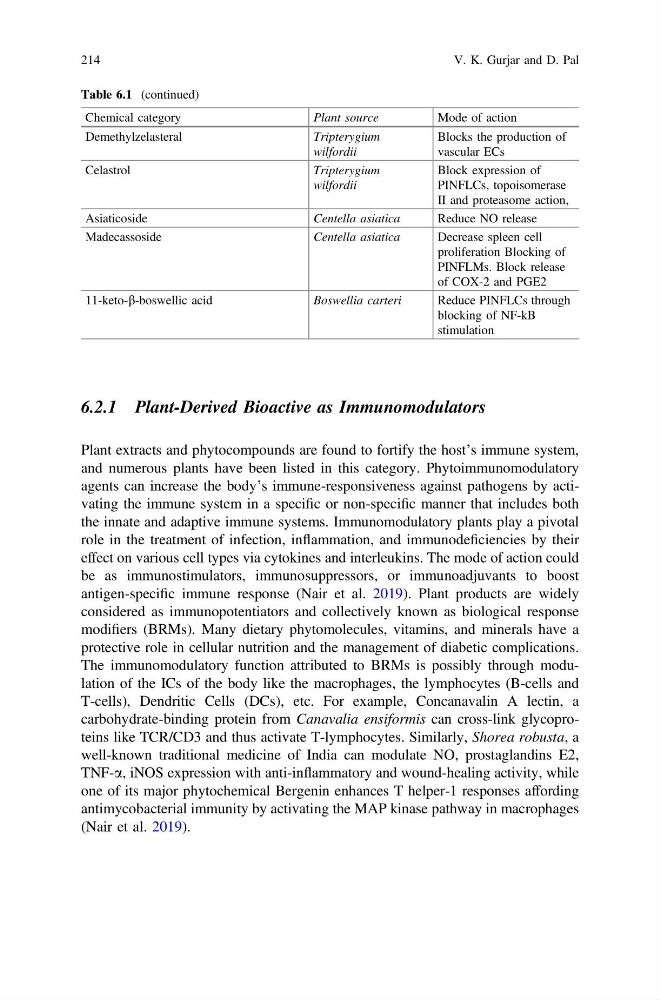
Table 6.1 (continued)
Chemical category
Plant source
Mode of action
Demethylzelasteral
Tripterygium
wilfordii
Blocks the production of
vascular ECs
Celastrol
Tripterygium
wilfordii
Block expression of
PINFLCs, topoisomerase
II and proteasome action,
Asiaticoside
Centella asiatica
Reduce NO release
Madecassoside
Centella asiatica
Decrease spleen cell
proliferation Blocking of
PINFLMs. Block release
of COX-2 and PGE2
11-keto-b-boswellic acid
Boswellia carteri
Reduce PINFLCs through
blocking of NF-kB
stimulation
214
V. K. Gurjar and D. Pal
Plant extracts and phytocompounds are found to fortify the host’s immune system,
and numerous plants have been listed in this category. Phytoimmunomodulatory
agents can increase the body’s immune-responsiveness against pathogens by activating the immune system in a specific or non-specific manner that includes both
the innate and adaptive immune systems. Immunomodulatory plants play a pivotal
role in the treatment of infection, inflammation, and immunodeficiencies by their
effect on various cell types via cytokines and interleukins. The mode of action could
be as immunostimulators, immunosuppressors, or immunoadjuvants to boost
antigen-specific immune response (Nair et al. 2019). Plant products are widely
considered as immunopotentiators and collectively known as biological response
modifiers (BRMs). Many dietary phytomolecules, vitamins, and minerals have a
protective role in cellular nutrition and the management of diabetic complications.
The immunomodulatory function attributed to BRMs is possibly through modulation of the ICs of the body like the macrophages, the lymphocytes (B-cells and
T-cells), Dendritic Cells (DCs), etc. For example, Concanavalin A lectin, a
carbohydrate-binding protein from Canavalia ensiformis can cross-link glycoproteins like TCR/CD3 and thus activate T-lymphocytes. Similarly, Shorea robusta, a
well-known traditional medicine of India can modulate NO, prostaglandins E2,
TNF-a, iNOS expression with anti-inflammatory and wound-healing activity, while
one of its major phytochemical Bergenin enhances T helper-1 responses affording
antimycobacterial immunity by activating the MAP kinase pathway in macrophages
(Nair et al. 2019).
Table 6.1 (continued)
Chemical category
Plant source
Mode of action
Demethylzelasteral
Tripterygium
wilfordii
Blocks the production of
vascular ECs
Celastrol
Tripterygium
wilfordii
Block expression of
PINFLCs, topoisomerase
II and proteasome action,
Asiaticoside
Centella asiatica
Reduce NO release
Madecassoside
Centella asiatica
Decrease spleen cell
proliferation Blocking of
PINFLMs. Block release
of COX-2 and PGE2
11-keto-b-boswellic acid
Boswellia carteri
Reduce PINFLCs through
blocking of NF-kB
stimulation
214
V. K. Gurjar and D. Pal