

The regulation mechanism of gene expression by miRNAs is via RNA interference. These small molecules are transcribed as longer precursors in the nucleus
and are then further processed into their mature forms (Wang et al. 2018b; Samad
et al. 2017). Most plant miRNA genes are located inside intergenic regions between
two adjacent genes and are transcriptionally regulated by their promoters and terminators (Hossain et al. 2019). miRNAs were reported to be involved in plant
secondary metabolite regulation such as terpenoid, phenolic, fatty acid, flavonoids,
phenolic, and nitrogen-containing compound biosynthesis (Liu et al. 2017; Samad
et al. 2019).
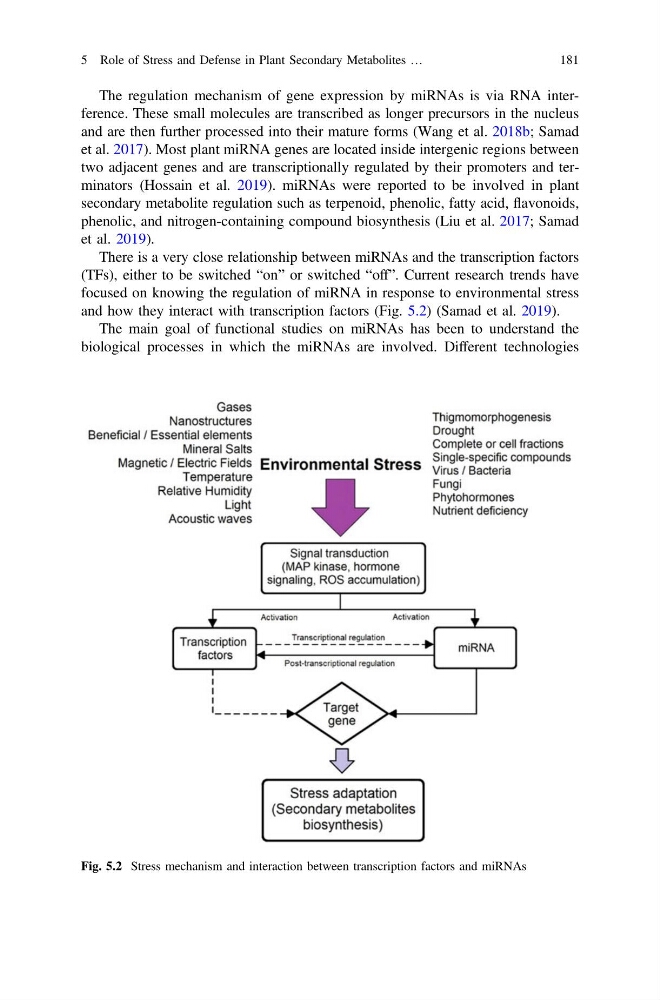
There is a very close relationship between miRNAs and the transcription factors
(TFs), either to be switched “on” or switched “off”. Current research trends have
focused on knowing the regulation of miRNA in response to environmental stress
and how they interact with transcription factors (Fig. 5.2) (Samad et al. 2019).
The main goal of functional studies on miRNAs has been to understand the
biological processes in which the miRNAs are involved. Different technologies
Fig. 5.2 Stress mechanism and interaction between transcription factors and miRNAs
5 Role of Stress and Defense in Plant Secondary Metabolites …
181
and are then further processed into their mature forms (Wang et al. 2018b; Samad
et al. 2017). Most plant miRNA genes are located inside intergenic regions between
two adjacent genes and are transcriptionally regulated by their promoters and terminators (Hossain et al. 2019). miRNAs were reported to be involved in plant
secondary metabolite regulation such as terpenoid, phenolic, fatty acid, flavonoids,
phenolic, and nitrogen-containing compound biosynthesis (Liu et al. 2017; Samad
et al. 2019).
There is a very close relationship between miRNAs and the transcription factors
(TFs), either to be switched “on” or switched “off”. Current research trends have
focused on knowing the regulation of miRNA in response to environmental stress
and how they interact with transcription factors (Fig. 5.2) (Samad et al. 2019).
The main goal of functional studies on miRNAs has been to understand the
biological processes in which the miRNAs are involved. Different technologies
Fig. 5.2 Stress mechanism and interaction between transcription factors and miRNAs
5 Role of Stress and Defense in Plant Secondary Metabolites …
181