

microbe-associated molecular patterns (MAMPs) that can be recognized by pattern
recognition receptors (PRRs). PGPFs can stimulate the defense system of plants
involving the modification of cell walls by the accumulation of lignin, callose,
phenols, etc., preventing the growth and proliferation of pathogens. In addition,
elicitors such as chitin, chitosan, and b-glucan that are part of the fungal cell wall
have been researched (Naziya et al. 2020; Fesel and Zuccaro 2016; Li et al. 2016).
Recent studies have been performed in different plants, e.g., fungal elicitation in
Leguminosae increased the accumulation of isoflavonoids and stilbenoids
(Araya-Cloutier et al. 2017). Moola and Diana (2019) used Aspergillus niger,
Penicillium notatum, and Rhizopus oligosporus as elicitors on hairy root culture of
Beta vulgaris to enhance betalain synthesis. Trichoderma spp. is one of the most
widely used microorganisms as a pathogen biocontrol agent and elicitor. In addition, this fungus has been shown to colonize roots and can also induce systemic
resistance (ISR), which favors plant growth, increases nutrient availability and
enhances disease resistance. The mechanisms employed by Trichoderma spp. are
the modulation of plant hormonal mechanisms and the production of secondary
metabolites (Nandini et al. 2020; Guzmán-Guzmán et al. 2019; Silva et al. 2019;
Martínez‐Medina et al. 2017). PGPFs can be used as bio-fertilizers, improving the
quality and quantity of products, and reducing the contamination of the agricultural
environment by lowering the use of chemical fertilizers (Pereira et al. 2019; Zhou
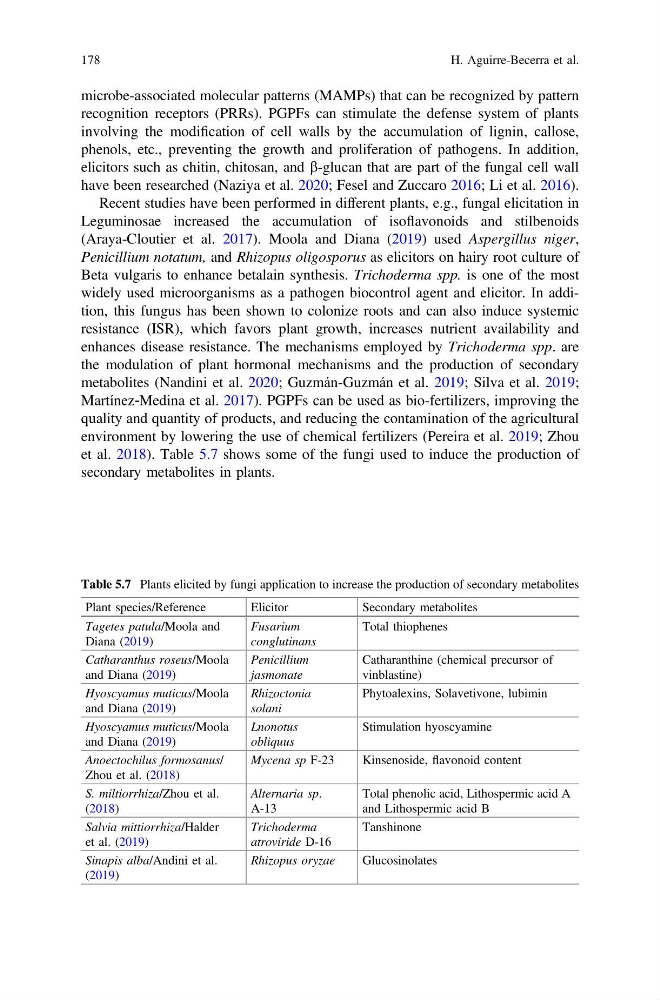
et al. 2018). Table 5.7 shows some of the fungi used to induce the production of
secondary metabolites in plants.
Table 5.7 Plants elicited by fungi application to increase the production of secondary metabolites
Plant species/Reference
Elicitor
Secondary metabolites
Tagetes patula/Moola and
Diana (2019)
Fusarium
conglutinans
Total thiophenes
Catharanthus roseus/Moola
and Diana (2019)
Penicillium
jasmonate
Catharanthine (chemical precursor of
vinblastine)
Hyoscyamus muticus/Moola
and Diana (2019)
Rhizoctonia
solani
Phytoalexins, Solavetivone, lubimin
Hyoscyamus muticus/Moola
and Diana (2019)
Lnonotus
obliquus
Stimulation hyoscyamine
Anoectochilus formosanus/
Zhou et al. (2018)
Mycena sp F-23
Kinsenoside, flavonoid content
S. miltiorrhiza/Zhou et al.
(2018)
Alternaria sp.
A-13
Total phenolic acid, Lithospermic acid A
and Lithospermic acid B
Salvia mittiorrhiza/Halder
et al. (2019)
Trichoderma
atroviride D-16
Tanshinone
Sinapis alba/Andini et al.
(2019)
Rhizopus oryzae
Glucosinolates
178
H. Aguirre-Becerra et al.
recognition receptors (PRRs). PGPFs can stimulate the defense system of plants
involving the modification of cell walls by the accumulation of lignin, callose,
phenols, etc., preventing the growth and proliferation of pathogens. In addition,
elicitors such as chitin, chitosan, and b-glucan that are part of the fungal cell wall
have been researched (Naziya et al. 2020; Fesel and Zuccaro 2016; Li et al. 2016).
Recent studies have been performed in different plants, e.g., fungal elicitation in
Leguminosae increased the accumulation of isoflavonoids and stilbenoids
(Araya-Cloutier et al. 2017). Moola and Diana (2019) used Aspergillus niger,
Penicillium notatum, and Rhizopus oligosporus as elicitors on hairy root culture of
Beta vulgaris to enhance betalain synthesis. Trichoderma spp. is one of the most
widely used microorganisms as a pathogen biocontrol agent and elicitor. In addition, this fungus has been shown to colonize roots and can also induce systemic
resistance (ISR), which favors plant growth, increases nutrient availability and
enhances disease resistance. The mechanisms employed by Trichoderma spp. are
the modulation of plant hormonal mechanisms and the production of secondary
metabolites (Nandini et al. 2020; Guzmán-Guzmán et al. 2019; Silva et al. 2019;
Martínez‐Medina et al. 2017). PGPFs can be used as bio-fertilizers, improving the
quality and quantity of products, and reducing the contamination of the agricultural
environment by lowering the use of chemical fertilizers (Pereira et al. 2019; Zhou
et al. 2018). Table 5.7 shows some of the fungi used to induce the production of
secondary metabolites in plants.
Table 5.7 Plants elicited by fungi application to increase the production of secondary metabolites
Plant species/Reference
Elicitor
Secondary metabolites
Tagetes patula/Moola and
Diana (2019)
Fusarium
conglutinans
Total thiophenes
Catharanthus roseus/Moola
and Diana (2019)
Penicillium
jasmonate
Catharanthine (chemical precursor of
vinblastine)
Hyoscyamus muticus/Moola
and Diana (2019)
Rhizoctonia
solani
Phytoalexins, Solavetivone, lubimin
Hyoscyamus muticus/Moola
and Diana (2019)
Lnonotus
obliquus
Stimulation hyoscyamine
Anoectochilus formosanus/
Zhou et al. (2018)
Mycena sp F-23
Kinsenoside, flavonoid content
S. miltiorrhiza/Zhou et al.
(2018)
Alternaria sp.
A-13
Total phenolic acid, Lithospermic acid A
and Lithospermic acid B
Salvia mittiorrhiza/Halder
et al. (2019)
Trichoderma
atroviride D-16
Tanshinone
Sinapis alba/Andini et al.
(2019)
Rhizopus oryzae
Glucosinolates
178
H. Aguirre-Becerra et al.